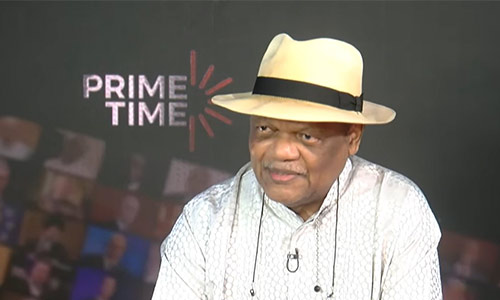
Atedo Peterside, President of the ANAP Foundation and founder of Stanbic IBTC Bank, has stated that he does not trust Nigeria’s judiciary, declared that the 2027 presidential election is a two-horse race between the APC and the ADC, warned that if the government and INEC prevent the ADC from running “we have a major crisis on our hands” and “all bets are off in terms of stability,” and called on those at the top to “lead by example and stop all this wastage” while 130 million Nigerians live in poverty.

Speaking in a wide-ranging television interview following the Supreme Court’s judgments on the ADC and PDP leadership crises, Peterside, whose ANAP Foundation backed polling that correctly predicted the three-horse race in the 2023 presidential election, offered assessments of the judiciary, the opposition landscape, the economy, and the government’s fiscal management that were characteristically blunt and unsparing.
Peterside opened with a declaration that challenged the celebratory mood surrounding the Supreme Court’s ADC ruling.
“I heard about the Supreme Court ruling, but with all due respects, I don’t trust our judiciary,” Peterside stated.
He explained that his distrust stems not from the specific ruling but from the systemic inequality in how the judiciary treats different categories of litigants.
“Only some Nigerians get prompt hearing from our judiciary. The rest of us, including you and I, if we brought a similar case as the fellow from ADC that came to court, you’d be lucky to get a hearing in even six months,” Peterside stated.
He drew on personal experience: “My father had a case in the judiciary. It took 23 years to be resolved from the High Court to the Supreme Court.”
“The only people that go around courts getting quick hearing, getting all kinds of attention, are people who are generally either gaming the system,” Peterside stated.
He cited former Supreme Court Justice Amina Augie’s public comments about how court registrars and other officials determine whose cases get heard expeditiously.
“An ordinary Nigerian cannot go to court and get a quick hearing on a matter like this. Only people who are highly privileged or sponsored by the powers that be get all this attention and quick response,” Peterside declared.
The observation, while not addressing the merits of the ADC ruling itself, raises a systemic question about equal access to justice in Nigeria. If political parties with powerful backers can obtain accelerated hearings, compressed filing timelines, and judgments within days, while ordinary citizens wait years or decades for their cases to be heard, the judiciary operates a two-tier system that undermines the principle of equality before the law.
Peterside offered a counterintuitive analysis of the ADC crisis, arguing that the government and INEC’s aggressive actions against the party had backfired by generating sympathy and attention.
“I think one thing that INEC has done for the ADC — Nigerians historically have a bit of a David and Goliath mentality. When they see an INEC or federal government agencies appearing to bully one of the opposition parties, it increases their sympathy for that opposition party,” Peterside stated.
“The worst thing that APC or INEC could have done to ADC was to ignore them. Then they would have been struggling to tell the nation that they are the most credible opposition party. But by going after them in this way, you make everybody believe that there’s something about the ADC that warrants all this attention,” he added.
He drew on an American public relations principle: “Americans often say any kind of PR is good PR. If every day the headline story is about ADC — ADC this, ADC that, ADC in court — it creates an impression that there’s something about ADC.”
“If they had ignored them, Nigerians would be debating which is the most credible opposition party. But by focusing so much on the ADC, they’re indirectly telling us that there’s something about the ADC that we need to watch out about,” Peterside observed.
He noted the substantive basis for the government’s apparent concern: “By coincidence, the last election, the candidates for the presidency that pulled second, third, and fourth are all in the ADC. So perhaps there’s something about the ADC that worries INEC or worries the federal government or worries the APC.”
“I don’t know, but they are the ones drawing attention to ADC every day, and I think it’s a mistake on their part,” Peterside concluded.
On the PDP, Peterside was equally direct, declaring the party effectively dead as a major opposition force regardless of the Supreme Court’s ruling.
“As soon as the major presidential candidates from the last election who are in opposition — Atiku, Peter Obi, Kwankwaso — all gathered and joined one party, that party became the major opposition party,” Peterside stated.
“PDP — forget about what any court says — PDP is no longer the PDP of the past. Whatever PDP had has probably transmutated into ADC. That’s my own ruling. That’s my own estimation,” Peterside declared.
The assessment reflects the political reality that the PDP’s value as an opposition vehicle was always derived from the calibre of politicians who used it as their platform. With Atiku, Obi, and other major figures now in the ADC, the PDP has lost the political capital that made it a credible alternative, regardless of which faction controls its organisational structures.
Asked who is genuinely competitive heading into 2027, Peterside was unequivocal.
“If I’m a betting man, I would say it’s a two-horse race between APC and ADC. That is if INEC and the courts will allow ADC to run,” Peterside stated.
“But even if they don’t allow them to run, then we have a major problem or a major crisis on our hands,” he warned.
“Everybody knows that the major opposition party is the ADC. And by the way, that’s partly why I left SDP. I was in SDP trying to make SDP a major political party. But as soon as negotiations fell apart and it became clear that SDP was not going to be the major opposition party, I had no business there any longer,” Peterside disclosed.
“ADC is the party that people who believe in opposition have decided to coalesce into,” he stated.
Peterside’s starkest warning concerned the consequences of eliminating credible opposition from the 2027 elections.
“If this government and INEC make the mistake of going into a general election with only one major party, I don’t want to predict what will happen to the nation. But all bets are off in terms of stability. That’s my assessment,” Peterside stated.
He invoked President John F. Kennedy’s political philosophy: “People keep on telling me why am I always quoting JFK? If you want stability in a political system, you have to give a semblance, make people believe that some change is possible, that you’re willing to allow some contest, meaningful contest.”
“Once you make it clear that for whatever reason or through whatever manipulation of the system, you won’t allow that, then all bets are off,” Peterside warned.
He drew a historical parallel: “We’ve seen it before. We saw when Abacha created an environment where he was heading to be the sole candidate. You know, those things can’t endure.”
The reference to the late military dictator Sani Abacha, who in 1998 engineered a process in which all five political parties he had created nominated him as their sole presidential candidate, is a pointed warning. Abacha’s one-candidate project ended with his sudden death in June 1998 and the collapse of the entire political arrangement he had built. Peterside’s invocation of that precedent suggests he believes a similar attempt to eliminate opposition in 2027 could produce equally destabilising consequences.
Peterside turned his attention to Nigeria’s economic situation, painting a picture of fiscal mismanagement, rising poverty, and a government that is spending money it does not have.
“The problem with the economy is that it’s a severe fiscal imbalance. We don’t have the revenues that we have been projecting, and that’s the reason why the capex for the budgets is seriously underfunded,” Peterside stated.
“In the meantime, we were racing ahead with massive projects like the Lagos-Calabar coastal road that was never properly debated or discussed by anybody. So there’s a revenue shortage, and if you insist on spending the way this federal government has been spending and you don’t have the revenue, there are only three things you can do,” Peterside explained.
“One, you either go and raise the revenue somehow, which they failed to do so far. Two, you borrow money. Or three, you print money. There’s no fourth way,” the economist stated.
He noted that the Central Bank under the current governor has avoided the money-printing approach that characterised the Buhari era: “After the experience of the last government when the CBN governor Emefiele under Buhari was printing naira like a drunken sailor, I think everybody decided that printing money is not something we want to do just yet.”
“So that puts the burden of the adjustment in two other areas. You have to raise the revenue from taxation or you borrow money,” Peterside stated.
He cited the health minister’s complaint of receiving only 36 million naira in 2025 capital expenditure as evidence of the severity of the revenue shortfall.
“If you’re not careful, this current year, barring a miracle, we may finish up with a 35 trillion naira deficit or something like that,” Peterside warned.
On the departure of Finance Minister Wale Edun, Peterside offered a pragmatic analysis.
“It was the same authorities that told us he was sacked that told us that he resigned. I think probably it’s a bit of both, because usually ministers don’t resign until the boss agrees to let them go,” Peterside stated.
He said the framing as a resignation was strategically necessary: “The coordinating minister of the economy is a very important position. You cannot in one breath say everything is going fine with the economy and then you’re sacking the coordinating minister. Then people start saying, but if everything is going fine, why are you sacking the coordinating minister?”
“So I think somewhere down the line somebody decided that let’s accept a resignation letter and let’s move on,” Peterside stated.
Peterside warned that the most devastating impact of the economic crisis is being felt unevenly across the country, with the worst suffering concentrated in states far from the corridors of power.
“The impact we see is the distorted income distribution. If you look at the breakdown across the states, you may understand why people who are based in Abuja and who only travel to the South-West may think that things are not so bad,” Peterside stated.
“The states that have poverty above 60 per cent — there’s no South-West state in there. You’ve got to go to those other parts of the country where poverty is ravaging millions of people to feel the pain,” he added.
“If you stay in Lagos or you stay in Abuja, you may get a false sense of ‘oh, things are not that bad.’ If you want poverty to hit you in the face, go and visit those states,” Peterside warned.
Peterside addressed the international dimension, noting that the tensions around the Strait of Hormuz and the conflict involving Iran have negative implications for Nigeria despite the country being an oil producer.
“In the very short term, I don’t see any benefits accruing to Nigeria from this war in Iran. If anything, it’s rising cost for various businesses on account of the war,” Peterside stated.
He noted that while higher oil prices might seem beneficial, the reality is more complex: “Petrol prices have gone up. So many companies are going to witness rising costs.”
Peterside concluded with a direct message to Nigeria’s political leadership.
“I would beg them and plead with them that let those at the top lead by example. Let them begin the belt-tightening right from Aso Rock, right from Abuja, right from the Villa,” Peterside stated.
“Let them show that they understand what 130 million Nigerians are going through. They should not exempt themselves from the pain. They should lead by example and stop all this wastage,” he added.
He pointed to visible symbols of government excess: “We see people going to the airport and 100 cars in a convoy or 50 and all that. Who’s paying for that fuel? Why are we sending those kinds of signals at a time when 130 million Nigerians are dead poor?”
“They should tighten their own belt and take it seriously and lead by example,” Peterside concluded.
Peterside’s assessments carry particular weight because of his unique position at the intersection of Nigerian finance, governance, and civil society.
As the founder of Stanbic IBTC Bank, one of Nigeria’s most respected financial institutions, he understands the economic realities facing the country at the most granular level. As president of the ANAP Foundation, whose polling correctly predicted the dynamics of the 2023 presidential race, his political assessments are grounded in data rather than partisan loyalty. And as a former SDP member who left that party when it became clear it would not serve as the main opposition vehicle, his declaration that the ADC is now the primary opposition platform reflects a considered judgment rather than partisan allegiance.
His warning that “all bets are off in terms of stability” if the government eliminates credible opposition from the 2027 elections is not the rhetoric of a politician seeking advantage but the assessment of a citizen whose business career depends on the stability he warns is at risk.
His distrust of the judiciary, his criticism of the government’s fiscal management, his warning about rising poverty, and his call for leadership by example are all consistent with a voice that has earned its credibility by being willing to say what many think but few in positions of influence are willing to articulate publicly.
As Peterside stated: “If you want stability in a political system, you have to make people believe that some change is possible.”
Whether Nigeria’s leaders are listening, and whether they have ears to hear, may determine whether the stability Peterside warns about survives to 2027 and beyond.
[A MUST HAVE] Evidence Act Demystified With Recent And Contemporary Cases And Materials

Available now for NGN 40,000 at ASC Publications, 10, Boyle Street, Onikan, Lagos. Beside High Court, TBS. Email publications@ayindesanni.com or WhatsApp +2347056667384. Purchase Link: https://paystack.com/buy/evidence-act-complete-annotation
______________________________________________________________________ “Enhance Legal Practice With Authoritative Reports” — Alexander Payne Offers Comprehensive Law Reports, Spanning Over A Century Of Nigerian Jurisprudence Interested buyers are encouraged to place their orders and enquiries via:
0704 444 4777, 0704 444 4999, 0818 199 9888
Website: www.alexandernigeria.com
Interested buyers are encouraged to place their orders and enquiries via:
0704 444 4777, 0704 444 4999, 0818 199 9888
Website: www.alexandernigeria.com