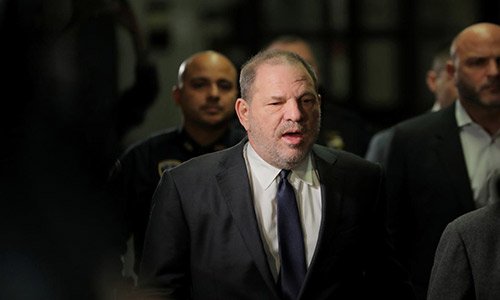
Former Hollywood producer Harvey Weinstein was convicted of sexual assault by a New York jury on Monday but acquitted on the most serious charges that could have sent him to prison for the rest of his life.

Once one of Hollywood’s most powerful producers, Weinstein, 67, was convicted of sexually assaulting former production assistant Mimi Haleyi in 2006 and raping another woman in 2013.
He faces up to 25 years in prison on the sexual assault conviction.
The jury acquitted Weinstein on two counts of predatory sexual assault, which carried a potential life sentence, and first degree rape.
The case was a milestone for the #MeToo movement that inspired women to go public with misconduct allegations against powerful men.
During his trial, Weinstein often appeared feeble, entering the courthouse using a walker. He sometimes leaned on his lead lawyer, Donna Rotunno, for support.
“He’s taken some good acting tips,” actress Rose McGowan said at the start of the trial on January 6 while staging a protest near the courthouse along with actress Rosanna Arquette and other Weinstein accusers.
More than 80 women, including famous actresses, had accused him of sexual misconduct stretching back decades. He had denied the allegations and said any sexual encounters were consensual.
Paul Callan, a former New York prosecutor who is not involved in the case, said Weinstein had strong grounds to argue the verdict should be overturned on appeal because of bias, noting that one of the jurors was the author of a forthcoming book on teenage girls and “predatory” older men.
During the trial, prosecutors portrayed Weinstein as a serial predator who had manipulated women with promises to open doors in Hollywood, coaxing them to hotel rooms or private apartments and then overpowering and violently attacking them.
“The man seated right there was not just a titan in Hollywood, he was a rapist,” Manhattan Assistant District Attorney Meghan Hast said during opening arguments.
Seated at the defence table, Weinstein often appeared impassive, though at times he looked intently at his lawyers when they cross-examined his accusers.
‘Jekyll and Hyde’
During the many weeks of trial, the prosecution methodically elicited graphic testimony from several accusers, including Haleyi, who said Weinstein invited her to his SoHo home after she had worked on one of his television productions.
After she arrived, Weinstein backed her into a bedroom, held her down on the bed and forced himself on her orally, yanking out her tampon, Haleyi told jurors.
The woman he raped in 2013 said that soon after meeting Weinstein she entered into an “extremely degrading” relationship with him that never included intercourse until, she alleged, he raped her.
She described Weinstein as a “Jekyll and Hyde” character: He was charming in public but often showed terrifying anger when they were alone, she said.
At one point, she started sobbing uncontrollably on the stand, prompting the judge to end testimony early for the day.
‘Prior bad acts’
Weinstein was charged with assaulting Haleyi and the other woman, but prosecutors bolstered their case by calling several other accusers as witnesses.
One of these women, “Sopranos” actress Annabella Sciorra, told jurors Weinstein came into her apartment one winter night in 1993 or 1994 and raped her.
Though the accusation was too old to be charged as a separate crime, prosecutors offered it to show Weinstein was a repeat sexual offender.
Three other women – costume designer Dawn Dunning, model Tarale Wulff and actress Lauren Young – testified that they were enticed into meeting Weinstein for professional reasons and then groped or raped.
Testimony of “prior bad acts” is generally not allowed in criminal trials, but an exception to the law allowed prosecutors to call these women to show Weinstein had a particular intention or a signature pattern of behaviour.
Legal experts said the women provided powerful evidence that was difficult for the defence to overcome.
Dunning testified that the producer groped her in 2004 and offered her movie roles in exchange for three-way sex with him and his assistant, which she refused.
Young, a model and actress, testified that the producer trapped her in a hotel bathroom in 2013, masturbated in front of her while groping her breasts, and told her: “This is what all the actresses do to make it.”
‘Last line of defence’
Throughout the case, the defence said regret drove the accusers to take consensual incidents and reframe them as crimes.
Weinstein’s lawyers zeroed in on friendly messages and ongoing contact between the women and Weinstein.
During cross-examination of Haleyi, for example, the defence showed her a message she sent Weinstein signed “lots of love” after her alleged attack.
Defence lawyers repeatedly suggested that the aspiring actress who accused him of raping her in 2013 willingly had sex with Weinstein to advance her career.
Weinstein never testified in his defence, although he told reporters he had wanted to. One of his lawyers said the case was too weak to warrant putting him on the stand.
Weinstein’s lawyer Rotunno told jurors during closing arguments that they were “the last line of defence” against an “overzealous” prosecution and that women were “responsible” for the “choices they make to further their own careers”.
Prosecutors pushed back against claims that his accusers were not credible and the notion that they were responsible for the alleged attacks.
Assistant District Attorney Joan Illuzzi said it was irrelevant whether they had ongoing contact with Weinstein after the alleged attacks.
Illuzzi rejected a defence claim that the aspiring actress had a loving relationship with Weinstein, but said it would not matter if she had been “head over heels in love with him”.
“He still wouldn’t be allowed to rape her on March 18 of 2013,” she said.
Weinstein still faces sexual assault charges in California, which were announced just hours after his New York rape trial began, and dozens of women have filed civil lawsuits against him.
SOURCE: REUTERS NEWS AGENCY
[A MUST HAVE] Evidence Act Demystified With Recent And Contemporary Cases And Materials

Available now for NGN 40,000 at ASC Publications, 10, Boyle Street, Onikan, Lagos. Beside High Court, TBS. Email publications@ayindesanni.com or WhatsApp +2347056667384. Purchase Link: https://paystack.com/buy/evidence-act-complete-annotation
______________________________________________________________________ “Enhance Legal Practice With Authoritative Reports” — Alexander Payne Offers Comprehensive Law Reports, Spanning Over A Century Of Nigerian Jurisprudence Interested buyers are encouraged to place their orders and enquiries via:
0704 444 4777, 0704 444 4999, 0818 199 9888
Website: www.alexandernigeria.com
Interested buyers are encouraged to place their orders and enquiries via:
0704 444 4777, 0704 444 4999, 0818 199 9888
Website: www.alexandernigeria.com