By Stanley Maduabuchi Ofoegbu Esq.

The fact that banks and their customers are usually in a fiduciary relationship cannot be denied. Banks are usually obligated to their customers in so many ways.
It is a trite law that customers monies in the hands of the banker are not in the custody or under the control of the customer and such monies remain the property in the custody and control of the banker and payable when a demand is made see GTB V DASHUWAR (2020) LPELR-52435 (CA), WEMA BANK PLC VOSILARU (2008)10NWLR (PT.1094)150;, JUKOK INT’LTD V DIAMOND BANK (2016)8 NWLR (PT.1507)55, 80 AT 111 PARAS A-B. It is also the law that the bank owe a duty of care to its customers and that when such duty is breached, the bank becomes liable in damages to its customer see KEYSTONE BANK LTD V MARKETING AND MEDIA LIMITED (2016)LPELR-41290(CA), ENTERPRISE BANK V DENWIGWE AND ORS (2018)LPELR-46261(CA) to mention but a few. In addition to the above, it is also the mandatory requirements of the law that while the banks exercise duties of care to their customers, such duties must be exercised within the bounds of law. In other words, the bank must take into cognizance certain provisions of the law especially, when they are expressly stated or spelt out in relevant laws of the land.
The said duties of care no doubt include the freezing of customer’s bank account with the aim of preserving the money in the face of fraud or other criminalities that may affect the account. This is because, all monies kept at the bank are totally under the custody and control of the bank and the bank is bound to account for every kobo that go missing from a customer’s account and hence, the need to freeze same becomes necessary.
QUESTION
Since freezing of customers account is one way of preserving customer’s money which automatically passes out as a cardinal duty of care owed to the customer, at what point can the bank unilaterally freeze or cause a caution to be placed on customers bank account?
What about directives from the Economic and financial crime commission requesting for the freezing of a customer’s account following the suspicion and allegation of fraud or the filing of criminal financial related charges at the court? Will such directive on the face of it be valid without more?
Are there liabilities that may flow from the unilateral freezing of customers account by the bank?
What remedy or remedies are available to a customer whose account is frozen by the bank?
The law is that a bank has no right or power by itself to freeze the account of a customer, be it its staff or otherwise, and or to prevent such a customer with money standing to his credit in his account from accessing the money. See DIAMOND BANK V UNAKA &ORS (2019) LPELR-50350(CA). The only exception is where the bank receives notice of death of a customer, it is under a duty in such a circumstance to stop withdrawals from the account, and only legal representatives of the customer duly appointed by law can access the said account thereafter. Where a bank takes it upon itself to freeze the account of a customer or restrain the customer from accessing the said account when he or she has credit therein simply because of an allegation of fraud made against such a customer, it will amount to self-help which is illegal and wrongful see DIAMOND BANK V UNAKA supra, FIDELITY BANK PLC V BAYUJA VENTURES LTD (2010) LPELR 8873(CA)
Similarly, it is the law that for a bank to freeze, place a caution or any form of restrain on a customer’s account, it has to be satisfied that there is a court order to that effect otherwise, it will be liable for a breach of contract unless there is a statute that gives it such mandate. See G.T.B PLC V ADEDAMOLA (2019)5 NWLR (PT.1664)30 AT 43, UBA V MARCUS (2015)LPELR-40397 (CA), OLALEKAN OYERINDE V ACCESS BANK PLC (2014) LPELR 23461(CA) to mention but a few.
From the above, it is obvious that a bank cannot unilaterally freeze a customer’s account without the consent of the said customer and without an order from the court to that effect. The mere fact that there is an allegation of fraud or that fraudulent activity is associated with the customer’s account will not justify the bank to unilaterally freeze the customer’s account. It is also immaterial that the need for freezing same was or appeared urgent, compelling and was done for the overall interest of the customer. It is also of no moment that the conduct of the bank was morally justified and gracious for the benefits of the customer. Once it is established that the said freezing was carried out in the absence of a valid court order, the said act no matter how morally good becomes wrongful and illegal unless it was carried out with the permission of the customer. In UNITY BANK PLC V OLATUNJI (2O15) 5 NWLR (PT.1452) 203, AROGUNDADE V SKYE BANK(2020) LPELR-52304 (CA) The courts while condemning the unilateral freezing of customers account held inter alia (among others) that though the said act of the bank may be morally good, a moral action may not necessarily be a legal action. The action of the bank may receive a moral approval but not a legal approval. An action receives a legal approval because there is a Law that backs up such action. When morally an action is fine but there is no law backing such action, the action will be illegal because morality and law are not synonymous.
It is not in doubt that the current administration claim to be fighting corruption. Whether the fight against corruption is indeed yielding any positive results and whether the fight is general or selective is not the issue here. However, the facts remain that findings reveal that the economic and financial crime commission the body saddled with the responsibility of fighting financial crime has formed a habit of writing and directing banks to get the account of suspects frozen for alleged financial fraud. Further findings also show that most banks honour such unscrupulous and shameful directives without asking relevant questions. As a result of these, it becomes necessary to examine the legality or otherwise of such orders.
Section 34 of the EFCC Act 2004 empowers the commission to apply to the court via exparte application to obtain an order before proceeding to freeze an account belonging to a customer of a bank. In otherworld’s, the commission cannot unilaterally write to any bank requesting the said bank to place a caution or freeze an account belonging to a customer simply because the customer is or may be prosecuted for fraudulent financial crimes without a valid order of the court first sought and obtained. In not one or two or even three cases, the court has severally deprecated and condemned such demonic and illegal acts of the commission in consonance with various banks. See AROGUNDADE V SKYE BAMK supra, GTB V JOSHUA (2021) LPELR- 53173 (CA) GTB V ADEDAMOLA supra to mention but a few. Accordingly, the commission cannot on its own write to the manager of any bank requesting for the freezing of any account simply because there is an evidence of fraud connected with such account. Where it does, the bank is required by law to pay deaf ears to such orders in the absence of any valid court order attached to the said application or request. Also, the mere fact that a request is accompanied with a supposed valid order of a high court or that of a federal high court may not totally exonerate a bank from liabilities from unlawful freezing of bank account. This is because, the bank being the custodian of customers account owe the said customer a duty to investigate if the said order of the court attached to the application for freezing is indeed genuine if not for anything, for the fact that things have fallen apart and the center is on the run.
Liabilities for wrongful freezing
Where a bank unilaterally freezes or restrains a customer from accessing his account without a valid court order, such a bank becomes liable for the tort of negligence among others. The customer is entitled to an award of damages as a form of compensation. The court may also demand that a written apology be addressed to the customer if the customer prays for same. Where a third party is instrumental to the freezing, the customer can elect to sue both the bank and the third party, claiming damages jointly and or severally in a single suit. The above cited cases are instructive in this point.
Way forward
- Where a bank freezes the account of a customer, the customer should approach the bank for a possible explanation.
- Where there is no court order directing same, the customer should demand for immediate release of the account from all form of restraint.
- Where oral application fails, the customer should urgently brief a legal practitioner who will cause a demand notice to be served on the bank having specific time frame. The said notice will be a concrete evidence against the bank in addition to oral evidence should the matter proceed to court.
- The legal practitioner should filed processes against the bank and any other person who is instrumental to such illegal act claiming general, special and punitive or exemplary damages.
In conclusion, the law is trite that where the law provides for the method of doing an act, failure to abide by such law renders the decision a nullity which can ground an action in damages. See UNTH MGT.BOARD & ANOR V HOPE CHINYELU NNOLI (1994)8 NWLR (PT.363) 376. Accordingly, it is expected that banks and other financial institution should buckle up.
Written By Stanley Maduabuchi Ofoegbu Esq.
WhatsApp 08068515340 email; ofoegbustanley72@gmail.com, Abuja.
[A MUST HAVE] Evidence Act Demystified With Recent And Contemporary Cases And Materials

Available now for NGN 40,000 at ASC Publications, 10, Boyle Street, Onikan, Lagos. Beside High Court, TBS. Email publications@ayindesanni.com or WhatsApp +2347056667384. Purchase Link: https://paystack.com/buy/evidence-act-complete-annotation
______________________________________________________________________ “Enhance Legal Practice With Authoritative Reports” — Alexander Payne Offers Comprehensive Law Reports, Spanning Over A Century Of Nigerian Jurisprudence Interested buyers are encouraged to place their orders and enquiries via:
0704 444 4777, 0704 444 4999, 0818 199 9888
Website: www.alexandernigeria.com
Interested buyers are encouraged to place their orders and enquiries via:
0704 444 4777, 0704 444 4999, 0818 199 9888
Website: www.alexandernigeria.com
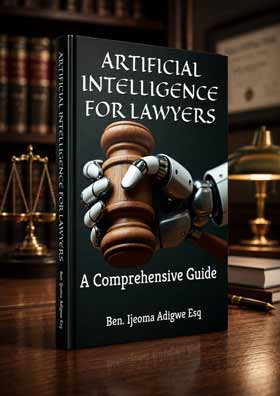 The book also examines Nigeria's legal ecosystem, focusing on the LPELR and NBA AI Guidelines. As a bonus, every purchase comes with a FREE eBook titled: How to Use the AI Features in LegalPedia and LawPavilion.
Ohio Books Ltd praises the publication, stating:
"....this is the only Nigerian book I know of on the topic."
How to Order:
📞 Call, Text, or WhatsApp: 08034917063 | 07055285878
📧 Email: benadigwe1@gmail.com
🌎 Website: www.benadigwe.com
Ebook Version: Access it directly online at https://selar.com/prv626
Authored by Ben Ijeoma Adigwe Esq., ACIarb (UK), LL.M, Dip. in Artificial Intelligence, Director at the Delta State Ministry of Justice, Asaba, Nigeria.
______________________________________________________________________
The book also examines Nigeria's legal ecosystem, focusing on the LPELR and NBA AI Guidelines. As a bonus, every purchase comes with a FREE eBook titled: How to Use the AI Features in LegalPedia and LawPavilion.
Ohio Books Ltd praises the publication, stating:
"....this is the only Nigerian book I know of on the topic."
How to Order:
📞 Call, Text, or WhatsApp: 08034917063 | 07055285878
📧 Email: benadigwe1@gmail.com
🌎 Website: www.benadigwe.com
Ebook Version: Access it directly online at https://selar.com/prv626
Authored by Ben Ijeoma Adigwe Esq., ACIarb (UK), LL.M, Dip. in Artificial Intelligence, Director at the Delta State Ministry of Justice, Asaba, Nigeria.
______________________________________________________________________