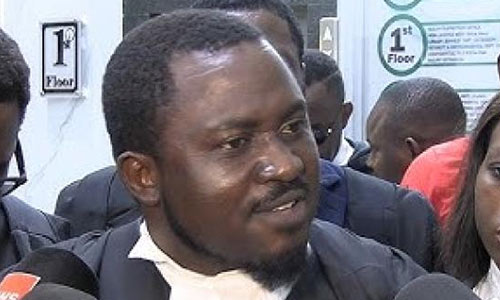
Nigerian lawyers have called for the Legal Practitioners Disciplinary Committee (LPDC) to sanction Barrister Marshall Abubakar over his decision to withdraw the bail application he had filed on behalf of detained activist Chidiebere Justice Mark, popularly known as Justice Crack, at the Federal High Court in Abuja on Thursday, describing his conduct as unethical, contrary to the Rules of Professional Conduct for Legal Practitioners 2007, and in violation of the constitutional right of an accused person to counsel of his choice.

The calls come in the wake of dramatic scenes at the court presided over by Justice Joyce Abdulmalik, where Abubakar’s withdrawal of the bail application over a dispute about who should lead the defence team left the activist in continued detention, reduced his wife to tears in open court, and triggered chaos outside the courtroom as members of the public attempted to confront the lawyer.
Legal practitioners who have weighed in on the controversy have identified specific provisions of the Rules of Professional Conduct (RPC) 2007 and the 1999 Constitution which they say Abubakar breached by his conduct.
The strongest authorities cited are as follows:
First, Rule 21(1) of the Rules of Professional Conduct for Legal Practitioners 2007 provides that a lawyer shall not abandon or withdraw from an employment once assumed, except for good cause. Lawyers argue that being denied the right to lead proceedings particularly where the client has expressed a preference for another counsel does not constitute “good cause” within the meaning of the rule, and that Abubakar’s withdrawal amounted to an abandonment of a vulnerable client in a criminal matter.
Second, Rule 14(4) of the RPC 2007 requires a lawyer, in a court case, to be personally present or properly represented throughout the proceeding. The provision imposes a duty not to abandon a client in court, and lawyers contend that Abubakar’s decision to withdraw his appearance and, as a consequence, cause the striking out of a pending bail application in a criminal matter, constitutes a direct violation of this obligation.
Third, Rule 29(3)(a)–(b) of the RPC 2007 addresses situations where a client changes counsel. The rule requires the former lawyer to hand over certain client papers and documents, which is the closest provision supporting the principle that the case file belongs to the client in substance, not to the counsel regardless of whether the matter is being handled on a pro bono basis or otherwise. Lawyers argue that this principle means that processes filed during the subsistence of a retainer belong to the client, not to the withdrawing counsel, and cannot simply be taken away as a consequence of a withdrawal of appearance.
Fourth, and most critically, Section 36(6)(c) of the 1999 Constitution of the Federal Republic of Nigeria guarantees every person charged with a criminal offence the right to defend himself in person or through legal practitioners of his own choice. Lawyers point out that Justice Crack’s case is a criminal matter, and the choice of who leads the defence belongs exclusively to the accused person — not to any individual lawyer on the team.
At the core of the legal criticism is the distinction between withdrawal of appearance and withdrawal of processes filed in a suit. Lawyers have argued that these are two entirely different things, and that Abubakar conflated them to the detriment of his client.
The position taken by legal commentators is that withdrawal of appearance merely means a lawyer is ceasing to represent the client going forward. It does not and should not entitle the withdrawing lawyer to take the processes filed during his active period of representation with him. The processes, including the bail application, were filed on behalf of the client, not on behalf of the lawyer. Once filed, they become part of the court’s record and the client’s case.
As one legal practitioner put it: “Withdrawal of appearance has nothing to do with all the processes filed during the active period of the court proceedings. In fact, the client owns the case file, not the counsel, irrespective of whether the matter is being handled on a pro bono basis or otherwise.”
The proper procedure, according to lawyers, would have been for the court to allow Abubakar to withdraw his appearance while permitting the new lead defence counsel Femi Balogun, who was senior at the Bar and had been directed by the family to lead — to proceed with the bail application or any other proceedings scheduled for the day. The bail application, having been validly filed and already before the court, should not have been struck out merely because the lawyer who filed it withdrew his appearance.
Some legal commentators have also raised questions about the court’s handling of the situation, suggesting that Justice Joyce Abdulmalik should not have allowed Abubakar to announce his appearance after the accused person had already informed the court of the lawyer of his choice.
The argument is that once the client in a criminal matter has indicated to the court which counsel he wishes to lead his defence, the court should have treated that as determinative under Section 36(6)(c) of the Constitution. Allowing Abubakar to subsequently announce his appearance and then withdraw it, along with all the processes he had filed, arguably enabled the very harm the constitutional provision was designed to prevent: the deprivation of a defendant’s right to pursue his liberty through counsel of his choice.
Furthermore, the principle of seniority at the Bar is well established in Nigerian legal practice. A junior counsel cannot ordinarily lead a senior without the senior’s consent, as this is a matter of professional courtesy and internal brief management. Balogun, being senior to Abubakar at the Bar and having been directed by the family to lead, had the stronger claim to lead proceedings under established legal etiquette.
The legal arguments are not merely academic. The practical consequence of the dispute was that Justice Crack an activist detained over allegations of criticising the Nigerian Army’s feeding arrangements remained in prison custody, his bail hearing collapsed, and his wife broke down in tears in open court.
The wife of the detained activist had been the one who originally reached out to Abubakar to represent her husband, and Abubakar himself acknowledged that he took up the matter pro bono at her request. The sight of the same woman weeping in court after the lawyer she had engaged withdrew the very application meant to secure her husband’s freedom has become one of the most talked-about images of the case.
Chaos erupted outside the Federal High Court as some members of the public reportedly tried to confront Abubakar after the proceedings, reflecting the depth of public anger over the incident.
In his post-court address to the media, Abubakar denied any personal grievance against the activist and insisted his decision was taken to avoid worsening tensions within the defence team. He maintained that he had led the defence from the onset, had written to the Attorney-General of the Federation seeking discontinuance of the case, and had met with activist Omoyele Sowore, the Minister of Justice, the DPPF, and the Permanent Secretary of the Ministry of Justice to secure Justice Crack’s release. He disclosed that he cut short a trip to New York City to attend to the case.
“You do not fight with your friends in the presence of your enemies and destroy your ammunition,” Abubakar said, adding that he bore no grudges and still desired justice for the activist.
He argued that proper procedure required Balogun to approach him privately before announcing his appearance in court, rather than springing the announcement without prior notice.
However, Balogun countered that Abubakar’s response was vindictive, stating: “Ordinarily, if he’s doing this for justice, for the interest of justice, I don’t see a reason, even if you are not the counsel leading, why you should withdraw the bail application you have filed for the person to enjoy his liberty.”
The LPDC, established under the Legal Practitioners Act, is the body empowered to hear and determine complaints of professional misconduct against legal practitioners in Nigeria. Conduct amounting to abandonment of a client, improper withdrawal from a matter, or actions that prejudice a client’s interest can ground disciplinary proceedings before the Committee.
If a formal complaint is lodged, Abubakar could face sanctions ranging from an admonition to suspension from legal practice, depending on the Committee’s findings. The key question for the LPDC would be whether the withdrawal constituted “good cause” within the meaning of Rule 21(1), and whether the consequential striking out of the bail application amounted to a prejudicial abandonment of a client in a criminal matter.
The incident has continued to generate fierce reactions on social media. A user identified as Kingkosec wrote: “If you aren’t an opportunist, why will it matter? The end of it, is it not for Justice Crack to be released? Why forcing yourself to be the lead lawyer? Are you interested in freeing him or growing your firm?”
Marcel wrote: “Barrister Marshal withdrew the bail which is now a personal interest, not to free Justice. He only wants to get the praises that he’s the one that freed him.”
Voice of the People commented: “May we never be in a situation that will make activist/charge-and-bail lawyers use to take glory.”
Others described Abubakar variously as “a self-serving lawyer,” “a greedy lawyer,” and accused him of allowing ego to override the interest of a detained citizen.
A more measured voice, Mazi Okwuoma, wrote: “Public transparency from defence counsel is crucial when handling cases of this magnitude. Hearing the legal rationale behind the abrupt withdrawal helps neutralize speculation.”
The Director of Public Prosecutions of the Federation, Rotimi Oyedepo, SAN, has taken over the prosecution of the case from the Department of State Services. The matter has been adjourned to Monday, May 18, 2026, for the hearing of a fresh bail application.
Justice Crack was arraigned and remanded in custody over a viral video allegedly criticising the Nigerian Army’s feeding arrangements, and was charged under Section 24(1)(b) of the Cybercrimes (Prohibition, Prevention, etc.) Act, 2015, as amended. The bail application came amid mounting public outrage over allegations that the activist was tortured in military custody before being transferred to the DSS.
The activist remains in prison custody.
[A MUST HAVE] Evidence Act Demystified With Recent And Contemporary Cases And Materials

Available now for NGN 40,000 at ASC Publications, 10, Boyle Street, Onikan, Lagos. Beside High Court, TBS. Email publications@ayindesanni.com or WhatsApp +2347056667384. Purchase Link: https://paystack.com/buy/evidence-act-complete-annotation
______________________________________________________________________ “Enhance Legal Practice With Authoritative Reports” — Alexander Payne Offers Comprehensive Law Reports, Spanning Over A Century Of Nigerian Jurisprudence Interested buyers are encouraged to place their orders and enquiries via:
0704 444 4777, 0704 444 4999, 0818 199 9888
Website: www.alexandernigeria.com
Interested buyers are encouraged to place their orders and enquiries via:
0704 444 4777, 0704 444 4999, 0818 199 9888
Website: www.alexandernigeria.com