FOLUSO OGUNMODEDE writes that as Nigeria clocked 57 yesterday, it was time for lawyers, including Senior Advocates of Nigeria and Doctors of Law to appraise the judiciary and its role in nation building Even though it struggles to extricate itself from allegations of corruption dogging it over the years, lawyers at the weekend were unanimous that but for the judiciary, the nation called Nigeria would have disintegrated and became history as some of those issues which otherwise would have consumed the country were doused by the judiciary. “The judiciary has played significant roles in unifying and stabilizing this troubled nation and if not for the judiciary, of course, the nation would have been in flames,” one said. “The judiciary regarded as the last hope especially in a situation where many things have not been as well as they should, here and there, has done substantially okay,” another said. Yet another said, “I don’t think we should give an open cheque to the courts, it is just that on the balance, they have lived up to their billings. Like we always say the last hope of the common man as the final sentinel of democracy, they are the last bus stop because if gold rust what will iron do?” The lawyers, Emeka Ngige, Yusuf Ali, Wale Adesokan, Mike Ozekhome, all Senior Advocates of Nigeria and Drs Robert Agbange, Oluwole Adeleke, Welfare Officer of the Nigerian Bar Association (NBA), Mr. Adesina Adegbite and Adetokunbo Mumuni, although differed in their appraisal, they said judiciary had remained the bedrock of Nigeria’s democracy. Ngige In the past 57 years of the judiciary, by a way of percentage, it has scored just 45% and the 45% was scored during the time of Justices Oputa, Kayode Esho, Nnaemeka Agu. These were the golden periods of the Nigerian judiciary, particularly the Supreme Court. But regarding this present age, a lot needs to be done because the common man has zero faith in the judiciary. Even the 45% score is not even a pass mark to begin with. The judiciary still has a long way to go.People resort to other alternative means of resolving their differences- like the police, army or native doctors. So, the judiciary needs to do more to inspire confidence especially in the issue of delays in justice system. The issue of delays is one of the factors that discourage a lot of people from approaching the judiciary. When most people realise that an issue that requires an urgent resolution would be treated for more than five to eight years, they would surely seek other means aside the judiciary. Ali The judiciary, basically, is a Nigerian institution which has also passed through so many travails. It has also had its apogee and at least, accrued certain height of achievements. On an average of a hundred per cent, the judiciary would still score higher than the other two arms of government in the past 57 years. I would still rate the judiciary, despite the challenges it has faced, at a minimum of 70% compared to the other arms of government. I believe that the judiciary is not yet at its El Dorado. Judiciary as a Nigerian institution has stood the test of time; it has seen Nigeria through times of glory and despair; progress and retardation. It ushered in the Nigerian independence and from 1960 to1966, it played a vital role as the 3rd arm of government in a democratic setting. From 1966 to 1975, it operated under the dark rules of the military regime and however proved itself as an enduring institution state. Hence, between 1979 and 1983, it also played a major role when another epoch of democratic governance emerged. However, May 1999 was one of the years the judiciary performed its best in stabilising the country even in the face of malicious military rule and brutal military dictatorship,And since 1999, the judiciary has served as a strong strategic factor in our democracy.” Examples of these abound everywhere. It is very clear that the judiciary is the only arm of government that was able to sanction its members through its strong and credible internal cleansing mechanism. The Nigeria judiciary has helped the nation’s polity to stabilise at every point in time. It has contributed in no mean measure to our national development and stability. It has stood its ground in the face of military tyranny and oppression. It has demonstrated its courage in the face of the civilian’s rascality. It has shown that Nigerians judges from all indices can rub shoulders with any other members in any part of the world. Nigeria judiciary is so strong that we have been exporting our Judges, where necessary and needed. It was from the same Nigerian judiciary that we produced Judges, who served in different part of the Africa sub-region. It was the same Nigerian Judiciary that produced the likes of Justice Teslim Elias, Prince Bola Ajibola of this world, who became a Judge in Hague, one of the strongest arms of the United Nations. The story of the Nigerian judiciary is from glory to glory. When we were under the military in 1970-71, it was the same judiciary that called the military government to order in the case of Lakanmi vs the AGF. In 1979, it was the judgment of the court that sent the military junta away. Also, when the Ibrahim Babangida regime embarked on its contraption, it was the judiciary that saved the situation and resolved knotty issues.Though, eventually, the government came back to the Abacha junta, even at that, the court did not keep silent in the face of Abacha’s tyranny. When the civilians came into power again, it was the court that checkmated the excesses of the political office holders. This was seen in Ladoja’s case, where the court reversed the illegality carried out by the legislative arms of government in Oyo State. Giving all these and comparing the judiciary with the other two arms of governments, one would not but hail the nation’s judiciary for its courage and steadfastness. Even, in the fight against corruption in Nigeria, the judiciary has performed its best in the fight against corrupt practices and reduced the scourge of corruption. So, to every rightful thinking person, Nigerian judiciary, no doubt has done well. Ozekhome Ozekhome noted that there is no doubt the Nigerian Judiciary has had to contend with powerful variegated forces since 1960, forces that were at once centripetal as they were centrifugal. He said: “It has been buffeted from all sides; assailed by inglorious politicians who lost their electoral legal battles in court; bled internally by some irredeemably corrupt judicial elements; mocked by a non-cooperating executive that denies it of much needed funds, and ridiculed by a legislature that makes laws for everything, except for the peace, order and good government of Nigeria. “Alexander Halmiton was right when he theorised that the judiciary is the weakest arm of government as it has neither pursed nor armed to effect its decisions. “In spite of these mountainous challenges, the Nigerian judiciary can unarguably be said to have fared better than the other two arms of government – the legislature and the executive. It has held its head high above murky waters, refusing to be cowed or vanquished by the two other more powerful sister arms of government. It has continued to serve as the bulwark against tyranny of the vociferous minority and oppression by the all-conquering majority. “Even under autocratic military dictatorships, the judiciary refused to blow muted trumpets, in spite of the ubiquitous blaring sirens of power and sheer repressive jack-bootism. “The Nigerian Judiciary sided with the common man and woman, delivering scathing and at times decisive judgments against repressive Heads of state and self-styled Military Presidents. In Ojukwu vs Governor of Lagos State (1986) 1 NWLR (part 18), for example, both the Court of Appeal and the Supreme Court described the action of the Lagos State Government in forcibly ejecting Ojukwu from his residence in Ikoyi, Lagos whilst his suit against the state government was still pending, live and extant, as amounting to “executive lawlessness. “In Nasiru Bello vs. Attorney-General of Oyo State (1986) 2 NSCC 1257, the apex court condemned the Oyo State Government for executing a convicted armed robber whose appeal was still pending before the Court. The revered late Justice Aniagolu bemoaned this dastardly act, thus: “This is the first case in this country, of which I am aware, in which a legitimate government of this country – past or present, colonial, or indigenous – hastily and illegally snuffed off the life of an appellant whose appeal had vested and was in being, with no order of court upon the appeal, and with a reckless disregard for the life and liberty of the subject and the principles of the rule of law. The brutal incident has bespattered the face of the Oyo State Government with the paint brush of shame. “In Nemi vs. A-G, Lagos State (1996) 6 NWLR, 42, at 55, the Court of Appeal innovatively held that notwithstanding that a convict was on death row, he was still entitled to challenge his torture, inhuman or degrading treatment, arising from the prolonged delay in executing him. “Thus, the Nigerian Judiciary affirmed the fundamental rights of even a convict not to be subjected to inhuman and degrading treatment, because every minute of being left on the death row means installment torture and indescribable psychological trauma. “It is true that there have been isolated cases of bad eggs within the Judiciary, in terms of corruption, bribe taking, compromise of cases, et al. yes, just like in every 12, there must be a Judas Iscariot. Such isolated cases have not only been promptly dealt with by the National Judicial Council (NJC); they have also not diminished or dimmed the good work of a vast majority of hardworking Judges who have shown exceptional courage, daring bravado, and activist orientation in handing down judgements that have deepened democracy, promoted good governance, protected Civil Rights and liberties, shielded the rule of law from assault and fought corruption in governance. “The lofty and far reaching recommendations of my Committee on Law, Judiciary, Human Rights and Legal Reforms at the last National Conference, if adopted , and enshrined in a brand new constitution to be approved and adopted by the Nigerian people in a popular referendum or plebiscite, will go a long way in empowering the Judiciary and bestowing on it, the much needed independence and autonomy.” Adesokan The Nigerian judiciary has come of age, evolved, grown and developed . It has risen to the challenges of modern Nigeria. It has stabilized the polity. The judiciary represents the anchor of hope in a ‘fantastically’ corrupt nation. Happily, the judiciary is reinventing, repositioning itself and also purging itself of its few bad eggs. Kudos to the Nigerian judiciary as Nigeria clocks 57. Adegbite Nigeria Judiciary is indeed one of the strongest you can think of across the continent of Africa. Our judiciary is no doubt the busiest on the continent and among the busiest across the world. With this background, one can safely salute the Nigerian Judiciary for withstanding the myriad of hurdles which had militated against it’s effectiveness over the years. In other words, despite the heavy workloads and the harsh working environment the Nigerian judiciary had over the years given good account of itself. We must however not fail to state that the golden era of the Nigerian judiciary is long gone. Nigerian Judiciary in the days of Kayode Eso JSC, Chukwudifu Oputa JSC, Irikefe JSC, all of blessed memories rated among the best in the world. Despite serving under military dictatorship, they were courageous and extremely competent. They never spared the military and they dared the demagogues through their several commendable in depth judgements. To me that courage seems to be lacking these days in the Judiciary. I think our judiciary needs to be more courageous and resist any manner of intimidation or enticement from the government. Above all, our judiciary has grown and developed tremendously in our 57 years of existence as an independent nation. We, however, need to go beyond the analog and move into the digital world. We need to deploy technology seriously in the judiciary to take it to the next level. There must be an end to cases being adjourned by courts without prior notice to lawyers and vice versa. There is room for a lot of improvement in our Judiciary. I must however commend the vision of the Chief Justice of Nigeria to revolutionise the digital system in the Supreme Court and which we hope will spread to the lower courts. Mumuni If we are talking about Nigeria’s judiciary since independence, I will want us to situate it in the eras of the first, second, third and the fourth republics. Shortly before the first republic, Nigeria judiciary has a reputation for hard work, integrity and all that is good about the administration of justice. I really appreciate the era of the judiciary in those periods. Even, in the second republic, it was still okay but in contemporary Nigeria, there are problems. This is because life has gotten so complicated and Nigerians are now wiser and faster in the way they conduct things and sadly, the judiciary as we see it is not moving along with the tide. That may be the problem. Justice Kayode Eso, when he was alive, said in their own time, there was no talk about millionaire judges. But we are now talking about millionaire judges even when there was no salary of a judge that is more than one million naira. You see, the thing is that when you collect salary, you spend from it to maintain yourself. How then can you be a millionaire judge? A judge should take the job the way God will do it Himself. I would not tag all judges as being corrupt because we still have sincere and God fearing judges around. There are still judges who do their work with integrity but there has to be a systematic way of getting rid of bad eggs from the Bench. We must look at the way we recruit people into the Bench. This is because how the Bench will look will be determined by the occupants. For this reason, I want to recommend that the process of appointing judges to the Bench should be stricter. Account checks in terms of character must be carried out on all aspiring judges. Specifically, I want to suggest that the Nigerian Bar Association (NBA) should be involved in the appointment of judges in practical terms, so that we can have the best in the interest of justice administration. Agbange The judiciary as one of the three arms of government has not done badly in Nigeria. Although as a nation, there have been challenges faced by the judiciary, like other arms of government, it must, however, be on record that out of the three arms of government, the Nigerian judiciary has been up and doing, for the roles it had played and still playing in our modern society. However, like what is happening to other arms of government and other facets of the Nigeria society, the judiciary in some years back had some grey areas requiring improvements. To me, however, if you examine the judiciary in whole, it has not done badly, but if you take the Court of Appeal in isolation, they are not performing very well, in view of cases before the courts, where the same court of concurrent jurisdiction gave different judgments almost on same issues at different divisions of the court. The decisions of the courts, especially at the Supreme Court and sometimes at the trial courts have not been too bad. Unfortunately, the tempo is coming down. Indeed, the Nigeria Judiciary had encountered numerous challenges, which in some areas make them strong, while in some areas, they need an improvement. Speaking on the political development and law process, for any nation in the world, to develop it must have a very strong legal system. So, this means that any nation that has no very strong legal system, that could guarantee due process and the rule of law, can never be developed. So, Nigeria is so lucky that what we inherited from the British colonial masters has helped us a lot. Based on this, Nigeria is able to have a very long and strong legal and court system, which has helped a lot in the socio-political development of the country. So, in the area of legal practice, we are not doing badly. However, we need to buckle up to meet the contemporary issues and ensure that the nation live up to expectation. You cannot assess the judiciary without the lawyers, who are the ministers in the temple of justice. Lawyers in the country have been doing their best in the development of the nation and its court system. However, there is skepticism that lawyers are aiding the politicians in creating clog in the wheel of court system, vis-a-vis the political development of the nation. Part of the arguments was that lawyers use the court to support some politicians in filing frivolous cases before the court. You find a governor sometimes, who used dubious method to win election, he must have spent all his money to win by all means, he would want to recoup what he spent from public cover. He would get money to pay lawyers who would ensure that cases are not determined timely. Adeleke But a critical look at how she had fared in the past 57 years would show that it has been 57 years of tortuous existence. No doubt, she got her parenthood from the Great Britain and her Common Law. The Nigerian Judiciary has served her “slave master” known as the Validity Act of 1865, who freed her in 1960 after a turbulent slavery that lasted 95 years. In 1958, she was asked to prepare herself for “independence” and in 1960, she was freed. Nigeria, her mother, also began her journey to free herself in 1957. Unfortunately, Nigerian Judiciary had to be brutally colonized and suppressed again by the military totalitarianism, which lasted for almost 30 years. The Nigerian Judiciary bounced back in 1999, during the return to civil polity. The Judiciary operated with corporate conservatism until the arrival of the Honourable Justice Alpha Belgore headship of same, who replicated some elements of the world’s greatest “expansioner” of the law scope, the late Lord Denning. At this point, the Judiciary became loved, endeared and cherished. The next was the arrival of Justice Idris Legbo Kutigi, who followed his predecessor’s precedence to a reasonable extent. Unfortunately, the tempo is dimming again. We now have billionaire Election Tribunal Judges and all what not. Indeed, the Nigeria Judiciary had encountered numerous challenges and more challenges are still mounting. Cost of justice and access to justice has remained elusive. While the conducts of the Supreme Court and some States/Federal High Courts have appreciated, those of the Appeal Court and the Magistrate/Customary/Area Courts have depreciated. Prosecutions of civil and criminal cases still linger for so long a time. Except in Lagos state, other states still hold criminal suspects via committal proceedings longer than necessary. Our laws have also remained substantially static. Our task to the Nigerian Judiciary is to ensure that our scope of law is steadily expanded. There should also be the decentralization of the Supreme Court, creation of more divisions of the Court of Appeal and appointment of more Justices to the Supreme Court and the Court of Appeal.]]>


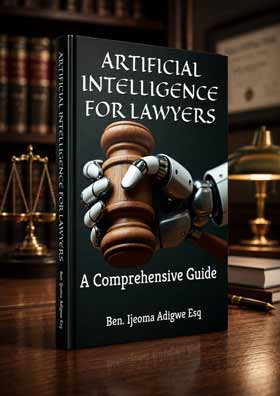 The book also examines Nigeria's legal ecosystem, focusing on the LPELR and NBA AI Guidelines. As a bonus, every purchase comes with a FREE eBook titled: How to Use the AI Features in LegalPedia and LawPavilion.
Ohio Books Ltd praises the publication, stating:
"....this is the only Nigerian book I know of on the topic."
How to Order:
📞 Call, Text, or WhatsApp: 08034917063 | 07055285878
📧 Email: benadigwe1@gmail.com
🌎 Website: www.benadigwe.com
Ebook Version: Access it directly online at https://selar.com/prv626
Authored by Ben Ijeoma Adigwe Esq., ACIarb (UK), LL.M, Dip. in Artificial Intelligence, Director at the Delta State Ministry of Justice, Asaba, Nigeria.
_______________________________________________________________________
“Enhance Legal Practice With Authoritative Reports” — Alexander Payne Offers Comprehensive Law Reports, Spanning Over A Century Of Nigerian Jurisprudence
The book also examines Nigeria's legal ecosystem, focusing on the LPELR and NBA AI Guidelines. As a bonus, every purchase comes with a FREE eBook titled: How to Use the AI Features in LegalPedia and LawPavilion.
Ohio Books Ltd praises the publication, stating:
"....this is the only Nigerian book I know of on the topic."
How to Order:
📞 Call, Text, or WhatsApp: 08034917063 | 07055285878
📧 Email: benadigwe1@gmail.com
🌎 Website: www.benadigwe.com
Ebook Version: Access it directly online at https://selar.com/prv626
Authored by Ben Ijeoma Adigwe Esq., ACIarb (UK), LL.M, Dip. in Artificial Intelligence, Director at the Delta State Ministry of Justice, Asaba, Nigeria.
_______________________________________________________________________
“Enhance Legal Practice With Authoritative Reports” — Alexander Payne Offers Comprehensive Law Reports, Spanning Over A Century Of Nigerian Jurisprudence
 Interested buyers are encouraged to place their orders and enquiries via:
0704 444 4777, 0704 444 4999, 0818 199 9888
Website: www.alexandernigeria.com
Interested buyers are encouraged to place their orders and enquiries via:
0704 444 4777, 0704 444 4999, 0818 199 9888
Website: www.alexandernigeria.com