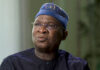
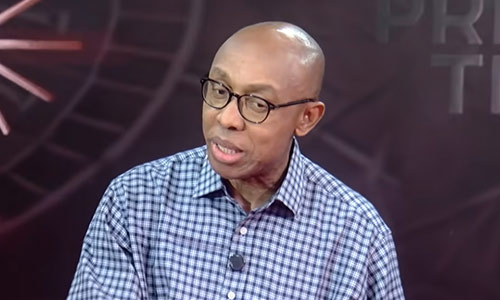
Human rights lawyer and former Chairman of the National Human Rights Commission, Professor Chidi Anselm Odinkalu, has criticised Justice Hyeladzira Nganjiwa of the Federal High Court, Warri Judicial Division, over his 167-page judgment restraining former Deputy Senate President, Senator Augustine Ovie Omo-Agege, from presenting himself as the Nigeria Democratic Congress (NDC) candidate for Delta Central Senatorial District in the 2027 general elections.

Odinkalu questioned the judge’s continued service on the bench, accusing him of unnecessarily involving the judiciary in partisan political disputes and renewing his call for accountability within Nigeria’s judicial system.
The judgment, delivered on Tuesday, November 24, 2026, arose from Suit No. FHC/WR/CS/120/2026, instituted by Alexander Osondu Akpodiete against the Independent National Electoral Commission (INEC), the Nigeria Democratic Congress (NDC) and Augustine Ovie Omo-Agege, listed as the first, second and third defendants, respectively.
According to the certified true copy of the judgment, the plaintiff commenced the action by an originating summons dated June 9, 2026, and filed on June 10, 2026, raising five questions for the court’s determination.
One of the central questions concerned the interpretation of Section 77(4), (5) and (6) of the Electoral Act 2026, particularly whether a political party could lawfully permit a person whose name was not contained in the register of members submitted to INEC at least 21 days before its primary election to participate in that primary.
The proceedings consequently raised questions about compliance with statutory requirements governing political party membership and participation in primary elections.
In the concluding portion of the judgment, Justice Nganjiwa restrained Omo-Agege, whether acting personally or through his agents, privies, surrogates or other persons, from parading himself as the winner of the NDC senatorial primary or as the party’s candidate for Delta Central Senatorial District in the 2027 general elections.
The court also ordered the parties to bear their respective costs.
Reacting to the judgment in a post on his X account, Odinkalu expressed concern about both the decision and the continued presence of Justice Nganjiwa in the judiciary.
“Hyeladzira Nganjiwa’s judgment in @FederalHigh in Warri, Delta State, disqualifying @OvieOmoAgege from the contest for @NGRSenate in #NigeriaDecides2027 is 167 pages long,” Odinkalu wrote.
He alleged that the judgment demonstrated the danger of judicial officers becoming entangled in partisan political controversies.
“It is also a model of a judge inserting the courts needlessly into partisan disputation either as an instrument in a political transaction or as an actor who manifestly has no business being on the bench,” he stated.
Odinkalu maintained that the controversy raised wider questions about judicial accountability and the responsibility of institutions charged with supervising judicial conduct.
“This case is important for all the wrong reasons. Nganjiwa should not be sitting as a judge,” he declared.
The former NHRC chairman went further to revisit the history of complaints involving Justice Nganjiwa before the National Judicial Council (NJC), particularly proceedings arising from a complaint submitted by the Economic and Financial Crimes Commission (EFCC).
According to Odinkalu, the NJC’s findings in 2019 raised concerns about the judge’s continued suitability to exercise judicial authority.
“The findings of @njcNig on him in 2019 in the complaint by @officialEFCC make that quite clear,” he alleged.
Odinkalu also criticised the NJC leadership over its decision to allow Nganjiwa to return to judicial duties following an absence of approximately four years.
“But the #NJC hierarchy chose to return him to the judiciary after a 4 year hiatus on a technicality that did not lift the irredeemable tarnish of those findings. If anyone bothered to consider the implications, they failed to show it,” he wrote.
His comments linked the controversy surrounding the Omo-Agege judgment to his broader concerns about the disciplinary oversight of judicial officers.
However, Odinkalu’s references to the previous EFCC complaint and NJC proceedings were allegations and criticisms expressed in his post. They do not, on their own, establish wrongdoing in the handling of the present electoral case.
The human rights lawyer maintained that citizens must continue demanding accountability from the judiciary, arguing that public scrutiny remained essential to preserving confidence in the administration of justice.
“This is an example of why citizens cannot yield to any intimidation on the issue of judicial accountability,” he stated.
Odinkalu nevertheless acknowledged the contributions of judicial officers who continued to perform their responsibilities under difficult circumstances.
“There are good judges doing a difficult job in bad conditions. But people like Nganjiwa give them a bad name,” he said.
He argued that the conduct of individual judges could affect public confidence in the judiciary as an institution and maintained that the NJC must take responsibility for safeguarding judicial integrity.
Odinkalu also urged citizens not to abandon their responsibility to question judicial conduct where they believed the appropriate oversight institutions had failed to act.
“If the NJC will not do its job of acting to safeguard judicial authority, then citizens should not shirk the responsibility of denying them the #SocialCapital & respectability that comes from a judicial sinecure,” he wrote.
The controversy followed the Federal High Court’s determination of a pre-election dispute concerning Omo-Agege’s eligibility to participate in the NDC primary election and present himself as the party’s senatorial candidate.
The originating summons placed the provisions of Section 77(4), (5) and (6) of the Electoral Act 2026 before the court, particularly the requirement concerning submission of political party membership registers to INEC before primary elections.
The concluding orders contained in the certified true copy restrained Omo-Agege from presenting himself as the winner of the party’s senatorial primary or its candidate for the Delta Central seat.
Odinkalu’s reaction, however, focused primarily on Justice Nganjiwa’s continued service and his concerns about the relationship between political litigation, judicial independence and accountability.
[A MUST HAVE] Evidence Act Demystified With Recent And Contemporary Cases And Materials
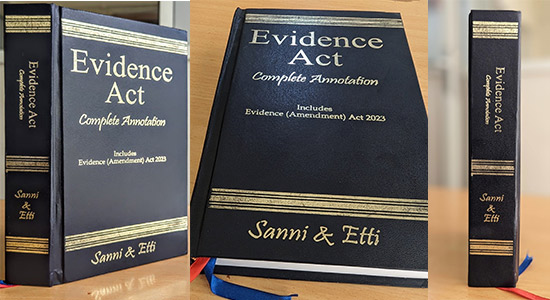
Available now for NGN 40,000 at ASC Publications, 10, Boyle Street, Onikan, Lagos. Beside High Court, TBS. Email publications@ayindesanni.com or WhatsApp +2347056667384. Purchase Link: https://paystack.com/buy/evidence-act-complete-annotation
______________________________________________________________________ “Enhance Legal Practice With Authoritative Reports” — Alexander Payne Offers Comprehensive Law Reports, Spanning Over A Century Of Nigerian Jurisprudence Interested buyers are encouraged to place their orders and enquiries via:
0704 444 4777, 0704 444 4999, 0818 199 9888
Website: www.alexandernigeria.com
“A Comprehensive Guide To Evidence Law” — Releases Second Edition In Three Volumes, Covering 4,051 Cases
For enquiries and orders, contact: 08035526491 Email: jerryamadisilk@gmail.com
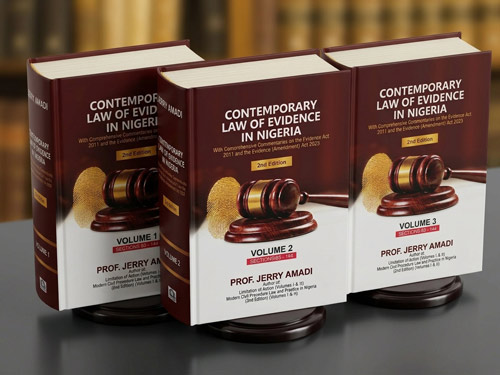 Prof. Jerry Amadi’s Evidence Law, Second Edition (2026), contains 3,314 pages in three volumes, covering the Evidence Act 2011, its 2023 amendment, and 4,051 Nigerian and English cases.