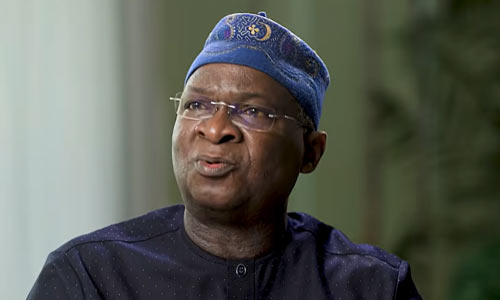
Former Lagos State Governor and former Minister of Works and Housing, Babatunde Raji Fashola, SAN, has rejected calls for individuals involved in election rigging to be killed, insisting that electoral offenders should face prosecution and appropriate custodial sentences rather than the death penalty.

Fashola warned that Nigeria must move away from extreme political rhetoric as preparations for the 2027 general elections intensify, stressing that democracy should be a contest of ideas rather than an opportunity for violence.
Speaking during an interview with Arise Television on Friday, November 27, 2026, the former governor reacted to the controversial “rig and die” slogan associated with former Deputy Senate President Ovie Omo-Agege, a Delta Central senatorial candidate of the Nigeria Democratic Congress (NDC).
The slogan, which has generated political debate, followed Omo-Agege’s warning that anyone attempting to manipulate the 2027 elections could face deadly consequences.
Asked whether individuals caught rigging elections should be sentenced to death, Fashola rejected the suggestion.
“Absolutely not. I mean, come on,” he said.
“I think we must move away from what I think are extreme narratives and rhetoric.”
The Senior Advocate of Nigeria maintained that electoral offences must be addressed through the existing legal framework, adding that punishment should follow established judicial procedures rather than threats of violence.
According to him, the Electoral Act does not prescribe the death penalty for election rigging, and even where capital punishment is provided for an offence, constitutional safeguards and due process must be observed.
“The punishment under the Electoral Act is not death. And even if it were death, which I will not support, there’s a process before you take human life; a charge, a trial, an opportunity to defend yourself,” Fashola stated.
He emphasised that condemning electoral malpractice did not justify the killing of suspected offenders, urging political parties and their supporters to respect democratic procedures.
“The penalty for rigging is not death. But don’t rig. Go and campaign for your party,” he said.
Fashola argued that political parties should concentrate on persuading voters and mobilising support rather than attempting to manipulate electoral outcomes.
He explained that no political party could realistically expect to enjoy equal support throughout the country, noting that the nature of democratic competition meant parties would win in some locations and lose in others.
“There are places where each party is popular. There are places where parties will never win, no matter what they do there. That is the reality across the world,” he said.
The former minister maintained that parties should maximise their electoral strength in areas where they enjoyed support while working to improve their performance elsewhere.
Drawing a comparison with football, Fashola explained that political parties must understand that success does not require winning every contest or securing every available vote.
He stressed that parties should accept the possibility of losing elections and focus on building broader public support rather than resorting to manipulation or intimidation.
Although Fashola rejected the death penalty, he acknowledged that electoral offences undermining democracy should attract sufficiently serious punishment to discourage potential offenders.
He suggested that lawmakers could consider stronger custodial sentences for particularly serious electoral offences, including penalties without the option of paying a fine.
“I think maybe there might be stiffer sentences without the option of a fine, maybe a defined custodial sentence that is deterrent in nature,” he said.
He argued that fines should not always be available as an alternative punishment for offences capable of damaging democratic institutions.
“I always hold the view that some very serious, really impactful conduct should not be allowed to be monetised, and undermining of democracy is seriously impactful,” Fashola stated.
However, he maintained that the seriousness of electoral offences did not justify taking the lives of those accused of committing them.
“I don’t think it goes that far,” he added.
Beyond election rigging, Fashola expressed concern about political violence and called for decisive legal action against those responsible for organising or sponsoring attacks during elections.
He argued that the prosecution of individuals involved in political violence could serve as a powerful deterrent and discourage others from engaging in similar conduct.
The former governor questioned why relevant prosecuting authorities had not taken more decisive steps to address electoral violence, despite the existence of laws under which offenders could be prosecuted.
He called for collaboration between state Attorneys-General, the Attorney-General of the Federation and law enforcement authorities to ensure that perpetrators were investigated and brought before the courts.
According to him, a well-investigated and successfully prosecuted case involving electoral violence could demonstrate that such conduct would no longer be tolerated.
Fashola also urged the Inspector-General of Police and relevant authorities to investigate security personnel who might have facilitated or failed to prevent politically motivated attacks.
He maintained that police officers found to have been complicit in electoral violence should also face prosecution.
The former minister explained that holding perpetrators and their sponsors accountable would be more effective than encouraging supporters of political parties to confront suspected offenders violently.
He stressed that democratic competition should be conducted through peaceful engagement, persuasion and debate.
According to him, elections should be understood as contests between competing political ideas, in which parties could win at one election and lose at another without resorting to violence.
Fashola further called for greater public education on elections, arguing that Nigeria had repeatedly amended its electoral laws without paying sufficient attention to helping citizens understand democratic principles and responsible political participation.
He said sustained nationwide enlightenment was necessary to improve electoral conduct and strengthen democratic institutions.
The former governor maintained that political parties, candidates and voters needed to understand that electoral contests naturally produced winners and losers.
He suggested that a better understanding of this principle would reduce the desperation often associated with elections and discourage manipulation, intimidation and violence.
His remarks followed controversy over the “rig and die” slogan introduced by Omo-Agege during a political event in October 2026.
The former Deputy Senate President had warned against attempts to manipulate the 2027 elections, declaring that electoral riggers could be killed.
“I want to make the news again. Anybody who rigs the election on that day, we will kill him! If you don’t value your life, come and rig the election,” Omo-Agege said.
The remarks subsequently generated debate over the appropriateness of threatening violence against individuals accused of electoral malpractice.
Omo-Agege later clarified that his statement was intended to discourage electoral manipulation and promote credible elections in 2027.
He maintained that the expression was not directed at any particular individual but reflected his opposition to attempts to compromise electoral outcomes.
Fashola, however, insisted that even when political actors were concerned about electoral malpractice, their responses should remain within the law.
His position was that the need for credible elections must not be confused with a licence to kill or threaten suspected offenders.
During the same interview, the former governor also addressed questions concerning the independence of the Independent National Electoral Commission (INEC), particularly in relation to the appointment of its chairman by President Bola Tinubu.
Fashola questioned the suggestion that presidential appointment alone necessarily prevented an INEC chairman from acting independently.
He argued that previous chairmen of the electoral body had also been appointed by sitting presidents and urged Nigerians to pay greater attention to the actual responsibilities exercised by the chairman during elections.
According to him, the INEC chairman, while serving as the returning officer for the presidential election, receives and announces results collated from the states.
Fashola maintained that the processes taking place at polling units, local government collation centres and state collation centres were central to the credibility of election results.
He argued that public scrutiny should extend to those stages rather than concentrating exclusively on the chairman at the national collation centre.
When questioned about the possibility of the INEC chairman being influenced through inducements, the former governor expressed confidence in the transparency associated with the public collation and announcement of presidential election results.
He suggested that the presence of cameras and public observation at the national collation centre made it difficult for the chairman to manipulate results without scrutiny.
These remarks reflected Fashola’s assessment of the electoral process rather than a finding that manipulation at any stage was impossible.
The former governor also expressed confidence in the APC’s prospects in Lagos State during the 2027 presidential election, despite the party’s defeat in the state during the 2023 presidential poll.
He acknowledged that the APC had been caught off guard by the outcome of the previous presidential election in Lagos but maintained that the party had subsequently strengthened its political organisation.
According to him, the party recovered during the governorship election that followed and had learnt lessons from its earlier performance.
He expressed confidence that the circumstances that contributed to the APC’s defeat in Lagos in 2023 would not be repeated.
Fashola also defended President Tinubu’s political record and his ability to maintain working relationships with politicians across different political tendencies, presenting those qualities as part of his case for the President’s re-election.
Nevertheless, his comments on electoral malpractice focused on the distinction between lawful punishment and politically motivated violence.
He maintained that individuals responsible for undermining elections should not escape accountability, while insisting that investigations, prosecutions and punishment must comply with the law.
For Fashola, the appropriate response to election rigging and political violence is stronger law enforcement, effective prosecution, appropriate custodial punishment and improved public understanding of democracy, rather than threats to kill alleged offenders.
He reiterated that politicians should concentrate on campaigning, persuading voters and respecting electoral outcomes instead of embracing rhetoric that could encourage violence as Nigerians prepare for the 2027 general elections.
[A MUST HAVE] Evidence Act Demystified With Recent And Contemporary Cases And Materials
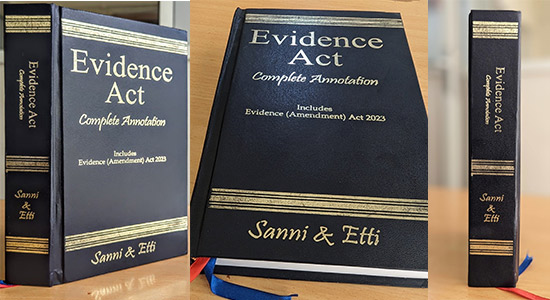
Available now for NGN 40,000 at ASC Publications, 10, Boyle Street, Onikan, Lagos. Beside High Court, TBS. Email publications@ayindesanni.com or WhatsApp +2347056667384. Purchase Link: https://paystack.com/buy/evidence-act-complete-annotation
______________________________________________________________________ “Enhance Legal Practice With Authoritative Reports” — Alexander Payne Offers Comprehensive Law Reports, Spanning Over A Century Of Nigerian Jurisprudence Interested buyers are encouraged to place their orders and enquiries via:
0704 444 4777, 0704 444 4999, 0818 199 9888
Website: www.alexandernigeria.com
“A Comprehensive Guide To Evidence Law” — Releases Second Edition In Three Volumes, Covering 4,051 Cases
For enquiries and orders, contact: 08035526491 Email: jerryamadisilk@gmail.com
 Prof. Jerry Amadi’s Evidence Law, Second Edition (2026), contains 3,314 pages in three volumes, covering the Evidence Act 2011, its 2023 amendment, and 4,051 Nigerian and English cases.