
The Federal Government has announced major reforms across Nigeria’s education sector, disclosing that approximately ₦379 billion has been disbursed through the Nigerian Education Loan Fund (NELFUND), while more than 2.8 million applications have been received under its Technical and Vocational Education and Training (TVET) programme.

The government also unveiled plans to strengthen teacher professionalism, expand digital learning, improve educational infrastructure and provide independent electricity to all federal tertiary institutions by 2028.
The Minister of Education, Dr. Tunji Alausa, disclosed the developments on Thursday, November 26, 2026, during the ministerial session of the 70th National Council on Education (NCE) meeting held in Maiduguri, Borno State.
Alausa explained that the initiatives, being implemented under President Bola Ahmed Tinubu’s Renewed Hope Agenda, were designed to improve access to quality education, address skills shortages, strengthen teaching standards and improve learning outcomes across the country.
Providing an update on the student loan scheme, the minister revealed that NELFUND had processed approximately 2.65 million applications, with about ₦379 billion disbursed to support students pursuing higher education.
He identified the programme as an important intervention aimed at reducing financial barriers preventing eligible Nigerians from accessing tertiary education.
The minister also disclosed that the Federal Government’s Technical and Vocational Education and Training programme had attracted more than 2.8 million applications.
According to him, the level of interest reflected growing demand among Nigerians for technical and vocational skills that could improve employability and prepare beneficiaries for opportunities in the labour market.
The TVET initiative forms part of the government’s broader efforts to strengthen practical skills development and address the gap between educational qualifications and the demands of employers.
On teacher development, Alausa announced that more than 80,000 teachers were undergoing certification and licensing through the Teachers Registration Council of Nigeria (TRCN).
He disclosed that the Federal Government was targeting 75 per cent teacher certification nationwide by the end of 2027.
The minister further revealed plans to ensure that all senior secondary school teachers were certified by 2028.
He explained that the emphasis on teacher certification and professional development was intended to improve the quality of classroom instruction and strengthen standards across the education system.
Alausa also highlighted substantial financial commitments to tertiary education, including ₦55 billion earmarked for medical education infrastructure and ₦150 billion for the revitalisation of tertiary institutions.
He disclosed that an additional ₦32 billion had been provided for needs-assessment projects in public colleges of education.
According to the minister, ₦39 billion had already been released to 166 public tertiary institutions under the Needs Assessment programme.
The investments are intended to address infrastructure and institutional challenges affecting public tertiary institutions while supporting improvements in teaching and learning facilities.
In the basic education sector, Alausa drew attention to the $532 million HOPE for Basic Education programme, describing it as part of the government’s efforts to strengthen access to education and improve learning opportunities.
He also announced the expansion of the Adolescent Girls’ Learning and Empowerment Project from 18 states to 21 states.
The expansion is aimed at extending educational opportunities to more vulnerable, displaced and disadvantaged children, particularly those facing barriers to formal education.
The minister maintained that the Federal Government was committed to ensuring that children who had been excluded from educational opportunities were supported through targeted programmes and investments.
On digital learning, Alausa disclosed that more than ₦11 billion had been allocated to digital skills development as part of efforts to prepare students and other beneficiaries for the demands of a technology-driven economy.
He also announced the installation of 34 solar mini-grids in tertiary institutions, alongside plans to provide independent solar power to all federal tertiary institutions by 2028.
The minister explained that improving electricity supply in educational institutions would support teaching, research, digital learning and other academic activities.
The initiative is also expected to reduce institutions’ dependence on unreliable electricity supply and improve their capacity to operate essential educational facilities.
Alausa further revealed that more than 40,000 geo-located schools had been integrated into digital education management systems.
According to him, the integration would strengthen educational planning, monitoring and school safety by improving the availability and management of school-related information.
He added that approved educational platforms were benefiting from zero-rated internet access, enabling users to access designated learning resources without incurring ordinary internet data charges for those platforms.
The minister identified digital technology as an important component of the government’s plans to improve educational access, accountability and institutional efficiency.
Beyond the national reforms, Alausa commended the Borno State Government for its efforts to expand educational opportunities, particularly in a state that has faced longstanding security and development challenges.
He disclosed that school enrolment in Borno had increased from approximately 770,000 learners in 2018 to about 1.8 million.
The minister attributed the improvement to purposeful leadership, sustained investment in school infrastructure, enhanced security and the resilience of the people of Borno State.
He also praised the standard of facilities at public schools he inspected during his visit, observing that some compared favourably with privately owned schools.
Alausa maintained that the progress recorded in Borno demonstrated the importance of government commitment, institutional coordination and continuous investment in education.
Addressing members of the National Council on Education, the minister urged them to ensure that their deliberations translated into measurable improvements in the education sector.
He stressed that constructing classrooms and providing infrastructure would not be sufficient unless such investments were accompanied by improvements in teacher welfare, professional development, accountability and learning standards.
According to him, effective education reform required attention to both the physical infrastructure of schools and the quality of teaching and learning delivered within them.
In his remarks, Borno State Governor, Professor Babagana Umara Zulum, commended the Federal Government’s reforms, particularly initiatives aimed at improving access to tertiary education, strengthening teachers’ welfare and addressing the mismatch between graduates’ qualifications and labour-market demands.
Zulum maintained that Nigeria needed stronger collaboration between educational institutions and industries to ensure that students acquired skills relevant to available employment opportunities.
He identified technical and vocational education as essential to reducing unemployment and equipping young Nigerians with practical knowledge that could support economic development.
The governor also welcomed the expansion of the student loan scheme, describing NELFUND as an important intervention for students who might otherwise struggle to finance their education.
He noted that financial support for students could improve access to higher education and provide opportunities for individuals from disadvantaged backgrounds.
Providing an update on education development in Borno State, Zulum disclosed that his administration was establishing 27 high-skilled colleges across the state.
According to him, 15 of the institutions had already been completed, while the remaining 12 were expected to be completed before the end of 2026.
The governor explained that the colleges were designed to promote skills acquisition and create pathways connecting non-formal education with the formal education system.
He said the institutions would offer opportunities in literacy, numeracy, digital learning and other specialised programmes.
The initiative is intended to support residents seeking practical skills while providing additional educational pathways for those who may not have benefited fully from conventional schooling.
Zulum maintained that a stronger relationship between vocational training and the formal education system would improve opportunities for young people and prepare them for productive employment.
He further reaffirmed his administration’s commitment to expanding educational infrastructure, recruiting additional teachers and improving their welfare.
The governor said the state would continue introducing incentives aimed at encouraging excellence in the teaching profession.
He also stressed the importance of ensuring that educational institutions responded to the practical needs of society and contributed to economic development.
The discussions at the 70th National Council on Education meeting highlighted the Federal Government’s emphasis on combining student financing, vocational training, teacher certification, institutional revitalisation and digital technology to address challenges affecting the education sector.
They also underscored the importance of cooperation between the Federal Government and state administrations in implementing education policies.
With approximately ₦379 billion reported as disbursed through NELFUND, more than 2.8 million TVET applications received and over 80,000 teachers undergoing certification, the Federal Government maintained that its interventions were intended to expand educational opportunities and improve professional standards.
The planned expansion of solar power infrastructure, digital education management systems and skills development programmes also forms part of efforts to modernise educational institutions and improve their effectiveness.
Alausa urged stakeholders to move beyond policy discussions and ensure that the programmes and investments produced practical improvements in schools, teaching quality and educational outcomes.
The minister maintained that sustained investment, institutional accountability, teacher development and cooperation among relevant authorities would remain essential to achieving the government’s education reform objectives.
[A MUST HAVE] Evidence Act Demystified With Recent And Contemporary Cases And Materials
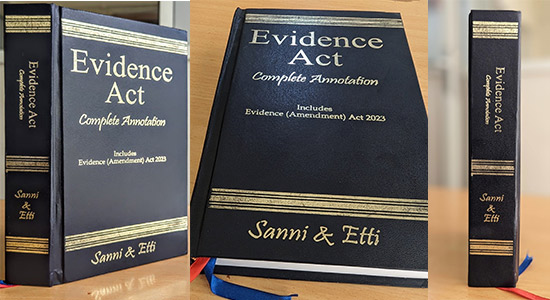
Available now for NGN 40,000 at ASC Publications, 10, Boyle Street, Onikan, Lagos. Beside High Court, TBS. Email publications@ayindesanni.com or WhatsApp +2347056667384. Purchase Link: https://paystack.com/buy/evidence-act-complete-annotation
______________________________________________________________________ “Enhance Legal Practice With Authoritative Reports” — Alexander Payne Offers Comprehensive Law Reports, Spanning Over A Century Of Nigerian Jurisprudence Interested buyers are encouraged to place their orders and enquiries via:
0704 444 4777, 0704 444 4999, 0818 199 9888
Website: www.alexandernigeria.com
“A Comprehensive Guide To Evidence Law” — Releases Second Edition In Three Volumes, Covering 4,051 Cases
For enquiries and orders, contact: 08035526491 Email: jerryamadisilk@gmail.com
 Prof. Jerry Amadi’s Evidence Law, Second Edition (2026), contains 3,314 pages in three volumes, covering the Evidence Act 2011, its 2023 amendment, and 4,051 Nigerian and English cases.