

Senior Advocate of Nigeria, Dr. M. O. Ubani, SAN, has stated that former Deputy President of the Senate, Senator Ovie Omo-Agege, may have credible grounds to challenge the Federal High Court judgment nullifying his senatorial nomination, insisting that the legal battle is far from over.

Ubani identified the evaluation of the Nigeria Democratic Congress (NDC) membership register submitted to the Independent National Electoral Commission (INEC) and the legal standing of the claimant who instituted the action as two critical issues that could determine the outcome of any appeal against the judgment.
The senior lawyer, however, cautioned against reaching a definitive conclusion on Omo-Agege’s prospects of success without first examining the Certified True Copy (CTC) of the judgment and the record of proceedings before the trial court.
In his legal analysis titled “Senator Omo-Agege’s Nomination Nullification: The Legal Battle Is Far From Over,” Ubani disclosed that he had requested a certified copy of the judgment from colleagues familiar with the proceedings.
He explained that his preliminary assessment was based on newspaper reports and other media accounts of what transpired in court.
“I have requested for a Certified True Copy (CTC) of the judgment from some reliable colleagues familiar with the case. My preliminary assessment, however, is based on reports from various newspapers and other media accounts,” he stated.
Ubani maintained that although Omo-Agege might have a credible appellate case, it would be inappropriate to assess his chances of success conclusively without studying the judgment and the evidence presented during the proceedings.
He explained that the legal implications of the judgment could be assessed under three principal scenarios, depending on what the documentary evidence and record of proceedings eventually establish.
Addressing the first issue, the senior advocate said the membership register of the NDC submitted to INEC would be central to determining whether the trial court properly evaluated the evidence relating to Omo-Agege’s eligibility.
According to him, if the membership register submitted to INEC within the statutory period contained Omo-Agege’s name, but the trial court nevertheless found otherwise, that discrepancy could constitute a substantial ground for appellate intervention.
He explained that an appellate court could intervene where a trial court demonstrably misinterpreted or failed to properly evaluate decisive documentary evidence and the error materially affected its conclusion.
Ubani stressed that the relevant question was not simply whether Omo-Agege’s name appeared in a party membership register at any particular time, but whether it was contained in the register lawfully submitted to INEC within the period prescribed by the applicable electoral legislation.
He also emphasised the importance of determining whether the trial judge properly considered the documentary evidence before arriving at the decision nullifying the nomination.
The second major issue identified by Ubani was the locus standi of the claimant who challenged Omo-Agege’s nomination before the Federal High Court.
He explained that if the claimant was not a legally qualified aspirant within the contemplation of the Constitution and the applicable Electoral Act, the competence of the action itself could become a decisive issue on appeal.
According to him, the question of locus standi goes beyond the substantive merits of an electoral dispute because it concerns the legal capacity of a claimant to invoke the jurisdiction of the court.
He maintained that where a claimant lacks the necessary legal standing to institute an action, the court may lack jurisdiction to entertain the matter, regardless of the merits of the allegations presented.
Ubani consequently advised Omo-Agege’s legal team to carefully examine the claimant’s status, the nature of his participation in the NDC nomination process and the precise statutory provisions under which the action was commenced.
He explained that these considerations would help determine whether the claimant was legally entitled to challenge the nomination.
The senior lawyer, however, cautioned that the existence of potentially arguable grounds of appeal did not automatically mean that the judgment would be overturned.
Examining another possible scenario, Ubani stated that Omo-Agege’s prospects of successfully challenging the judgment could become considerably more difficult if the evidence established that his name was absent from the NDC membership register lawfully submitted to INEC within the prescribed period.
He specifically referred to the statutory 21-day period preceding the NDC primaries, noting that compliance with the applicable membership registration requirements would be crucial.
According to him, if the relevant register did not contain Omo-Agege’s name and the claimant was legally qualified to institute the action, the legal grounds available for challenging the judgment would be significantly weakened.
Ubani also addressed allegations that Omo-Agege participated in an All Progressives Congress (APC) primary election before subsequently moving to the NDC.
He acknowledged that the allegation could have implications for the substantive dispute but insisted that its legal significance could not be determined in isolation from the relevant facts and documentary evidence.
According to the senior advocate, any assessment of the allegation must take into account the chronology of Omo-Agege’s resignation from his former political party, his admission into the NDC, his membership registration and his participation in the party’s nomination process.
He maintained that the documentary sequence of these events, considered alongside the applicable electoral laws, would be necessary to determine whether the allegation affected the validity of the nomination.
Ubani cautioned against treating the allegation of participation in an earlier APC primary as conclusive proof of ineligibility without examining the full circumstances.
While acknowledging the seriousness of the Federal High Court judgment against Omo-Agege, the lawyer stressed that the judicial process had not necessarily reached its final stage.
He explained that the Court of Appeal would have the opportunity to determine whether the trial court correctly interpreted the applicable Electoral Act, properly evaluated the membership register submitted to INEC and exercised jurisdiction over an action commenced by a claimant with the requisite legal standing.
“I must concede that the judgment against Senator Ovie Omo-Agege is a serious one. Nevertheless, the legal process is not yet exhausted,” Ubani stated.
The senior advocate identified two principal areas that Omo-Agege’s legal team should consider in challenging the judgment.
The first, according to him, is whether the trial court misunderstood or improperly evaluated the documentary evidence relating to the NDC membership register.
The second is whether the claimant who instituted the proceedings possessed the requisite locus standi to challenge Omo-Agege’s nomination.
Ubani explained that the membership-register issue could provide a substantial ground for appeal if the documentary evidence supported Omo-Agege’s position.
He added that the locus standi argument could prove even more significant if the record established that the claimant was not a legally recognised aspirant entitled to invoke the court’s jurisdiction in the circumstances of the case.
He maintained that these issues required careful examination by the appellate court and should not be determined through political considerations or public speculation.
According to him, the outcome of any appeal would depend on the evidence admitted during the trial, the record of proceedings, the applicable statutory provisions and whether the trial court committed an error sufficiently material to justify appellate intervention.
Ubani further emphasised that Omo-Agege’s political standing, personal influence or public sympathy would not determine the legal validity of the trial court’s judgment.
He explained that appellate proceedings are concerned with identifying legally significant errors in the judgment under challenge, rather than reconsidering a dispute on the basis of political arguments.
“We must appreciate that the appeal will not be determined by political arguments, public sympathy or the status of the appellant. It will turn on the record of proceedings, the evidence properly admitted, the precise wording and interpretation of the applicable legislation, and whether the trial court committed an error sufficiently material to justify appellate intervention,” he stated.
The senior advocate consequently warned against treating the nullification of Omo-Agege’s nomination as the final determination of his political future before the relevant appellate questions had been examined.
He maintained that the judgment raised arguable legal issues deserving judicial scrutiny, particularly concerning the interpretation of electoral legislation, the evaluation of documentary evidence and the legal competence of the claimant.
“For that reason, it would be premature to regard the judgment as the final determination of Senator Omo-Agege’s political fate. The Senator’s appeal presents arguable legal questions which deserve careful examination by the appellate court,” Ubani concluded.
[A MUST HAVE] Evidence Act Demystified With Recent And Contemporary Cases And Materials
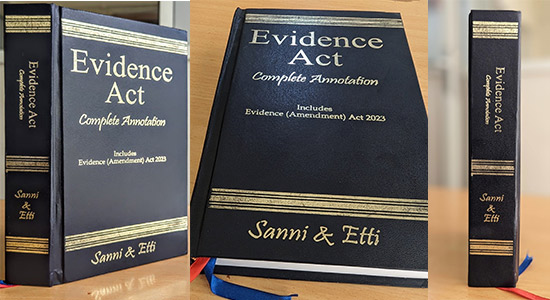
Available now for NGN 40,000 at ASC Publications, 10, Boyle Street, Onikan, Lagos. Beside High Court, TBS. Email publications@ayindesanni.com or WhatsApp +2347056667384. Purchase Link: https://paystack.com/buy/evidence-act-complete-annotation
______________________________________________________________________ “Enhance Legal Practice With Authoritative Reports” — Alexander Payne Offers Comprehensive Law Reports, Spanning Over A Century Of Nigerian Jurisprudence Interested buyers are encouraged to place their orders and enquiries via:
0704 444 4777, 0704 444 4999, 0818 199 9888
Website: www.alexandernigeria.com
“A Comprehensive Guide To Evidence Law” — Releases Second Edition In Three Volumes, Covering 4,051 Cases
For enquiries and orders, contact: 08035526491 Email: jerryamadisilk@gmail.com
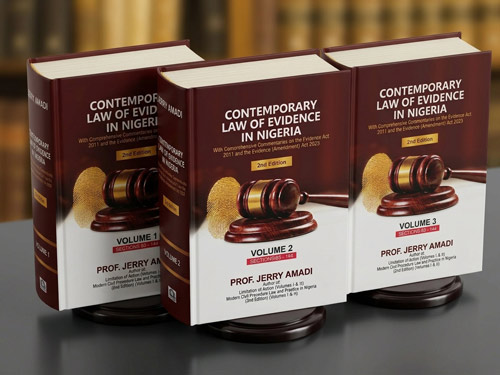 Prof. Jerry Amadi’s Evidence Law, Second Edition (2026), contains 3,314 pages in three volumes, covering the Evidence Act 2011, its 2023 amendment, and 4,051 Nigerian and English cases.