A promotional video advertising a legal technology application known as Paralex has raised important questions about compliance with Nigeria’s Rules of Professional Conduct for Legal Practitioners, 2023, particularly concerning the solicitation of clients, public ratings of lawyers, third-party involvement in legal services and payment arrangements.

The application, presented as a digital platform designed to connect lawyers with potential clients and fellow legal practitioners across Nigeria, advertises features that allow users to search for lawyers, compare professional profiles, request legal services, communicate directly with practitioners and make payments through an integrated wallet.
While technology-based platforms can improve access to legal services and facilitate professional collaboration, the features displayed in the Paralex promotional video, which has been circulated on various lawyers’ platforms in Nigeria, raise regulatory questions about whether such arrangements comply with the ethical obligations imposed on Nigerian legal practitioners. However, TheNigeriaLawyer has yet to identify those behind the application.
The video opens with the Paralex logo and the message, “Built to connect lawyers with clients and one another across Nigeria.”
It subsequently presents the application as a means of connecting legal practitioners with potential clients and colleagues in other states.
One of the promotional messages asks, “Looking for a fast, direct way to connect with potential clients, or with a colleague in another state?”
The video further states, “Reach prospects and colleagues in other jurisdictions directly, through one simple chat.”
This feature raises questions under Rule 39 of the Rules of Professional Conduct for Legal Practitioners, 2023, which regulates advertising, promotion and the solicitation of professional employment.
Under Rule 39(1), lawyers may advertise or promote their services, provided such advertising is fair, proper and consistent with the requirements of professional conduct.
However, Rule 39(2) prohibits advertisements that are misleading, diminish public confidence in the legal profession, compare lawyers with other practitioners or make improper claims concerning the quality or success of legal services.
Rule 39(3) also places restrictions on direct and indirect solicitation of professional employment.
The distinction is particularly relevant to Paralex because the application presents itself not merely as an informational directory but also as a platform through which lawyers can reach potential clients and obtain professional engagements.
Although a digital directory that allows members of the public to independently identify and contact qualified lawyers is not necessarily prohibited, regulatory concerns could arise if the application actively solicits clients on behalf of lawyers, directs prospective clients towards particular practitioners or employs promotional practices inconsistent with Rule 39.
@thenigerialawyer“Find The Right Lawyer” — Paralex App’s Star Ratings, Client Solicitation And Payment Wallet Raise Questions Under Nigeria’s Legal Ethics Rules
Another prominent feature displayed in the video is a searchable directory of lawyers accompanied by numerical star ratings.
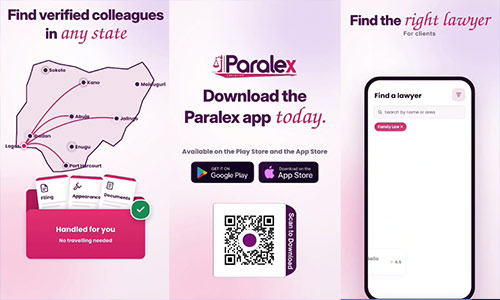
Under the message “Find the right lawyer,” the application displays a search interface where users can look for legal practitioners by name or practice area.
The illustrated profiles include practitioners associated with criminal law, property law, corporate law and family law.
Several profiles are accompanied by ratings ranging from 4.6 to 4.9 stars, presenting prospective clients with a numerical means of assessing the listed practitioners.
This feature raises a separate question under Rule 39(2)(c) and (d), which restricts comparisons between legal practitioners and promotional claims concerning the quality of their services or professional success.
A public rating system that presents one lawyer as having 4.9 stars and another as having 4.6 stars could encourage comparisons based on numerical scores rather than independently verified professional qualifications.
The relevant question is whether such ratings constitute prohibited promotional comparisons or statements about professional quality under the Rules.
However, the mere appearance of star ratings in a promotional illustration does not, without further evidence, establish that participating lawyers have engaged in professional misconduct. The method of generating the ratings, their actual use and the extent of each lawyer’s involvement would need to be examined.
The application also advertises a feature that enables lawyers to find colleagues in different jurisdictions and arrange legal work without travelling.
Under the message “Find verified colleagues in any state,” the video displays a map of Nigeria connecting locations including Lagos, Ibadan, Abuja, Kano, Sokoto, Maiduguri, Enugu, Jos and Port Harcourt.
The accompanying interface advertises assistance with filings, court appearances and documents, alongside the statement “Handled for you” and the assurance that no travelling is needed.
The proposed arrangement appears intended to facilitate professional collaboration by allowing a lawyer handling a matter in one jurisdiction to engage another practitioner in a different state for filings, appearances and related assignments.
Such collaboration is not inherently unlawful. Nigerian lawyers routinely brief colleagues to appear in court, file processes and undertake other professional responsibilities on their behalf.
Nevertheless, the arrangement raises questions about how the platform identifies and verifies participating practitioners, manages instructions and ensures that legal responsibilities remain with appropriately qualified lawyers.
The promotional video also displays a registration interface through which lawyers can create accounts by providing their names, Bar numbers and practice areas.
While the inclusion of a Bar number suggests an attempt to verify professional identity, the video does not explain the procedures used to determine whether a listed individual is duly qualified, entitled to practise or subject to any professional restrictions.
The claim that the application connects users with verified lawyers therefore requires an examination of the verification process behind the platform.
Of particular concern is the application’s advertised payment system, described in the video as the “Paralex wallet.”
Under the message “Get paid securely,” the promotional material displays a wallet interface containing an available balance of ₦250,000.
A notification on the screen reads “Payment received” and identifies a ₦50,000 consultation fee.
The same interface displays three categories of payments: ₦50,000 for consultation, ₦35,000 for filing support and ₦60,000 for court appearance.
The wallet also carries the message “Protected by Paralex.”
Although these amounts appear in a demonstration interface and cannot be treated as evidence of actual transactions, the feature raises important questions about how the application processes payments for legal services, whether it retains any portion of professional fees and what safeguards exist for money received on behalf of lawyers or their clients.
Under Rule 3(1)(c) of the Rules of Professional Conduct, a lawyer is prohibited from sharing legal fees with a non-lawyer except as permitted under Rule 53.
Rule 53 regulates the division of professional fees and generally restricts fee-sharing to lawyers based on the division of professional services or responsibilities, subject to specified exceptions.
Consequently, if a commercial platform receives a percentage of legal fees as a commission for introducing clients or facilitating professional engagements, questions could arise about whether participating lawyers are engaging in prohibited fee-sharing.
However, there is an important distinction between a payment processor charging ordinary technical transaction fees and an intermediary receiving a share of remuneration for legal services. The legal position would depend on the platform’s contractual and financial arrangements.
The promotional video does not disclose whether Paralex charges subscriptions, listing fees, transaction-processing charges, referral commissions or percentage-based deductions from professional fees.
It therefore does not establish that the platform engages in unlawful fee-sharing, but the absence of those details makes the payment structure an issue requiring clarification.
Rule 4 of the Rules of Professional Conduct raises another relevant consideration.
The provision prohibits a lawyer from permitting professional services to be controlled or exploited by a lay agency, whether an individual or corporate body, that intervenes between the lawyer and the client, subject to the recognised exception for institutions rendering assistance to indigent persons.
The rule is intended to preserve lawyers’ professional independence and prevent non-lawyer intermediaries from exercising improper control over legal services.
Where a technology platform merely supplies communication, administrative or payment facilities, its operations may be distinguishable from those of an intermediary exercising control over a lawyer’s professional relationship with a client.
However, if an application determines which lawyers receive instructions, controls the terms of professional engagements, fixes fees without the practitioner’s participation or otherwise manages legal work in a manner that compromises professional independence, its operations may warrant closer examination under Rule 4.
The payment illustrations in the Paralex video also raise questions under the Legal Practitioners Remuneration Order, 2023, which prescribes minimum remuneration for specified categories of legal services.
The Order covers consultations and legal opinions, litigation, company incorporation, property transactions and other legal services.
The prescribed charges vary according to the category of work, the practitioner’s level of experience and the applicable geographical classification.
The Nigerian Bar Association has repeatedly reminded lawyers that they are required to comply with the Remuneration Order and that charging below the prescribed scales without following the applicable procedures may amount to professional misconduct.
Against that background, the ₦50,000 consultation fee, ₦35,000 filing-support payment and ₦60,000 court-appearance payment displayed in the Paralex video invite questions about whether actual fees processed through the platform would comply with the relevant remuneration requirements.
The promotional material does not establish that those amounts are fixed prices, compulsory charges or the full professional fees payable for the services depicted.
Nevertheless, if the platform offers standardised legal-service prices, compliance would need to be assessed against the applicable remuneration scales and the nature of each engagement.
There are also questions about confidentiality and the handling of client information.
The video illustrates direct communication between a lawyer and a user through an in-app messaging interface, including a conversation about reviewing legal documents.
Since legal instructions frequently involve confidential personal information, financial records, litigation documents and privileged communications, any platform handling such material would need appropriate safeguards.
Lawyers participating in such arrangements remain subject to their duties of confidentiality and professional responsibility, including those established under the Rules of Professional Conduct.
An integrated wallet similarly raises questions about custody, segregation, accounting and the treatment of money belonging to clients or practitioners.
The existence of a wallet is not, by itself, evidence of financial impropriety. The relevant issues include who controls the funds, whether the platform acts as a payment intermediary or custodian, and what arrangements exist for protecting money received for legal services.
Beyond these concerns, the video concludes by encouraging users to download the Paralex application through the Google Play Store or Apple’s App Store, reinforcing its presentation as a technology solution for accessing legal practitioners and coordinating legal services across Nigeria.
The growing use of digital technology in legal practice is not itself contrary to professional ethics. Online directories, secure communication tools, document management platforms and arrangements for briefing lawyers in other jurisdictions can serve legitimate purposes.
The central issue is whether such technology operates within the professional boundaries established for lawyers or introduces commercial arrangements that undermine their independence, encourage improper solicitation, facilitate prohibited fee-sharing or promote comparisons inconsistent with professional advertising rules.
The features displayed in the Paralex promotional video therefore raise questions that could appropriately be examined by the Nigerian Bar Association, the General Council of the Bar and other relevant regulatory authorities.
Such an examination could establish how the application verifies lawyers, how its rating system operates, whether clients are solicited or allocated to practitioners, who controls legal-service payments and whether any commissions are deducted from professional fees.
It could also determine whether participating lawyers retain full control over their professional instructions, client relationships and remuneration.
At present, the promotional video alone does not establish that Paralex or any participating legal practitioner has violated the Rules of Professional Conduct, and no finding of professional misconduct against the platform has been established by the material examined.
Nevertheless, the questions raised by its advertised features illustrate the need for clear regulatory guidance on how technology-driven legal marketplaces should operate within Nigeria’s professional legal framework.
The challenge for the legal profession is to embrace innovation that improves access to justice without allowing technology platforms to circumvent the ethical rules governing client acquisition, professional independence, lawyers’ remuneration and the protection of clients.
[A MUST HAVE] Evidence Act Demystified With Recent And Contemporary Cases And Materials

Available now for NGN 40,000 at ASC Publications, 10, Boyle Street, Onikan, Lagos. Beside High Court, TBS. Email publications@ayindesanni.com or WhatsApp +2347056667384. Purchase Link: https://paystack.com/buy/evidence-act-complete-annotation
______________________________________________________________________ “Enhance Legal Practice With Authoritative Reports” — Alexander Payne Offers Comprehensive Law Reports, Spanning Over A Century Of Nigerian Jurisprudence Interested buyers are encouraged to place their orders and enquiries via:
0704 444 4777, 0704 444 4999, 0818 199 9888
Website: www.alexandernigeria.com