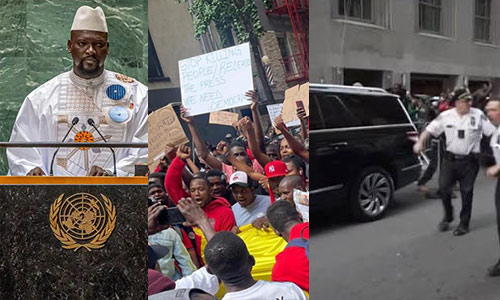
Hundreds of Guineans living in the United States gathered in New York City to protest against President Mamadi Doumbouya during his visit for the 81st session of the United Nations General Assembly, with tensions escalating outside the Waldorf Astoria as demonstrators confronted vehicles linked to the Guinean delegation and New York police intervened.

The protest took place on Wednesday, September 23, 2026, both at Dag Hammarskjold Plaza near the United Nations headquarters and around the Waldorf Astoria in Manhattan, where Doumbouya was staying during his visit to New York. Reuters documented members of the Guinean diaspora demonstrating against Doumbouya and displaying material concerning people they alleged had been killed or disappeared under his government.
The demonstrations coincided with Doumbouya’s participation in the UN General Assembly, where he addressed world leaders later that day.
Photographs from the protest showed demonstrators carrying placards and images of people they said were victims of political repression, disappearances and killings in Guinea. Reuters described the demonstrators as protesting against Doumbouya and “killings allegedly carried out on his behalf.” Those accusations remain allegations and should not be treated as judicial findings against the Guinean president.
Some protesters also reportedly wore shirts portraying Doumbouya as “wanted” and containing allegations of kidnapping, disappearance and murder, while demonstrators demanded accountability, political freedoms and justice for persons they said had disappeared under his administration.
BREAKING: Protesters CHASE after a van and throw Bottles as NYPD attempts to stop them – Large protest against the President of Guinea, Mamady Doumbouya outside of Waldorf-Astoria
Video by @yyeeaahhhboiii2 | Licensing @FreedomNTV desk@freedomnews.tv pic.twitter.com/ieYYNa8zHv
— Oliya Scootercaster 🛴 (@ScooterCasterNY) September 23, 2026
The demonstration was not entirely one-sided. Reuters also documented members of the Guinean diaspora who gathered in New York in support of Doumbouya, illustrating the political divisions among Guineans abroad over his leadership.
Tensions rose outside the Waldorf Astoria when protesters moved towards a van or vehicle associated with the Guinean delegation.
Videos circulated from the scene showed demonstrators chasing the vehicle as officers of the New York Police Department attempted to contain the crowd. Objects appearing to be bottles were also thrown towards the vehicle, according to contemporaneous reports and footage.
Reports described the vehicle as connected to the Guinean delegation. However, available evidence does not establish that President Doumbouya himself was inside the vehicle when protesters confronted it, and reports caution against describing the incident as a direct physical attack on the president.
Police officers moved in to control the situation around the hotel and maintain a security perimeter as the confrontation intensified.
Doumbouya had arrived in New York on September 21 for the UN high-level week. Guinea’s diplomatic mission had announced an official welcome for him at the Waldorf Astoria that day, followed by his UN address on September 23 and a planned engagement with members of the Guinean community on September 24.
The demonstrations reflected longstanding political and human-rights disputes in Guinea, particularly allegations concerning the fate of opposition and civil-society activists.
Among the most prominent cases are Oumar Sylla, popularly known as Foniké Menguè, and Mamadou Billo Bah, two activists associated with the National Front for the Defence of the Constitution, FNDC, whose whereabouts have remained unknown since July 2024.
Human Rights Watch said the two men were detained alongside Mohamed Cissé on July 9, 2024, by security personnel and taken to an undisclosed location. Cissé was released the following day, but Sylla and Bah remained missing. HRW has called on the Guinean authorities to disclose their whereabouts and carry out a credible investigation.
The Guinean authorities have denied responsibility for their disappearance. In 2024, the prosecutor’s office of the Conakry Court of Appeal said the men had not been arrested by authorities and were not being held in the country’s prisons.
Two years after their disappearance, Amnesty International, Human Rights Watch and other rights organisations renewed demands in July 2026 for the authorities to establish what happened to them and for anyone responsible for unlawful disappearances to be held accountable.
The New York protesters also criticised Guinea’s political trajectory under Doumbouya and raised concerns about the country’s return to constitutional government.
Doumbouya first came to power after soldiers overthrew then-President Alpha Condé in September 2021. His government subsequently faced criticism from opposition groups and international human-rights organisations over restrictions on demonstrations, arrests, political activity and other civil liberties.
Against that background, demonstrators in New York called for political accountability and denounced what they viewed as repression under his administration. Some also criticised his continued political role following the country’s transition process.
While the protests unfolded outside, Doumbouya went ahead with his participation in the General Assembly.
The Presidency of Guinea confirmed that he addressed the 81st session on September 23, presenting his government’s positions on national sovereignty, international cooperation, development and Africa’s representation in global institutions.
In his address, Doumbouya argued that African countries should be able to develop governance and development models suited to their own social and political realities rather than simply applying external models without adaptation.
The Guinean Presidency said he presented sovereignty not as isolation but as the ability of Guinea to determine its priorities while building balanced international partnerships based on mutual interests.
He also promoted his administration’s Simandou 2040 development programme, presenting Guinea’s mineral resources and major infrastructure programme as part of a strategy to transform the economy and attract international investment.
Separate reporting on the address said Doumbouya also criticised African leaders who change constitutional rules to remain in office, describing such manipulation as another form of unconstitutional change.
The New York demonstrations therefore unfolded against two sharply contrasting presentations of Guinea: inside the United Nations, Doumbouya promoted his government’s vision of sovereignty, development and international partnership, while outside, sections of the diaspora demanded answers over disappearances, alleged killings and political rights.
At the same time, the presence of pro-Doumbouya demonstrators showed that the Guinean community in the United States was itself divided over his record and political direction.
Despite social-media claims that protesters had trapped Doumbouya inside his hotel or prevented him from reaching the United Nations, the more reliable evidence confirms the protests and the confrontation around a delegation-linked vehicle but does not independently establish that he was personally trapped or inside the vehicle that was chased. Doumbouya ultimately delivered his UN address on September 23.
[A MUST HAVE] Evidence Act Demystified With Recent And Contemporary Cases And Materials

Available now for NGN 40,000 at ASC Publications, 10, Boyle Street, Onikan, Lagos. Beside High Court, TBS. Email publications@ayindesanni.com or WhatsApp +2347056667384. Purchase Link: https://paystack.com/buy/evidence-act-complete-annotation
______________________________________________________________________ “Enhance Legal Practice With Authoritative Reports” — Alexander Payne Offers Comprehensive Law Reports, Spanning Over A Century Of Nigerian Jurisprudence Interested buyers are encouraged to place their orders and enquiries via:
0704 444 4777, 0704 444 4999, 0818 199 9888
Website: www.alexandernigeria.com
Interested buyers are encouraged to place their orders and enquiries via:
0704 444 4777, 0704 444 4999, 0818 199 9888
Website: www.alexandernigeria.com