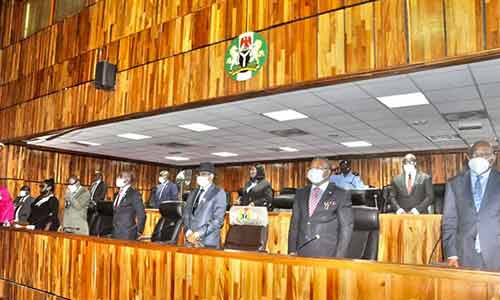
The Federal High Court sitting in Abuja has dismissed a suit challenging the National Human Rights Commission over its handling of a complaint arising from a military operation in Benue State, holding that the Commission retains a statutory discretion over how it conducts investigations and that asking the Nigerian Army for comments on allegations against it does not amount to an unlawful delegation of that function.


Delivering judgment on 26 June 2026 in Sesugh Akume v National Human Rights Commission & 2 Ors, Suit No. FHC/ABJ/CS/1135/2024, Honourable Justice Peter O. Lifu held that the applicant had failed to establish that the Commission acted outside the powers conferred on it by the National Human Rights Commission (Amendment) Act 2010.
The applicant has since filed a Notice of Appeal against the decision, contending that its central findings run counter to the evidence on the record.
The action arose from an attack on 7 March 2023 by personnel of Operation Whirl Stroke on part of the applicant’s community at Jootar, near Zaki-Biam, in the Sankera area of Benue State.
According to his account, Iniongo Verve was killed, Aondowase Abeda was seriously injured, and close to one hundred motorcycles, a source of livelihood for the community, were taken away. He named in his complaint the officer he says commanded the operation.
He reported the attack to the Commission on 31 March 2023. Its Benue State office conducted a preliminary investigation, visited Jootar and gathered evidence, including mortuary receipts, x-ray images and medical documentation, before the matter was transferred to the headquarters in Abuja.
By a letter dated 7 November 2023, the Commission informed him that it had forwarded his complaint to the Nigerian Army for thorough investigation, that the Army would conduct a detailed investigation and interview relevant parties, and that the Commission would relay the Army’s findings to him.
He wrote to the Executive Secretary on 24 January 2024, to the Chairman of the Governing Council on 27 February 2024, and again to the Executive Secretary, copying the Chairman, on 15 March 2024. Having received no resolution, he filed at the Federal High Court on 8 August 2024.
The originating summons asked the court to determine whether it is the duty of the Nigerian Army to investigate reports of human rights violations levelled against itself on behalf of the Commission; whether the Commission has the vires to outsource investigations to a third party or to pick and choose which complaints to address; whether human rights cases fall into a special category requiring expedition; and whether a person who suffers delayed justice ought to be compensated.
He sought declarations to that effect, an order mandating the respondents to conclude the matter within two weeks and report compliance, N100 million in general, aggravated, exemplary and punitive damages, and N20 million in costs at 30 per cent interest until liquidation.
The respondents filed a notice of preliminary objection contending that the conditions precedent had not been met and that no reasonable cause of action had arisen.
On the pre-action notice, the court examined section 15 of the 2010 Act, which introduced section 18(3) and (4) requiring one month’s written notice before a suit is commenced against a member of the Council, the Executive Secretary, or any officer or employee of the Commission.
“A careful reading of the provision shows that the protection afforded by the section is directed against proceedings commenced against a member of the Council, the Executive Secretary, an officer or employee of the Commission. The provision does not expressly include the Commission itself,” the court held, adding that it could not insert words the legislature deliberately omitted.
The requirement therefore applied to the second and third respondents but not to the Commission. Examining the document relied upon as notice, the court found that it did not satisfy the statutory requirement, being “an appeal to the Chairperson, Governing Council NHRC to come into the matter in question” rather than a formal notice of intention to sue. The objection accordingly succeeded against the Executive Secretary and the Chairman of the Governing Council, and failed against the Commission.
The court rejected the objection on cause of action, holding that “the allegation that a statutory body failed, refused, or neglected to perform a duty imposed upon it by law is capable of constituting a complaint cognisable by a Court,” and that the respondents’ contention that the investigation was ongoing went to their defence rather than to the existence of a cause of action.
It also rejected the applicant’s objection that the preliminary objection was itself filed out of time and without payment of default fees, holding that procedural rules cannot prevent a court from examining an issue going to its own competence.
On the substance, the court examined sections 5(b) and 5(j) of the Act, which require the Commission to monitor and investigate all alleged cases of human rights violations and to receive and investigate complaints and make appropriate determinations.
The applicant argued that those provisions impose a mandatory duty on the Commission to conduct every aspect of an investigation personally, and preclude it from obtaining information from the alleged violator.
“I am unable to agree with this submission,” the court held.
It pointed to section 6(1)(a), under which “the Commission shall have power to conduct its investigations and inquiries in such manner as it considers appropriate.”
“The phrase ‘in such manner as it considers appropriate’ is broad and unambiguous. It confers discretion on the Commission regarding investigative methods and procedures. The legislature deliberately refrained from prescribing a fixed process. The Court cannot impose restrictions which the statute itself does not contain,” the court said.
It also relied on section 6(1)(f), which empowers the Commission to cooperate and consult with other agencies and organisations, governmental and non-governmental, as it may deem appropriate.
“The Nigerian Army is undoubtedly a governmental institution. Consequently, where allegations are made against military personnel, the act of requesting comments or information from the military authorities cannot, without more, be construed as an unlawful delegation or outsourcing of investigative powers.”
The court drew the distinction on which the case turned: “There is a clear distinction between seeking information from an affected party and surrendering decision-making authority to that party. The evidence before the Court does not disclose that the Commission relinquished its power of investigation or determination to the Nigerian Army.”
It noted that sections 5(j), 6(1)(e) and 22(1) reserve the powers of determination and award exclusively to the Commission, and that there was no evidence those powers had been delegated.
The court added that administrative investigations involving security agencies “often require tact, diplomacy and institutional engagement,” that the law does not compel the Commission to disclose every investigative strategy, and that section 6(3), which provides that the Commission shall not be subject to the direction or control of any other authority or person, confers an institutional independence that extends to discretion over investigative modalities.
“A complainant who submits a petition to the Commission undoubtedly possesses the right to expect diligence, fairness and reasonable expedition. However, that right does not extend to dictating investigative methods, compelling disclosure of internal strategies or imposing timelines not prescribed by statute,” the court held.
The court accepted the applicant’s argument on the character of human rights complaints in unqualified terms.
“Human rights complaints concern the dignity of the human person and often involve allegations of grave violations. Such complaints deserve prompt attention and diligent handling. Undue delay in the resolution of human rights complaints may undermine public confidence in institutions established for the protection of rights. Human rights cases therefore occupy a special position within constitutional adjudication and ought, as much as practicable, to be handled with dispatch.”
It nonetheless declined to convert that into liability.
“However, desirable conduct and legally enforceable obligations are not always synonymous. While this Court encourages the Commission to conclude investigations within reasonable time, the Court cannot import into the statute timelines which the legislature itself did not enact. The NHRC Act contains no provision prescribing a mandatory period within which every complaint must be concluded.”
“In the absence of such statutory prescription, delay alone, without proof of bad faith, arbitrariness, malice or complete refusal to act, cannot automatically ground liability against the Commission.”
The court added that where a statutory body is actively engaged in investigation, a court must be slow to interfere with administrative discretion absent clear evidence of bad faith or total abdication, and that “if it is established that the Applicant declined invitations for interviews, resisted engagement with relevant authorities or undertook parallel actions capable of affecting ongoing investigations, such conduct cannot simultaneously be invoked as proof that the Commission failed to act. Equity aids the vigilant and not those whose conduct contributes to the very situation of which they complain.”
Citing Ani & Ors v Otu & Ors, the court restated that a party seeking declaratory relief must succeed on the strength of his own case and not on the weakness of the defence, and that such relief is not granted even on admission where entitlement is not established by the claimant’s own evidence.
“The evidence before this Court does not disclose any unlawful act committed by the 1st Respondent beyond the Applicant’s dissatisfaction with the pace and manner of investigation. Such dissatisfaction, without proof of illegality or statutory breach, cannot sustain the award of damages sought,” it held.
It further observed that the Commission handles numerous petitions from across the Federation and that the court “must be cautious not to substitute its own preferences for the statutory discretion vested in the Commission.”
The substantive suit was accordingly dismissed. Mr. Gwaza Shenge appeared for the applicant, and Professor A. I. Chukwuemerie, SAN, with Mr. E. Edeh, for the respondents.
In a statement issued in Abuja on 25 September 2026, the applicant announced that his lawyers had filed a Notice of Appeal and set out the grounds on which he says the findings cannot stand.
He described the case in a single line: “A complaint against the military was referred to the military.”
On the finding that there was no evidence the Commission handed its investigation to the Army, he points to the Commission’s own letter of 7 November 2023, which he says states that the Army “will conduct a detailed investigation of the issues you raised in your complaint,” will “interview relevant parties,” and that “once the Nigerian Army concludes their inquiry, we will inform you of their findings and any recommended actions.”
On the finding that the Act sets no mandatory period, he says page 10 of the same judgment records the respondents’ concession that the 14-day timeline under their own Rule 74(3) could not be enforced, and that their written address repeats it. “Rules and Standing Orders made under an Act of the National Assembly are subsidiary legislation, and carry the force of law like the Act itself,” the statement says. “The finding on delay mentions neither the Rule nor the concession.”
On the observation about declined invitations, he says his affidavit denies any invitation, and that the only invitation in evidence is a contact dated 8 March 2024 from an officer of the 401 Special Forces Brigade, “a formation of the very military accused, not from the Commission.”
On the pre-action notice, he says a separate letter of 15 March 2024 to the Executive Secretary, copied to the Chairman, bears the Commission’s received stamp and states everything section 18 requires, and that the judgment does not mention it, nor section 19, under which notice to the Commission is served by delivery to the Executive Secretary.
The statement also challenges the description of the Commission’s own exhibits, saying that a paragraph of the counter-affidavit describes the letter written to the Army as Exhibit A, whereas the document on the record marked Exhibit A is his own complaint of 31 March 2023; and that another paragraph describes the letter to the Army as Exhibit C, whereas the document marked Exhibit C is his letter of 27 February 2024 to the Chairman of the Governing Council.
He says the document marked Exhibit D, dated 15 October 2024, refers to a letter to the Army of 8 February 2024, without that letter being attached, and that the letter is nowhere produced in the record.
He adds that while the counter-affidavit states that the Army “swung into action” and “immediately” involved its 401 Special Forces Brigade, the date of that contact on the record is 8 March 2024, a year after the attack.
“In law, a finding is called ‘perverse’ when it runs counter to the evidence on record, ignores evidence that was before the court, or rests on matters that were not established. We say this judgment is such a case, and that is the basis of our appeal,” the statement says.
The statement quotes paragraph 11 of the Commission’s counter-affidavit of 16 October 2024, which states: “Sometimes, because of their training and necessary disposition due to the nature of their work as defenders of the nation in times of war or unrests (many of which have been experienced in recent years as they fight bandits etc across all of Nigeria) a lot of tact, patience and tolerance is needed in dealing with the Nigerian Army which has to be applied otherwise no result may be achieved in a matter involving loss of lives of civilian lives through their officers and men.”
He sets that against the Act’s grant to the Commission of power to summon and compel evidence from any person, body or authority, and its provision that the Commission is not subject to the direction or control of any other authority.
He also quotes his written address before the trial court: “It is a waste of public funds for NHRC being funded with billions of naira every year from the public treasury to refuse to treat a complaint reported to it. It is failures as this that make people lose hope in bodies like NHRC and the government itself and run to individuals like Omoyele Sowore, Ahmed Isa, Martins Vincent Otse, Ukan Kurugh, and other defenders of human rights who are not funded by the government at all.”
“The larger question is not whether citizens should seek help from such individuals,” the statement says. “It is why citizens should have to look outside a statutory national human-rights institution at all, when Parliament has already given that institution the powers and the responsibility to investigate their complaints.”
The statement records that the respondents were served on 14 August 2024; that at the first hearing on 12 September 2024 the judge declined to hear the matter and the Commission had filed nothing by that date; that the file went to the Chief Judge for reassignment and was returned to the same judge; that it was listed for definite hearing on 26 November 2025 and the court did not sit; that it was adjourned to 22 January 2026 and again not heard; that it was finally heard on 10 March 2026 and adjourned to 21 May 2026 for judgment, on which day the court did not sit; and that judgment was delivered on 26 June 2026, more than three years after the attack and nearly two years after filing.
It refers to a separate matter concerning the same judge in which, as widely reported, the Court of Appeal criticised his proceeding to judgment on 15 June 2026 notwithstanding a subsisting stay, and on 28 July 2026 nullified that judgment. The statement expressly states that the separate decision “is not the basis of this appeal.”
On verification, it states that everything set out is drawn from documents filed in the suit, and invites members of the public and the press to apply at the registry of the Federal High Court, Abuja for Certified True Copies of the judgment, the originating summons, the affidavits and the exhibits, on payment of the prescribed fees.
The applicant thanked his counsel for his “tenacity, diligence and legal industry.”
[A MUST HAVE] Evidence Act Demystified With Recent And Contemporary Cases And Materials

Available now for NGN 40,000 at ASC Publications, 10, Boyle Street, Onikan, Lagos. Beside High Court, TBS. Email publications@ayindesanni.com or WhatsApp +2347056667384. Purchase Link: https://paystack.com/buy/evidence-act-complete-annotation
______________________________________________________________________ “Enhance Legal Practice With Authoritative Reports” — Alexander Payne Offers Comprehensive Law Reports, Spanning Over A Century Of Nigerian Jurisprudence Interested buyers are encouraged to place their orders and enquiries via:
0704 444 4777, 0704 444 4999, 0818 199 9888
Website: www.alexandernigeria.com
Interested buyers are encouraged to place their orders and enquiries via:
0704 444 4777, 0704 444 4999, 0818 199 9888
Website: www.alexandernigeria.com