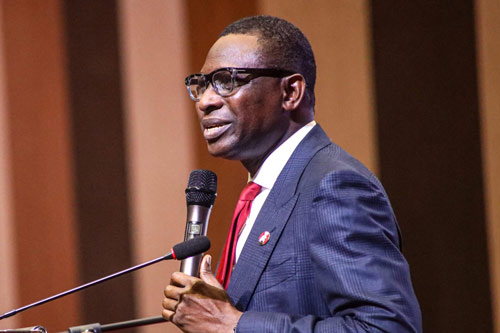
The Chairman of the Economic and Financial Crimes Commission, Ola Olukoyede, has raised fresh concerns over the scale of alleged corruption in Nigeria’s public sector, disclosing that the anti-graft agency receives more than 20,000 petitions relating to public corruption every year.

Olukoyede said some of the cases investigated by the Commission involved public officers whose financial positions changed dramatically within only a few years in office, with investigators allegedly tracing millions of dollars, large amounts of naira and numerous properties to individuals who had comparatively modest finances before entering public service.
The EFCC chairman spoke on Thursday in Abuja at a public lecture held to commemorate the 80th birthday of former Attorney-General of the Federation and Minister of Justice, Chief Kanu Agabi, SAN. The event, which also featured the unveiling of books in Agabi’s honour, brought together senior members of the judiciary, lawyers, public officials, academics and civil society representatives.
Olukoyede said the volume and nature of petitions reaching the EFCC illustrated what he described as a serious public-sector corruption problem.
“I receive over 20,000 petitions in a year in respect to public corruption, all terrible. What is going on? Like every minute, public officers take money, and if you go through some of our case files you will weep,” he said.
He argued that the consequences of alleged diversion of public resources extended beyond the individuals directly involved and affected Nigerians collectively through lost public funds and weakened development.
According to him, citizens should regard themselves as victims whenever resources intended for public purposes are fraudulently diverted.
“The way people take national resources, as Nigerians we’re victims of these fraudulent activities. And we must come together for once in our lifetime and say no to the activities of some of our leaders,” Olukoyede said.
The EFCC chairman said investigations had uncovered cases in which public servants entered office with less than ₦100,000 in their bank accounts but, after spending three or four years in office, were allegedly connected to substantial dollar and naira holdings.
“Somebody will spend three to four years as a public servant, but before he got to office he had less than N100 thousand in his account. By the time he’s leaving, we were able to trace several millions of dollars and naira to him,” he said.
Olukoyede also said some investigations had linked public officers to unusually large numbers of properties.
“Some build 50 something houses, sometimes 200 houses. There’s no way a nation will develop with those kinds of people in power, no way,” he said.
His remarks concerned allegations and matters contained in EFCC petitions and investigative files; receipt of a petition or investigation by the Commission does not by itself establish criminal liability, which remains subject to proof and judicial determination where charges are filed.
Olukoyede nevertheless maintained that public officials should be prepared to account for their stewardship and explain the sources of assets acquired while holding office.
He said accountability and transparency must be central to public service if Nigeria is to reduce the diversion of resources required for infrastructure and development.
The EFCC chairman’s latest disclosure reflects an increase from figures he publicly cited in 2024, when he said the Commission had received about 14,000 petitions from members of the public within a one-year period.
His comments also came days after he told an inter-religious gathering in Abuja that the fight against corruption required more than enforcement by anti-graft agencies and urged religious leaders to help strengthen ethical values among citizens.
Also speaking at Agabi’s birthday event, the Chairman of the Independent Corrupt Practices and Other Related Offences Commission, Dr Musa Adamu Aliyu, SAN, identified social tolerance of corrupt behaviour and weaknesses within public institutions as two major factors sustaining corruption.
“The major challenge of corruption in this country is that we tolerate the culture of corruption, that is why it is thriving. Secondly, we have systemic errors, our systems are weak,” Aliyu said.
The ICPC chairman argued that enforcement alone would be insufficient if institutions remained vulnerable and society continued to accommodate practices that undermined integrity.
He consequently called for integrity education to begin at an early stage, particularly in primary and secondary schools.
Aliyu said younger Nigerians, including members of Generation Z and Generation Alpha, should deliberately be taught values of integrity, accountability and responsible citizenship.
“We need to tell them that we want them to imbibe the culture of integrity,” he said.
The position is consistent with other recent remarks by the ICPC chairman advocating the deliberate development of a generation that values honesty, accountability and patriotism as part of a long-term strategy against corruption. The Commission has also highlighted integrity clubs, youth programmes and partnerships with educational institutions as elements of its preventive approach.
The Abuja event itself focused substantially on ethical governance and anti-corruption. The public lecture, delivered by Cable Media and Publishing Limited founder Simon Kolawole, was titled “Prioritising Ethical Conduct and Anti-Corruption Measures in Governance in Nigeria.”
Former President Goodluck Jonathan, who attended the event, separately cautioned political actors against treating misconduct as acceptable merely because it occurred in the pursuit of political power, stressing that politics remained governed by rules.
Olukoyede and Aliyu’s interventions placed emphasis on two complementary dimensions of the anti-corruption effort: investigation and accountability for alleged financial wrongdoing on the one hand, and institutional reform and ethical education intended to prevent corruption on the other.
[A MUST HAVE] Evidence Act Demystified With Recent And Contemporary Cases And Materials

Available now for NGN 40,000 at ASC Publications, 10, Boyle Street, Onikan, Lagos. Beside High Court, TBS. Email publications@ayindesanni.com or WhatsApp +2347056667384. Purchase Link: https://paystack.com/buy/evidence-act-complete-annotation
______________________________________________________________________ “Enhance Legal Practice With Authoritative Reports” — Alexander Payne Offers Comprehensive Law Reports, Spanning Over A Century Of Nigerian Jurisprudence Interested buyers are encouraged to place their orders and enquiries via:
0704 444 4777, 0704 444 4999, 0818 199 9888
Website: www.alexandernigeria.com
Interested buyers are encouraged to place their orders and enquiries via:
0704 444 4777, 0704 444 4999, 0818 199 9888
Website: www.alexandernigeria.com