The Independent Corrupt Practices and Other Related Offences Commission (ICPC) has said its investigation found no evidence linking the Chief of Staff to the President, Femi Gbajabiamila, to the purported appointment of Adeniyi Adeyemi as Director-General of the Presidential Foreign Investment Promotion Council, an organisation investigators say had no lawful basis as a federal government agency.


According to the commission’s findings, Adeyemi allegedly personally forged a March 2024 appointment letter on a fake State House letterhead and attributed a purported signature on the document to Gbajabiamila. The ICPC said it found no evidence that the Chief of Staff appointed Adeyemi or had any direct engagement with him over the disputed council.
The findings provide further details about the controversy surrounding the PFIPC, which allegedly succeeded in obtaining government office space, recognition and access to government banking arrangements despite, according to investigators, having no legal foundation.
The ICPC investigation was initiated following a directive by President Bola Tinubu to probe the activities of the purported council. In an interim report submitted to the President on August 6, 2026, the commission concluded that Adeyemi was never appointed by the Federal Government and that the PFIPC was not established by any law, executive order or other valid government instrument.
The commission consequently recommended that Adeyemi be prosecuted over alleged forgery, impersonation and related offences.
As part of the investigation, the ICPC examined whether Adeyemi’s purported appointment was genuine, whether the appointment letter presented by him was authentic, the role of the Office of the Chief of Staff in presidential appointments and the circumstances under which Adeyemi claimed to have assumed leadership of the PFIPC.
Investigators found that the Office of the Chief of Staff does not itself issue appointment letters to political appointees or heads of ministries, departments and agencies.
According to the commission, the Chief of Staff’s role is limited to conveying presidential approvals to the Office of the Secretary to the Government of the Federation, which is then responsible for issuing the appropriate appointment letters.
The commission said it examined official correspondence records of the Office of the Chief of Staff, including its dispatch records and Automated Correspondence Management platform, but found no communication involving Adeyemi or the PFIPC between 2024 and September 2025.
The first official inquiry about the purported council, according to the findings, came in October 2025 when the Office of the National Security Adviser sought clarification regarding the status of the organisation.
After officials established that the council had no lawful basis, the Office of the Chief of Staff reportedly wrote to the Inspector-General of Police requesting a formal investigation.
The ICPC also scrutinised other documents allegedly used to present the PFIPC as a legitimate government entity.
One such document purportedly bore the name Akanbi Adewale, described as a Director of Administration in the State House, and was used to request an administrative code for the purported council from the Office of the Accountant-General of the Federation.
Investigators, however, said their review of State House records between 2023 and 2026 found that no person named Akanbi Adewale served as Director of Administration during the relevant period.
The commission further found that the individual was never an employee of the State House and was not deployed there during the period under investigation.
The ICPC also said the State House had no department known as “Administration and Support Services,” as reflected in one of the disputed documents, explaining that the appropriate unit is known as the Administration Department.
Investigators said a visual comparison of genuine State House documents with correspondence presented by Adeyemi revealed differences in the letterheads.
According to the commission, the disputed letterhead lacked security features contained in authentic State House stationery, leading investigators to conclude that it did not originate from the State House.
The investigation also involved forensic handwriting examination.
The ICPC said forensic analysis established that the signature purportedly belonging to the alleged State House official was fabricated by Adeyemi.
It further found that handwriting and signatures appearing on other correspondence linked to Adeyemi were produced by the same person.
On that basis, the commission concluded that the letter used to request an administrative code from the Office of the Accountant-General of the Federation was forged and did not emanate from the State House.
Investigators similarly examined the signature purportedly belonging to Gbajabiamila on the alleged appointment letter.
The ICPC said the signature differed from the Chief of Staff’s specimen signature.
Gbajabiamila had previously denied writing, authorising or signing any State House correspondence connected with the PFIPC.
Beyond the alleged forgery itself, the investigation reportedly exposed significant weaknesses in the verification procedures of several federal institutions.
The ICPC found that ministries, departments and agencies failed to adequately verify the authenticity of documents presented by representatives of the purported PFIPC before acting on them.
The commission said those administrative weaknesses enabled the alleged scheme to continue and allowed the organisation to gain a level of official recognition despite having no lawful foundation.
Documents examined during the wider investigation showed that the Office of the Secretary to the Government of the Federation, Office of the Accountant-General of the Federation and Central Bank of Nigeria acted on correspondence from the PFIPC as though it were a legitimate government agency.
The purported council was reportedly able to obtain office space at the Federal Secretariat, open government accounts and receive civil servants deployed to work with it.
The ICPC’s findings indicate that these developments were facilitated, at least partly, by the failure of relevant institutions to independently authenticate the documents presented to them.
Adeyemi has, however, denied wrongdoing and maintained that he will defend himself against the allegations.
In an earlier interview, he described the government’s actions against him as a “defence mechanism” and claimed that he feared for his safety.
He had also previously alleged that Gbajabiamila was involved in his appointment and claimed that he paid money to someone he believed was the Chief of Staff.
Adeyemi subsequently modified that position, saying he could not state with certainty whether Gbajabiamila was personally involved in issuing the purported appointment letter.
Gbajabiamila has consistently denied the allegations and later petitioned law-enforcement authorities.
The Chief of Staff also filed a ₦15 billion defamation suit against Adeyemi.
As part of the broader ICPC investigation ordered by the President, Gbajabiamila appeared before the commission in July and answered questions from investigators.
The ICPC has now concluded that there is no evidence connecting Gbajabiamila, his office or the State House to Adeyemi or the PFIPC.
Instead, the commission said forensic examination linked the alleged forged appointment documents and other purported State House correspondence directly to Adeyemi.
Adeyemi is separately facing criminal proceedings over the activities of the PFIPC.
He was charged alongside two other defendants, who were reported to be at large, over allegations including forgery and impersonation.
The allegations have not resulted in a conviction, and Adeyemi remains entitled to the presumption of innocence until the charges are determined by a competent court.
The ICPC findings also raised broader questions extending beyond who allegedly forged the PFIPC documents.
According to the commission, the episode demonstrated how weaknesses in government verification procedures could allow a purported agency without legal foundation to obtain official accommodation, banking arrangements, personnel and access to several layers of the federal bureaucracy.
The PFIPC investigation has also led authorities to another alleged fake government entity — the National Brands Development and Made in Nigeria Special Project Office, which was said to have operated from within the Office of the Secretary to the Government of the Federation.
President Tinubu subsequently ordered the suspension of three permanent secretaries and the arrest of the alleged promoter of the office, George Buchi Nwabueze.
ICPC Chairman Dr. Musa Aliyu said investigators found that Nwabueze allegedly operated under several variations of his name and that suspected collaborators existed within the OSGF.
The commission also alleged that forged legislative instruments were used to give the entities an appearance of legitimacy and facilitate the opening of bank accounts in their names.
Nwabueze has separately maintained publicly that the Made-in-Nigeria initiative is legitimate, meaning the claims surrounding that office remain contested and subject to investigation.
The emergence of the second purported agency has widened scrutiny beyond the conduct of individual suspects to the institutional weaknesses that allowed organisations alleged to be fictitious to interact with government offices as though they were properly established federal bodies.
For the ICPC, the central finding in the PFIPC investigation is that it found no evidence linking Gbajabiamila, the Office of the Chief of Staff or the State House to Adeyemi’s purported appointment, while forensic and documentary examinations allegedly traced the disputed appointment and other State House documents to Adeyemi himself.
“Order Justice Omolaye-Ajileye’s Electronic Evidence Books Now” — Essential Guides On Evidence Act, Case Law And Digital Proof
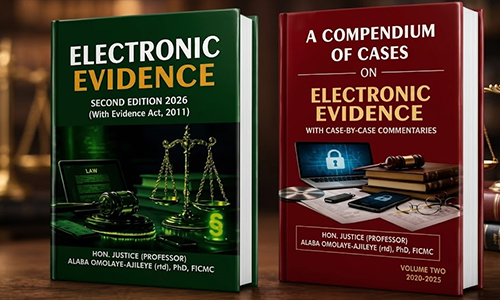

 Interested buyers are encouraged to place their orders and enquiries via:
0704 444 4777, 0704 444 4999, 0818 199 9888
Website: www.alexandernigeria.com
Interested buyers are encouraged to place their orders and enquiries via:
0704 444 4777, 0704 444 4999, 0818 199 9888
Website: www.alexandernigeria.com