*Says “I Chose To Concede While The Counting Was Still Underway, The Will Of The People Must Stand Above The Ambition Of Any One Man”

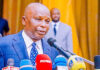
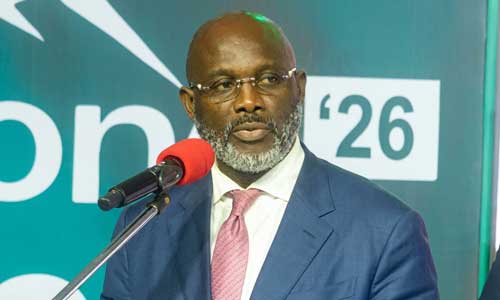
A former President of Liberia, George Weah, has warned that democracy in Africa is endangered not only by military seizures of power but by elected leaders who gradually dismantle the institutions meant to restrain them, telling Nigerian lawyers that “a tyrant with a certificate of return is still a tyrant.”
Weah delivered the keynote address at the opening ceremony of the 66th Annual General Conference of the Nigerian Bar Association, held in Port Harcourt, Rivers State, under the theme “Beyond Limits.”
“Elections Are The Doorway Into Democracy, Not The House Itself”
Opening his address, Weah asked the gathering to observe a moment of silence following a death that morning, before extending greetings to President Bola Ahmed Tinubu, whom he thanked for the reception he had received; the host Governor of Rivers State, Siminalayi Fubara; the Attorney-General of the Federation and Minister of Justice, Chief Lateef Fagbemi; justices and members of the judicial branch; members of the National Assembly; and the leadership and members of the Association.
He gave special recognition to Babatunde Ogala, whom he described as a friend and brother who travelled to Liberia to encourage him to accept the invitation.
He said he was glad to be at the conference of a body with a membership of over 150,000, describing the Association as “the biggest, longest, oldest and one of the most respected professional bodies on our continent.”
Turning to his theme, he said: “Democracy does not survive on the strength of elections alone. Elections are the doorway into democracy, not the house itself. What holds us up? What keeps the roof from collapsing on the people who live inside it? Our institutions.”
He added: “And among the most important of these in every serious nation is an independent judiciary, protected by a fearless, principled bar.”
“A Tyrant With A Certificate Of Return”
Weah then identified what he described as the more dangerous of the two threats to democracy.
“The danger is not only that soldiers might seize power in the night, or that a defeated candidate might refuse to leave office,” he said. “It is also that a leader who arrives in office through free and fair elections can, over time and often gradually, come to govern like the very dictators that ballot was meant to guard against, leaning on the judiciary until it bends to his will and strong-arming the legislature until it becomes an echo chamber rather than a check on his power.”
He then delivered the line that drew one of the loudest reactions of the morning. “A tyrant with a certificate of return is still a tyrant.”
He continued: “Democracy, properly understood, does not end on election night. It is tested every single day after, in how power treats the courts and the parliament that exist to restrain it.”
“Democracy Cannot Survive On Strong Men”
Weah said he had been struck, in preparing his address, by a remark of the Association’s outgoing President.
“Your own outgoing president, Mazi Afam Osigwe, said something not long ago that I found myself nodding at, as though he had seen my own notes before I wrote them. He said democracy cannot survive on strong men. It survives on strong institutions,” he said.
“That sentence deserves to be written above the door of every parliament and every courtroom in West Africa.”
He said the rule of law is not an abstraction. “It is the practical guarantee that a citizen’s rights do not depend on who is in office or what favour they can secure. That a journalist, a trader or a student in Port Harcourt, Monrovia or elsewhere has the same protection under the law as a minister or a general. The moment that guarantee weakens, everything else in a nation weakens with it: investment, security, public trust and peace itself.”
“Budget Manipulations, Wrong Appointments And Pressure On Judges”
Weah said the threat comes as much from governments that call themselves democratic as from coup makers.
“It also comes from governments that call themselves democratic, through budget manipulations, wrong appointments and pressure on judges, and deciding that courts should be a convenience rather than a check,” he said.
He gave examples. “We have seen nations where the judiciary’s own budget must first pass through the executive it is meant to hold accountable. We have seen special courts set up not to deliver justice but to secure political outcomes, and dozens of judges dismissed in a single stroke by presidential decree. And we have seen across our region, since 2020, an unsettling pattern of soldiers stepping over constitutions altogether.”
He cautioned against complacency. “This bar, to which you belong and have gathered here in your thousands, cannot afford to assume that Nigeria, or Liberia, or any of us, is somehow immune.”
He stated the standard plainly. “A court decision must mean what it says without any political permission. It is what protects a nation from sliding gradually and progressively into the very condition we condemn when soldiers do it with guns.”
He described the obligation as binding rather than optional. “That tradition is not a declaration. It is a duty, because protecting the independence of the court and the rights of the ordinary Nigerian citizen is protecting democracy itself, here in Nigeria and across our region.”
“I Chose To Concede While The Counting Was Still Underway”
Weah, who governed Liberia from 2018 until January 2024, used his own defeat to illustrate the point.
“In November 2023, when the early provisional results of our run-off election made clear which way our country had voted, I did not wait for the counts to be completed or for the final result to be formally announced before I picked up the phone to congratulate my successor,” he said.
He recalled the advice he received. “There were those around me who suggested patience, who argued that the sitting president owed it to himself to contest every figure until the very last vote is certified.”
He said he took a different course. “I chose otherwise. I chose to concede while the counting was still under way, because I have always believed and still believe that the will of the people must stand above the ambitions of any one man in the democratic setting.”
He added a warning. “Once elections do not follow democratic precepts, it is very dangerous for the peace and security of any country.”
He thanked the Association for its recognition of that decision. “The invitation spoke directly of that decision, of a leader who chose to put his country before his own ambition. It means a great deal to me, not because I need reminding of what I did, but because it tells me that this bar understands precisely what is at stake when we insist that no office is ever worth more than the peace and the will of the people who confer it.”
He drew the comparison. “If a small nation like mine can insist on that and stand up for itself, then surely this continent, with all its wealth of talent gathered in this very hall today, can stand beyond the limits we have too often assumed for us.”
“Brain Circulation” Rather Than Brain Drain
Turning to the conference theme, Weah said Africa’s limits are not a matter of talent.
“I have never believed that Africa’s limits are a matter of talent. I have stood beside the finest footballers our continent has produced and sat at negotiating tables with heads of state from every corner of the earth. We Africans are not short of brilliance,” he said.
“We are short, too often, of the infrastructure and the organised will to let that brilliance connect with itself.”
He said many Nigerian lawyers had built careers in London, Washington and the Gulf, and that this should not be treated only as loss. “For too long we have called this only a brain drain, as though it is purely a loss. I ask you to think instead about brain circulation, pulling that expertise back into nation building without demanding anyone abandon what they have earned and learned abroad.”
He cited the scale of diaspora contribution. “Our African diaspora already sends home well over 100 billion dollars a year in remittances alone, more than the foreign aid and investment Africa receives combined. Imagine that same energy formally invited into legal reform and judicial modernisation as a deliberate national strategy, because the fight against poor governance and economic deprivation is not one we can afford to enter with half our talents.”
He continued: “A Nigerian-trained lawyer on an arbitration panel in Paris, or advancing a global institution in New York, is not lost talent. It is talent operating at the highest global standard, available to be called home if we organise the bridge for it to cross.”
“I Did Not Come Here As A Lawyer”
Weah spoke of his own background in framing the theme.
“I did not come here as a lawyer, and I would not pretend to be one. I grew up in the ghetto of Gibraltar in Monrovia, Liberia, where very few believed that a boy raised largely by his grandmother would one day stand on the world’s biggest football stages or take an oath as President of the Republic of Liberia,” he said.
He added: “I was told, in many quiet and not so quiet ways, what the limits of my life were supposed to be. I did not accept them, not out of arrogance, but because the limits placed on us by men are not the same as the limits placed on us by God.”
Of the theme, he said: “Beyond Limits, to me, is not a slogan. It is a living testimony of a life. When I first heard it, I smiled, because if my own life has taught me one thing, it is that limits are very often not the walls we think they are. They are only the edge of what someone has tried so far.”
Five Values
Weah set out five values he said are required to break such boundaries.
On discipline, he said: “Discipline is the bridge between goals and accomplishment. In football, talent without discipline gets you benched or cut from the team entirely. In the law, brilliance without discipline leads to compromised justice. Discipline is the quiet commitment to doing what is right, what is necessary and what is ethical, even when no one is watching.”
On hard work, he said: “There are no elevators to success. You must take the steps to push past the barriers of systemic corruption, weak infrastructure or institutional inertia. Your hard work secures the liberties of the common man and fortifies the rule of law.”
On respect, he said: “Respect for the dignity of every human being, for the sanctity of our institutions and for the constitutions that bind us. True leaders do not go beyond limits by tearing others down. We go beyond limits by lifting others up, by respecting diversity of thought and by upholding the integrity of the judicial process.”
On perseverance, he said: “When you push against a limit, the limit pushes back. You will face defeat. I lost elections before I ever won one. I lost matches before I ever raised a trophy. Perseverance is the internal voice that says I will rise again. For the legal profession in Nigeria and across Africa, persevering means standing firm for justice even when the political and social winds blow fiercely against you.”
On spiritual strength, he said: “We must acknowledge a power greater than ourselves. Spiritual strength gives us moral clarity when our choices are blurred. It gives conscience to our intellect and soul to our ambitions, and it reminds us that every position of leadership we hold is a temporary stewardship granted by the Almighty to serve his people.”
“True Justice Is Blind”
Weah told the gathering that Nigeria holds the key to the promise of the continent, and that when its Bar goes beyond limits, “the legal architecture of Africa itself grows stronger.”
He set out what he understands justice to require. “True justice is blind. It does not know politics. It does not see family or friendship. It knows only the truth, and it interprets the law the same way whether or not anyone is watching.”
He put a test to the profession. “The true measure of a lawyer is not how many cases you have won, how many titles you hold or how much you earn. It is this: when the country needs courage, do you have the courage to stand? When justice needs a voice, will you give it one? And when the law itself is threatened, will you go beyond every limit to defend it?”
He added: “The law must never be an instrument of chaos. It must never become a weapon of war. It must remain what it was always meant to be: an instrument of remedy, of peace, of unity and of accountability, an instrument of humanity, of transparency and of truth.”
He invited the lawyers to see themselves as referees. “You must be able to protect the law whether the person before you is rich, poor or powerful. As the law provides, you must be able to stand in defence of those who cannot defend themselves. You must ensure that due process is honoured.”
He closed with a series of appeals. “Nigerians depend on you. West Africa depends on you. Africa depends on you. The world depends on you. Democracy depends on you, and free and fair elections depend on you.”
He ended: “Stand up for the rule of law. Stand up for fairness. Stand up for impartiality. Stand up for gender equality. Stand up for humanity. Stand up for peace and stand up for democracy. Stand up against discrimination. Stand up for accountability. Stand up for free and fair elections. God bless the Nigerian Bar Association, and may God bless our beloved Africa.”
“That Hope Remains To Be Realised”
In his welcome address, the President of the Nigerian Bar Association recalled the decision to shelve the previous year’s conference over the state of emergency in the state, and reflected on the country’s unrealised promise.
“We are reminded that when Nigeria gained independence on October 1st, 1960, there were a lot of hopes that Nigeria was going to be the beacon of Africa. It was going to be like the lighthouse. It was going to guide many African nations to greatness,” he said. “Sixty-six years after, and this is our 66th Annual General Conference, that hope remains to be realised.”
Fubara: “Wherever The Law Is Treated As Sovereign”
Declaring the conference open, the Governor of Rivers State, Siminalayi Fubara, thanked the Association for returning the conference to Port Harcourt following the lifting of the state of emergency, and spoke on the judiciary as a refuge for the common man.
“The ultimate aim of law is to protect and advance citizens’ security and their wellbeing by assuring equity before the law, safeguarding the fundamental human rights of all, and fostering an environment conducive to socio-economic activities and national development,” he said.
He added that meaningful human progress prevails “wherever the law is treated as sovereign.”
CJN On Technology And Artificial Intelligence
The Chief Justice of Nigeria, Hon. Justice Kudirat Kekere-Ekun, represented by the Chief Judge of Rivers State, spoke on the judiciary’s readiness to adapt to a technology-driven world.
“The world in which we practise is changing rapidly. Technology is transforming legal research, case management and the delivery of legal services,” she said. “While artificial intelligence is raising new technical questions, both for the bar and the bench, we must be prepared to understand these developments and use them responsibly.”
Other dignitaries who delivered goodwill messages included the Shehu of Borno, a representative of the Chief of Army Staff, and the President of the Uganda Law Society.
“Order Justice Omolaye-Ajileye’s Electronic Evidence Books Now” — Essential Guides On Evidence Act, Case Law And Digital Proof
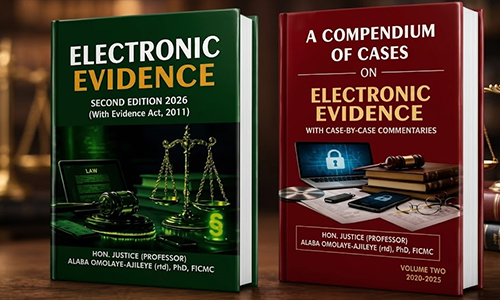
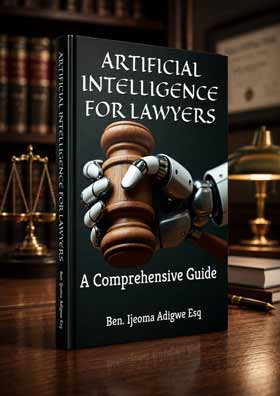 The book also examines Nigeria's legal ecosystem, focusing on the LPELR and NBA AI Guidelines. As a bonus, every purchase comes with a FREE eBook titled: How to Use the AI Features in LegalPedia and LawPavilion.
Ohio Books Ltd praises the publication, stating:
"....this is the only Nigerian book I know of on the topic."
How to Order:
📞 Call, Text, or WhatsApp: 08034917063 | 07055285878
📧 Email: benadigwe1@gmail.com
🌎 Website: www.benadigwe.com
Ebook Version: Access it directly online at https://selar.com/prv626
Authored by Ben Ijeoma Adigwe Esq., ACIarb (UK), LL.M, Dip. in Artificial Intelligence, Director at the Delta State Ministry of Justice, Asaba, Nigeria.
______________________________________________________________________
[A MUST HAVE] Evidence Act Demystified With Recent And Contemporary Cases And Materials
The book also examines Nigeria's legal ecosystem, focusing on the LPELR and NBA AI Guidelines. As a bonus, every purchase comes with a FREE eBook titled: How to Use the AI Features in LegalPedia and LawPavilion.
Ohio Books Ltd praises the publication, stating:
"....this is the only Nigerian book I know of on the topic."
How to Order:
📞 Call, Text, or WhatsApp: 08034917063 | 07055285878
📧 Email: benadigwe1@gmail.com
🌎 Website: www.benadigwe.com
Ebook Version: Access it directly online at https://selar.com/prv626
Authored by Ben Ijeoma Adigwe Esq., ACIarb (UK), LL.M, Dip. in Artificial Intelligence, Director at the Delta State Ministry of Justice, Asaba, Nigeria.
______________________________________________________________________
[A MUST HAVE] Evidence Act Demystified With Recent And Contemporary Cases And Materials

 Interested buyers are encouraged to place their orders and enquiries via:
0704 444 4777, 0704 444 4999, 0818 199 9888
Website: www.alexandernigeria.com
Interested buyers are encouraged to place their orders and enquiries via:
0704 444 4777, 0704 444 4999, 0818 199 9888
Website: www.alexandernigeria.com