*Dismisses Both Appeal and Cross-Appeal


The Court of Appeal, Abuja Division, has affirmed the judgment of the High Court of the Federal Capital Territory dismissing the suit brought by Mr Tobenna Erojikwe seeking to compel the Nigerian Bar Association, the Chairman of its Electoral Committee and the election service provider to release the critical information, documents and databases used in the NBA national elections of July 20, 2024.
The court simultaneously dismissed the NBA’s cross-appeal, rejecting its contentions that the suit was an abuse of court process and that it was premature for failure to exhaust internal remedies.
Judgment was delivered on June 3, 2026, in Appeal No. CA/ABJ/CV/1020/2025 by Hon. Justice Oyejoju Oyebiola Oyewumi, JCA, with Hon. Justice Balkisu Bello Aliyu, JCA, and Hon. Justice Donatus Uwaezuoke Okorowo, JCA, concurring.
The Origin of the Dispute
Erojikwe contested the office of President of the Nigerian Bar Association at the election of July 20, 2024. The ECNBA declared Mazi Afam Josiah Osigwe, SAN, winner with 20,435 votes. Erojikwe emerged first runner-up with 10,998 votes, while Chukwuka Nwabueze Ikwuazom, SAN, polled 9,018 votes.
Alleging breaches and irregularities in the conduct of the election, Erojikwe resolved to conduct an audit to facilitate his right of appeal under the NBA Constitution, and requested a list of documents and databases from the ECNBA and from ElectionBuddy Inc., the Canadian company based in Edmonton that provided the electronic voting software.
By a letter dated July 25, 2024, the request was refused.
The Suit
Erojikwe commenced proceedings at the High Court of the FCT by originating summons dated July 29, 2024, and filed on August 6, 2024, in Suit No. FCT/HC/CV/3493/2024, against the Incorporated Trustees of the NBA, Mr Oluseun Abimbola, SAN, as Chairman of the ECNBA, and ElectionBuddy Inc.
He posed six questions and sought seven reliefs, grounded on Paragraphs 8(c), 8(e) and 8(f) of Part II of the Second Schedule to the NBA Constitution 2015 (as amended in 2021), and Sections 25(b)(ii), (iv), (v) and 30(1)(d) of the Nigeria Data Protection Act 2023.
The reliefs included declarations that he was entitled to the information; that the refusal breached the NBA Constitution; that the refusal was unjustifiable under the NDPA; that the refusal impeded his right of appeal; that his letters disclosed a prima facie case of malpractice; a mandatory injunction compelling immediate release; and a perpetual injunction restraining any obstruction of his right of appeal.
Notably, the declared winner of the election was not joined as a party.
The High Court Decision
On March 27, 2025, Hon. Justice C.O. Agashieze dismissed the originating summons in its entirety and awarded N200,000 costs against the Claimant.
The trial court held that the Claimant “would have been entitled to the information and data requested if he complied with the requirement of consent as provided in both Section 25(1) and 30(1) of the Nigeria Data Protection Act.”
“The Claimant here failed to show evidence of having obtained the consent of the data subjects. Unless and until that is done, he will not be entitled to same, and the decision not to release the said information cannot be construed as a violation of the constitution of the NBA,” the trial court held.
Citing Amasike v. Registrar-General, Corporate Affairs Commission (2010) LPELR-456 (SC), the court applied the principle that “when a statute dictates a certain mode of doing something, then that method and no other must be employed.”
The trial court held that ordering release without consent “would have amounted to a violation of the provisions of the Act,” and that “the court cannot command the doing of an illegality or an action that constitutes a violation of an existing law.”
On the questions concerning his right of appeal and the existence of a prima facie case of malpractice, the trial court held both to be academic, citing Nnaemeka & Ors v. Onwe & Anor (2024) LPELR-62695 (CA).
It also declined to make findings on alleged breaches because the declared winner had not been joined, citing Jegede v. INEC (2021) LPELR-55481 (SC): “A court has no jurisdiction to make any order against the interest of any person unless he is made a party. Where there is brazen and far-reaching allegation of infraction against a party, that party must be heard; the adversary will not be allowed to dig a hole around the party, so doing will amount to setting a trap or laying ambush in litigation.”
The court cited Ugwumba Uche Nwosu v. APP (2020) 16 NWLR (Pt. 1749) 28 for the proposition that “any act not authorised by law is an illegality and the law insists that a court should never allow itself to be used as a vehicle or an instrument to enforce an illegality.”
On the mandatory injunction, the trial court applied Unity High School & Anor v. Hon. Minister of the FCT & Ors (2023) LPELR-61059 (CA) and Attorney-General Anambra State v. Okafor (1992) 2 NWLR (Pt. 224) 396, holding that none of the conditions had been established, and observing: “There was no order of court disobeyed, neither was there an attempt to steal a march on the Claimant by the Defendants. Rather, the 1st and 2nd Defendants only maintained their stand on the provisions of the law and declined to grant a request that was made to them, basing their actions on the provisions of the law and the protection of the rights of the data subjects.”
On perpetual injunction, it applied Goldmark (Nig) Ltd & Ors v. Ibafon Co. Ltd (2012) LPELR-9349 (CA), holding that as the Claimant had established no entitlement, “there is therefore nothing to protect.”
THE MAIN APPEAL
“Or” Is Disjunctive, but Words Derive Colour From Context
Erojikwe’s principal argument on appeal was that Section 25 of the NDPA employs the word “or,” making consent merely one of several alternative lawful bases for processing personal data, and that his request was justified under legitimate interest, legal obligation and public interest grounds.
Justice Okorowo, JCA, accepted the linguistic point but rejected its consequence.
“There is considerable force in the submission that the word ‘or’ appearing in Section 25(1) is ordinarily disjunctive,” he held, citing Abubakar v. INEC (2020) 12 NWLR (Pt. 1737) 37, A.G. Federation v. Abubakar (2007) 10 NWLR (Pt. 1041) 1, and NDPHC v. Lutin Investments Ltd (2021) 8 NWLR (Pt. 1779) 1.
“However, statutory interpretation is not a mechanical exercise. Words derive colour from context. The duty of the Court is to ascertain legislative intention from the statute read as a whole,” he held, citing Mobil Oil (Nig.) Ltd v. FBIR (1977) 3 SC 97, A.G. Bendel State v. A.G. Federation (1981) 10 SC 1, and Saraki v. FRN (2016) 3 NWLR (Pt. 1500) 531.
“The NDPA is a rights-protective statute enacted to safeguard privacy, informational autonomy and the integrity of personal data. This being the reason for the enactment, the Court must therefore adopt a purposive construction which advances those objectives,” the court held.
What the Requested Data Would Have Revealed
The court then examined, category by category, what the disclosure sought would expose.
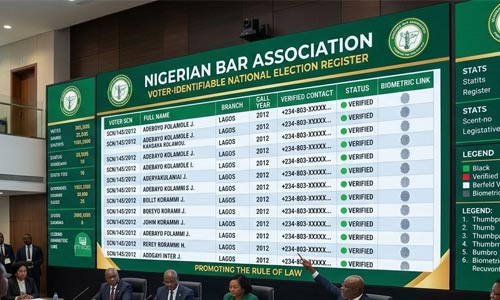
“Voter identities would directly disclose the persons who participated in the election. Voting activity records could reveal whether, when and how particular individuals exercised voting rights. Voter verification records could expose personal identifiers utilised during authentication and accreditation. Electoral databases may contain personal particulars of eligible voters, including names, contact details and membership information. Transaction logs and audit trails could permit reconstruction of voting patterns and, in certain circumstances, facilitate identification of individual voting behaviour,” the court held.
“When viewed cumulatively, these categories of information create a substantial risk of exposing the electoral choices of identifiable persons.”
“The NDPA Cannot Be Interpreted in a Manner That Destroys the Very Privacy Interests It Was Enacted to Protect”
The court accepted the Respondents’ contention that disclosure would compromise ballot secrecy.
“The secrecy of the ballot is one of the foundational principles of democratic elections. Whether in public elections or elections conducted within professional associations, confidence in the electoral process depends substantially upon the assurance that individual voting choices will not be exposed to public scrutiny. The NDPA cannot be interpreted in a manner that destroys the very privacy interests it was enacted to protect,” the court held.
Section 30 Imposes Additional Safeguards
The court identified what it described as the critical feature overlooked in the appellant’s argument.
“Section 30 specifically regulates sensitive personal data and imposes additional safeguards. Of particular significance is Section 30(1)(d)(ii), which expressly provides that sensitive personal data shall not be disclosed outside the entity without the explicit consent of the data subject,” the court held.
“While legitimate interest may constitute a lawful basis under Section 25, it does not automatically override the safeguards prescribed under Section 30. The statute must be read holistically,” the court held, citing Nafiu Rabiu v. Kano State (1980) 8-11 SC 130 and Skye Bank Plc v. Iwu (2017) 16 NWLR (Pt. 1590) 24.
The Four-Part Test
The court then laid down what an applicant must establish where the disclosure sought could reveal individual voting behaviour.
“In my view, where disclosure sought would reveal or facilitate identification of individual voting behaviour, lawful basis alone is insufficient. The applicant must additionally satisfy the Court that: disclosure is strictly necessary; the objective cannot be achieved through less intrusive means; adequate safeguards exist; and the privacy rights of affected persons are protected,” the court held.
“The Appellant failed to establish these requirements. Indeed, the request was framed in terms broad enough to expose identifiable voter information. The Court cannot sanction such disclosure merely because an election candidate wishes to audit an election.”
“Anonymised or Aggregated Information”
Critically for future election audits, the court indicated where the line lies.
“The proper balance lies in disclosure of anonymised or aggregated information where appropriate, not disclosure of voter-identifiable databases,” the court held.
“Talismanic Phrases”
The court warned against the reflexive invocation of statutory language.
“Although the lawful bases enumerated under Section 25 are framed disjunctively, their application in circumstances involving highly sensitive personal information must be read together with the requirements of necessity, proportionality, accountability, data minimisation and appropriate safeguards embedded throughout the Act. A party relying on legitimate interest or legal obligation cannot simply invoke those expressions as talismanic phrases to override the privacy rights of data subjects,” the court held.
Ballot Secrecy Beyond the Statute
The court went further, locating a democratic principle beyond the NDPA itself.
“Beyond the statutory protection afforded by the NDPA, there is the broader democratic principle of ballot secrecy. The secret ballot exists to protect voters from intimidation, coercion, retaliation, ostracisation and other forms of undue influence. The disclosure of voter-identifiable records after an election may encourage witch-hunting, factional reprisals and institutional division,” the court held.
“Courts must therefore exercise exceptional caution before compelling disclosure of information capable of revealing individual voting choices. The preservation of confidence in electoral processes requires that voters remain assured that their choices will not subsequently become the subject of public scrutiny.”
The Trial Judge Was Wrong on Consent, but Right on the Result
In a significant qualification, the Court of Appeal corrected the trial court’s reasoning while upholding its conclusion.
“I therefore hold that, although the learned trial Judge may have overstated the role of consent by treating it as invariably mandatory under Section 25, the ultimate decision to refuse disclosure was correct. The decision of a Court will not be disturbed merely because the reasons are imperfect if the conclusion itself is correct,” the court held, citing Ndayako v. Dantoro (2004) 13 NWLR (Pt. 889) 187 and Oredoyin v. Arowolo (1989) 4 NWLR (Pt. 114) 172.
THE CROSS-APPEAL
The NBA cross-appealed, contending that the suit constituted an abuse of court process because Erojikwe had earlier lodged a complaint before the National Officers Election Appeal Committee, and that the action was premature for failure to exhaust internal remedies.
“A Complaint Before the Committee Cannot Amount to a Suit”
The court set out the settled ingredients of abuse of process, citing A.C.B. Plc v. Nwaigwe & Ors (2011) LPELR-208 (SC), Saraki v. Kotoye (1992) 9 NWLR (Pt. 264) 156, and the recent decision in Nwankwo v. Kay-Kay Construction Ltd (2026) LPELR-83060 (SC), per Sankey, JSC.
It then rejected the NBA’s contention outright.
“The proceedings before the National Officers Election Appeal Committee cannot, by any stretch of legal reasoning, be equated with proceedings before a court of law. The said Committee is merely an internal dispute resolution mechanism established under the Constitution of the NBA for the resolution of electoral grievances within the Association. It is not vested with the constitutional status, powers, or authority of a court established under the Constitution of the Federal Republic of Nigeria,” the court held.
“Consequently, a complaint lodged before such a Committee cannot amount to a ‘suit’ for the purpose of determining whether there exists multiplicity of actions capable of constituting an abuse of court process.”
Different Reliefs, Different Powers
The court also distinguished the reliefs.
“The substance of the action before the lower Court was principally to compel the release of electoral materials and relevant data allegedly required by the 1st Cross-Respondent to effectively pursue his electoral grievance. Such reliefs, particularly those requiring coercive judicial orders against the Cross-Appellant and other Respondents, were matters which only a court of competent jurisdiction could competently grant. The Election Appeal Committee lacked the coercive powers and constitutional authority to make such binding judicial pronouncements,” the court held.
“For such abuse to arise, the parallel proceedings complained of must be pending before two courts of coordinate or competent jurisdiction. That is clearly not the situation in the present case.”
“Conditions Precedent Are Not to Be Implied”
On the exhaustion of internal remedies, Justice Okorowo, JCA, was equally firm.
“The record shows that he had approached the NBA Election Appeal Committee before instituting the action and that the Committee ultimately deferred to the jurisdiction of the High Court. More importantly, no provision of the NBA Constitution has been brought to the Court’s attention making the exhaustion of internal remedies a condition precedent to judicial intervention. Conditions precedent are not to be implied; they must be expressly stated,” he held, citing Eguamwense v. Amaghizemwen (1993) 9 NWLR (Pt. 315) 1 and Nigercare Dev. Co. Ltd v. Adamawa State Water Board (2008) 9 NWLR (Pt. 1093) 498.
The Orders
“In the final analysis, it is plain from all the foregoing that the Main Appeal fails and the Cross Appeal equally fails. Parties are to bear their costs,” Justice Oyewumi, JCA, held.
Justice Balkisu Bello Aliyu, JCA, concurred, adopting the lead judgment “in toto” and affirming the judgment of the trial High Court.
Justice Donatus Uwaezuoke Okorowo, JCA, agreed with the reasoning and conclusions in both the main appeal and the cross-appeal, delivering the detailed concurring reasoning on the NDPA construction set out above.
Why It Matters
The decision is the most authoritative Nigerian pronouncement yet on the tension between a candidate’s desire to audit an electronic election and the privacy rights of the voters whose data such an audit would expose.
It establishes that a losing candidate has no automatic entitlement to voter-identifiable electoral databases; that Section 25 of the NDPA, though disjunctive in form, must be read alongside the additional safeguards in Section 30 where sensitive personal data is involved; that legitimate interest cannot be invoked as a talisman; that ballot secrecy applies to professional association elections as it applies to public elections; and that where an audit is genuinely required, the appropriate remedy is anonymised or aggregated data rather than records capable of identifying how individuals voted.
CTC of Judgement Tobenna vs NBA
Judgement Mr. Tobenna V The Incorporated Trustees of the Nigeria Bar Association
It also settles two procedural questions in favour of aggrieved candidates: that recourse to an internal election appeal committee does not bar a subsequent action in court, and that unless the association’s constitution expressly makes internal remedies a condition precedent, none will be implied.
Appearances
Okechukwu Umemuo, with Mana Phar, appeared for the Appellant. Abdul Mohammed, SAN, with Abusufyanu Abubakar and Isaac O. Akwu, appeared for the 1st Respondent/Cross-Appellant. C.O. Ogbu, Esq., with G.O. Onwuchukwa, appeared for the 2nd Respondent.
Judgment was delivered on June 3, 2026, in Appeal No. CA/ABJ/CV/1020/2025 by the Court of Appeal, Abuja Division.
Get up to 20% off selected LAWBREED Supreme Court Reports, plus access to My S.C Extra, featuring Supreme Court judgments from 1972 to date. Call/WhatsApp: 08077011741 | 08077011755 | 08077011730 | 08023269613 Email: orders@lawbreed.com | mails@lawbreed.com
 LAWBREED — Equipping You For Greater Success!
______________________________________________________________________
“Enhance Legal Practice With Authoritative Reports” — Alexander Payne Offers Comprehensive Law Reports, Spanning Over A Century Of Nigerian Jurisprudence
LAWBREED — Equipping You For Greater Success!
______________________________________________________________________
“Enhance Legal Practice With Authoritative Reports” — Alexander Payne Offers Comprehensive Law Reports, Spanning Over A Century Of Nigerian Jurisprudence
 Interested buyers are encouraged to place their orders and enquiries via:
0704 444 4777, 0704 444 4999, 0818 199 9888
Website: www.alexandernigeria.com
Interested buyers are encouraged to place their orders and enquiries via:
0704 444 4777, 0704 444 4999, 0818 199 9888
Website: www.alexandernigeria.com

 The book also examines Nigeria's legal ecosystem, focusing on the LPELR and NBA AI Guidelines. As a bonus, every purchase comes with a FREE eBook titled: How to Use the AI Features in LegalPedia and LawPavilion.
Ohio Books Ltd praises the publication, stating:
"....this is the only Nigerian book I know of on the topic."
How to Order:
📞 Call, Text, or WhatsApp: 08034917063 | 07055285878
📧 Email: benadigwe1@gmail.com
🌎 Website: www.benadigwe.com
Ebook Version: Access it directly online at https://selar.com/prv626
Authored by Ben Ijeoma Adigwe Esq., ACIarb (UK), LL.M, Dip. in Artificial Intelligence, Director at the Delta State Ministry of Justice, Asaba, Nigeria.
_______________________________________________________________________
The book also examines Nigeria's legal ecosystem, focusing on the LPELR and NBA AI Guidelines. As a bonus, every purchase comes with a FREE eBook titled: How to Use the AI Features in LegalPedia and LawPavilion.
Ohio Books Ltd praises the publication, stating:
"....this is the only Nigerian book I know of on the topic."
How to Order:
📞 Call, Text, or WhatsApp: 08034917063 | 07055285878
📧 Email: benadigwe1@gmail.com
🌎 Website: www.benadigwe.com
Ebook Version: Access it directly online at https://selar.com/prv626
Authored by Ben Ijeoma Adigwe Esq., ACIarb (UK), LL.M, Dip. in Artificial Intelligence, Director at the Delta State Ministry of Justice, Asaba, Nigeria.
_______________________________________________________________________
“Order Justice Omolaye-Ajileye’s Electronic Evidence Books Now” — Essential Guides On Evidence Act, Case Law And Digital Proof