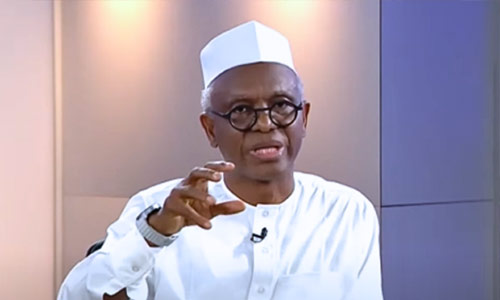
Former Kaduna State Governor Nasir El-Rufai has rejected allegations by the Independent Corrupt Practices and Other Related Offences Commission (ICPC) that he abused medical privileges or violated a court order while in custody, issuing a detailed seven-point rebuttal through his media aide, Muyiwa Adekeye, accusing the anti-graft agency of misrepresenting both facts and law, demanding the retraction of the ICPC’s July 7, 2026, publication, and threatening immediate contempt proceedings if the commission restricts his access to medical care, family, or legal counsel.
The statement, dated July 8, 2026, was issued in response to the ICPC’s publication titled “El-Rufai and Medical Doctor Abuse Privilege, Violate Court Order,” which the defence described as resting “on an incomplete and, in material respects, inaccurate account of the proceedings before 6th July and on that day, and of the circumstances of the medical visit that followed.”
The defence gave a detailed account of the events leading to El-Rufai’s non-appearance before the court in Kaduna on July 6, 2026, directly contradicting the ICPC’s narrative.
According to the statement, during the preceding week, Professor Bello Abubakar, El-Rufai’s personal physician, came to the ICPC facility to examine him, “having first spoken with the ICPC’s own attending doctor regarding the request.” However, despite the prior coordination, Professor Abubakar “was kept waiting for over two hours and was ultimately not permitted to see his patient.”
Following that denial, the family formally requested in writing that El-Rufai be taken to the National Hospital, Abuja, to see Professor Abubakar for a consultation at 5:00 PM on Tuesday, July 7, 2026.
“The ICPC conveyed that request for consultation to the National Hospital several days before any family member was informed of a proposed court sitting in Kaduna on 6th July,” the statement disclosed.
The defence stated that each step in this sequence fell within El-Rufai’s entitlement to medical access secured by the standing order of Justice R.M. Aikawa dated April 1, 2026, in Charge No. FHC/KD/73C/2026. It was against this background, “an unresolved medical need, a documented denial of access to his physician the week before, and Malam El-Rufai’s continuing ill health,” that the trip to Kaduna became untenable.
The statement directly challenged the ICPC’s account that El-Rufai “reportedly indicated that he had no immediate medical complaints” and that the request to see his doctor was linked to his wife’s request rather than genuine medical need.
“On the record, the ICPC’s own personnel had known, for a week, of the outstanding request for Malam El-Rufai to see Professor Abubakar, of the earlier denial of that access, and of the family’s already-approved arrangement for a hospital visit on 7th July — all of it predating, and independent of, any awareness of a court date,” the defence stated.
“The suggestion that he had ‘no immediate medical complaints’ on 6th July, or that the request to see his doctor was devised to avoid court, is accordingly untrue,” the statement declared.
The defence disclosed what occurred in court on July 6 when the prosecution attempted to present its version of events.
“In open court on 6th July, the prosecution sought to place this same account before the court from the Bar — that is, as submissions of counsel rather than sworn testimony — in support of an application that the trial proceed in Malam El-Rufai’s absence. No witness was called and no evidence was tendered in support of the application,” the statement recounted.
“When the defence objected on the basis that evidence of this nature could only properly be given on oath and tested by cross-examination, and asked that the prosecution enter the witness box to have the account formally tested, the prosecution declined to do so,” the defence stated.
The court subsequently adjourned the matter to July 15, 2026, to hear El-Rufai’s recusal application and to await the Chief Judge’s directive on a pending transfer petition dated June 30, 2026.
The defence stated that the ICPC’s claim that the medical visit constituted “a clear violation of the court order” was legally unsupported.
“No such order is identified — not its date, its forum, or its terms,” the statement challenged.
The defence identified the only relevant order as that of Justice Aikawa dated April 1, 2026, which directs that El-Rufai be afforded access to medical care in custody. “That order does not regulate, restrict, or impose conditions on who may see or be seen by him while that access is being exercised,” the statement stated.
“The ICPC’s suggestion that this order was ‘violated’ by his being seen by other persons at the hospital misstates the order’s terms. The order requires the ICPC’s compliance, and should not be construed as a restriction upon the defendant,” the defence argued.
The defence provided a detailed counter-narrative of the hospital visit that directly challenges the ICPC’s characterisation of it as a staged political meeting.
The family’s request, as approved by the ICPC, was for a consultation at 5:00 PM on July 7, described as “a quiet period at the hospital.” However, the ICPC “unilaterally rescheduled the consultation to 10:00 AM the same day, a materially busier period, and did not inform the family of the change until the morning of the visit itself.”
After the consultation with Professor Abubakar in a private consultation room, El-Rufai “remained in a public area of the hospital’s private wing for approximately one hour while awaiting a written medical report — a report the ICPC itself required before he could be returned to custody.”
The defence stated that some people became aware of his expected presence and requested to see him, while others “merely encountered him as he waited for his medical report” and approached for greetings, “as often happens when a prominent person is sighted.”
“The ICPC’s narrative that this visit was converted into a political meeting takes no account of its own conduct. It was the Commission that moved the appointment from a quiet 5:00 PM slot to a high-traffic 10:00 AM slot, without notice to the family until that morning, and it was the Commission’s own personnel who were stationed at the scene throughout,” the defence stated.
“A narrative of political theatre engineered by the defence is not supported by a sequence in which the Commission itself selected the time, controlled the access, and had its own officers present,” the statement concluded on this point.
The defence objected to the ICPC’s characterisation of its accommodation of El-Rufai’s medical needs as “professional courtesies” and “goodwill” that it would no longer extend.
“Access to necessary medical care, including consultation with a physician of one’s choosing, is not a matter of institutional discretion,” the defence stated.
The statement invoked the United Nations Standard Minimum Rules for the Treatment of Prisoners (the Nelson Mandela Rules): Rule 24, which provides that prisoners should enjoy the same standard of health care available in the community without discrimination arising from their legal situation; Rule 27, which requires prompt access to medical treatment in urgent cases; and Rule 32, which provides that the physician-patient relationship in custody is governed by the same ethical and professional standards applicable to patients in the community, including confidentiality.
“Access to one’s own physician and to medical privacy are protections due to any person in custody, not concessions revocable at the ICPC’s discretion,” the defence stated.
The statement issued a direct warning: “The ICPC is certainly aware that any further restriction of his access to medical care, family, or legal counsel will be treated as a breach of that order. Malam El-Rufai’s counsels will meet any such breach with an immediate application to commit the ICPC for contempt, in addition to such other reliefs as may be appropriate for the enforcement of his fundamental rights.”
The defence demanded that the ICPC provide specific particulars of the allegation against Professor Bello Abubakar, who was arrested following his attendance on El-Rufai.
“We call on the ICPC to state, with specificity: what statement is alleged to be false; whether it was made orally or in writing, and to whom; the date and context in which it was made; and whether the Professor was afforded the statutory cautions before his arrest,” the statement demanded.
“In the absence of such particulars, the arrest of a treating physician immediately following his attendance on a patient in ICPC custody raises serious questions as to its basis,” the defence stated.
The statement called for “Professor Abubakar’s immediate and unconditional release pending the ICPC’s disclosure of the specific allegation against him.”
The defence directly addressed the ICPC’s threat to bring El-Rufai’s alleged “flagrant disobedience of court orders” to the attention of the courts.
“No order has been disobeyed. The only order bearing on this subject, the 1st April 2026 order of Justice Aikawa, entitles Malam El-Rufai to medical care; it has been complied with, not disobeyed, and it is not the order the ICPC purports to invoke against him,” the defence stated.
The defence concluded by calling on the ICPC to retract its statement “insofar as it asserts a breach of a court order.”
“The sequence of events does not support the inference that the medical visit was used to stage a political meeting. Malam El-Rufai will continue to assert his right to a fair trial, his right to medical care of his choosing under the order of Justice Aikawa and the Nelson Mandela Rules, and his right to be treated in accordance with the standards guaranteed by law,” the statement concluded.
The statement was signed on July 8, 2026, by Muyiwa Adekeye, Media Adviser to former Governor Nasir El-Rufai.
 The book also examines Nigeria's legal ecosystem, focusing on the LPELR and NBA AI Guidelines. As a bonus, every purchase comes with a FREE eBook titled: How to Use the AI Features in LegalPedia and LawPavilion.
Ohio Books Ltd praises the publication, stating:
"....this is the only Nigerian book I know of on the topic."
How to Order:
📞 Call, Text, or WhatsApp: 08034917063 | 07055285878
📧 Email: benadigwe1@gmail.com
🌎 Website: www.benadigwe.com
Ebook Version: Access it directly online at https://selar.com/prv626
Authored by Ben Ijeoma Adigwe Esq., ACIarb (UK), LL.M, Dip. in Artificial Intelligence, Director at the Delta State Ministry of Justice, Asaba, Nigeria.
_______________________________________________________________________
“Enhance Legal Practice With Authoritative Reports” — Alexander Payne Offers Comprehensive Law Reports, Spanning Over A Century Of Nigerian Jurisprudence
The book also examines Nigeria's legal ecosystem, focusing on the LPELR and NBA AI Guidelines. As a bonus, every purchase comes with a FREE eBook titled: How to Use the AI Features in LegalPedia and LawPavilion.
Ohio Books Ltd praises the publication, stating:
"....this is the only Nigerian book I know of on the topic."
How to Order:
📞 Call, Text, or WhatsApp: 08034917063 | 07055285878
📧 Email: benadigwe1@gmail.com
🌎 Website: www.benadigwe.com
Ebook Version: Access it directly online at https://selar.com/prv626
Authored by Ben Ijeoma Adigwe Esq., ACIarb (UK), LL.M, Dip. in Artificial Intelligence, Director at the Delta State Ministry of Justice, Asaba, Nigeria.
_______________________________________________________________________
“Enhance Legal Practice With Authoritative Reports” — Alexander Payne Offers Comprehensive Law Reports, Spanning Over A Century Of Nigerian Jurisprudence
 Interested buyers are encouraged to place their orders and enquiries via:
0704 444 4777, 0704 444 4999, 0818 199 9888
Website: www.alexandernigeria.com
Interested buyers are encouraged to place their orders and enquiries via:
0704 444 4777, 0704 444 4999, 0818 199 9888
Website: www.alexandernigeria.com