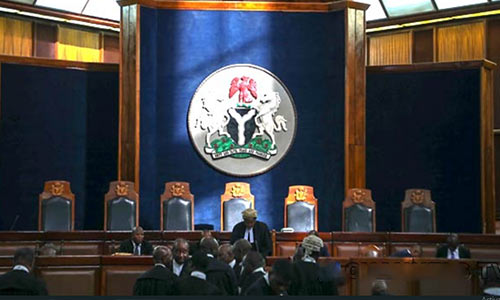
The Supreme Court has ordered the Chief Registrar of the Court of Appeal and the Admiralty Marshal to immediately release the crude oil aboard the FPSO Tamara Tokoni to General Hydrocarbons Limited, holding that the dispute between the company and First Bank of Nigeria is contractual in nature and not an admiralty matter.

In a unanimous judgment delivered on Friday, a five-member panel of the apex court allowed the appeal filed by General Hydrocarbons and set aside the decision of the Court of Appeal, which had ordered the seizure and preservation of the crude cargo.
The panel held that the Federal High Court and the Court of Appeal lacked jurisdiction to entertain the suit as an admiralty action, since the substance of the dispute arose from financing, loan, collateral and contractual arrangements between the parties.
The justices who sat on the appeal were Justices Uwani Musa Abba Aji, Adamu Jauro, Mohammed Lawal Garba, Tijjani Abubakar and Habeeb Adewale Abiru, who read the lead judgment.
The Supreme Court directed that the crude oil aboard the floating production, storage and offloading vessel be handed over to General Hydrocarbons forthwith and without delay.
The ruling effectively overturns earlier orders obtained by First Bank in relation to the crude cargo, including the Court of Appeal’s decision directing that the oil be preserved and, at a point, sold with the proceeds kept in an interest-bearing escrow account under the custody of the Chief Registrar of the Court of Appeal.
The dispute arose from a commercial financing arrangement linked to Oil Mining Lease 120, held by General Hydrocarbons, a company chaired by media entrepreneur Nduka Obaigbena.
Under a 2021 project finance and subrogation agreement, First Bank was said to have provided funding for the exploration and development of the asset, with the parties allegedly entering into an arrangement designed to address legacy non-performing exposure connected to earlier oil and gas transactions.
First Bank claimed that General Hydrocarbons defaulted on its obligations and owed the bank about $225.8 million. The bank also alleged that proceeds from crude oil sales, said to have been pledged as collateral, were diverted.
General Hydrocarbons denied the allegations and maintained that First Bank breached the funding agreement by failing to properly finance the development of the asset. The company also pursued counterclaims reportedly exceeding $1 billion before different legal forums.
As the dispute escalated, First Bank approached the Federal High Court under admiralty jurisdiction, seeking to arrest and preserve the crude oil stored aboard the FPSO Tamara Tokoni.
The bank’s position was that the cargo, being aboard a maritime vessel, could be treated as the res in an admiralty action and preserved by the Admiralty Marshal pending the resolution of the dispute.
General Hydrocarbons objected, arguing that the real issue between the parties was a commercial debt and contractual disagreement, not a maritime claim.
The company maintained that First Bank invoked the wrong legal procedure and that the lower courts lacked jurisdiction to treat the matter as an admiralty action merely because the crude oil was stored aboard an FPSO.
The Supreme Court agreed with General Hydrocarbons.
The apex court held that a contractual dispute cannot be converted into an admiralty matter simply because the asset in contention is crude oil located on a vessel.
By setting aside the Court of Appeal’s judgment and ordering the release of the crude cargo, the Supreme Court restored control of the oil to General Hydrocarbons and removed it from the custody created by the lower court orders.
The decision is significant because it reinforces the principle that courts must first possess proper subject-matter jurisdiction before making orders affecting assets or property.
It also draws a clear distinction between admiralty claims, which fall within maritime jurisdiction, and ordinary commercial disputes arising from loan, finance, collateral or contractual arrangements.
The broader disagreement between First Bank and General Hydrocarbons is linked to a long-running dispute over oil assets, legacy debts, alleged non-performing loans, AMCON-related recovery efforts, arbitration proceedings and competing claims over liabilities arising from earlier transactions connected to Atlantic Energy Drilling Concepts.
Reports indicate that Atlantic Energy, chaired by Jide Omokore, had obtained substantial credit facilities from First Bank in 2011 to finance oil asset operations involving Forcados-related assets and strategic alliance arrangements with the Nigerian Petroleum Development Company.
The facilities later became non-performing, and First Bank reportedly wrote off a major portion of the exposure in 2019.
General Hydrocarbons later became involved in efforts said to be aimed at resolving part of the bank’s legacy exposure, leading to further agreements among First Bank, AMCON and General Hydrocarbons.
However, the relationship deteriorated, resulting in court cases, arbitral proceedings, receivership moves and disputes over whether General Hydrocarbons remained liable to the bank or whether First Bank had breached its own funding obligations.
At different stages, AMCON and a receiver-manager also became involved in attempts to enforce recovery actions against General Hydrocarbons, but some of those steps were challenged before the Federal High Court.
In one of the related proceedings, the Federal High Court in Lagos restrained AMCON and others from appointing or enforcing a receiver over General Hydrocarbons and its assets.
Another Federal High Court later struck out proceedings connected to the receivership on the ground that they amounted to an abuse of court process in view of an existing restraining order.
Although an arbitral tribunal had reportedly awarded certain legal and arbitration costs against General Hydrocarbons, the Supreme Court’s latest decision specifically concerns the jurisdictional question and the legality of treating the crude oil aboard FPSO Tamara Tokoni as the subject of an admiralty action.
With the apex court’s ruling, First Bank’s admiralty route has collapsed, while the underlying contractual, financial and arbitral disputes between the parties may continue in the appropriate legal forums.
The judgment is expected to have wider implications for lenders, oil companies and asset recovery proceedings, especially where parties seek to use admiralty jurisdiction to secure assets arising from commercial finance disputes.
 Interested buyers are encouraged to place their orders and enquiries via:
0704 444 4777, 0704 444 4999, 0818 199 9888
Website: www.alexandernigeria.com
Interested buyers are encouraged to place their orders and enquiries via:
0704 444 4777, 0704 444 4999, 0818 199 9888
Website: www.alexandernigeria.com

 The book also examines Nigeria's legal ecosystem, focusing on the LPELR and NBA AI Guidelines. As a bonus, every purchase comes with a FREE eBook titled: How to Use the AI Features in LegalPedia and LawPavilion.
Ohio Books Ltd praises the publication, stating:
"....this is the only Nigerian book I know of on the topic."
How to Order:
📞 Call, Text, or WhatsApp: 08034917063 | 07055285878
📧 Email: benadigwe1@gmail.com
🌎 Website: www.benadigwe.com
Ebook Version: Access it directly online at https://selar.com/prv626
Authored by Ben Ijeoma Adigwe Esq., ACIarb (UK), LL.M, Dip. in Artificial Intelligence, Director at the Delta State Ministry of Justice, Asaba, Nigeria.
_______________________________________________________________________
The book also examines Nigeria's legal ecosystem, focusing on the LPELR and NBA AI Guidelines. As a bonus, every purchase comes with a FREE eBook titled: How to Use the AI Features in LegalPedia and LawPavilion.
Ohio Books Ltd praises the publication, stating:
"....this is the only Nigerian book I know of on the topic."
How to Order:
📞 Call, Text, or WhatsApp: 08034917063 | 07055285878
📧 Email: benadigwe1@gmail.com
🌎 Website: www.benadigwe.com
Ebook Version: Access it directly online at https://selar.com/prv626
Authored by Ben Ijeoma Adigwe Esq., ACIarb (UK), LL.M, Dip. in Artificial Intelligence, Director at the Delta State Ministry of Justice, Asaba, Nigeria.
_______________________________________________________________________