Two of Nigeria’s most eminent legal scholars, Professor Alex A. Izinyon, OFR, SAN, and Professor Dakas C.J. Dakas, SAN, will review two important scholarly works authored by distinguished jurist, legal scholar, and forensic expert, Justice (Prof.) Alaba Omolaye-Ajileye, at a public presentation scheduled for Thursday, July 2, 2026, at the Conference Centre, National Open University of Nigeria (NOUN), Abuja.

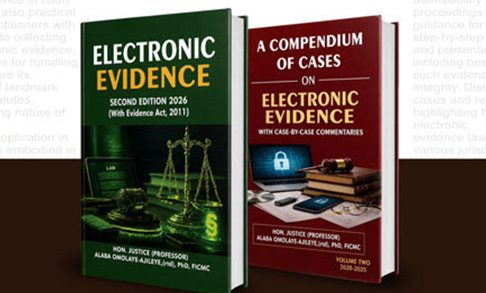
The event will feature the review and public presentation of “Electronic Evidence” (Second Edition, 2026) and “A Compendium of Cases on Electronic Evidence, Volume Two (2020-2025),” both addressing the increasingly complex and consequential field of digital evidence in Nigerian courts. The occasion will also witness the formal launch of the Justice Alaba Omolaye-Ajileye Educational Foundation for Indigent Students.
Professor Izinyon, OFR, SAN, is widely respected as one of Nigeria’s foremost legal academics and advocates, with an outstanding record of contributions to legal education, arbitration, forensic advocacy, and jurisprudence. His scholarship and decades of experience at the Bar and in academia have earned him the Officer of the Federal Republic (OFR) national honour.
Professor Dakas, SAN, currently serves as Chairman of the Nigerian Law Reform Commission and is internationally acclaimed for his scholarship in constitutional law, governance, public policy, and legal reform. His role as reviewer is expected to bring unique insights into how the law must adapt to technological change, drawn from his extensive experience leading Nigeria’s law reform institution.
Their reviews are expected to provide critical scholarly perspectives on the works while stimulating broader conversations about the intersection of technology, forensic investigation, judicial decision-making, and the administration of justice.
Justice Omolaye-Ajileye’s “Electronic Evidence” remains one of the pioneering Nigerian texts on the admissibility, authentication, evaluation, and evidential weight of electronically generated materials. Since its first publication, the work has become an indispensable reference for judges, legal practitioners, investigators, academics, and students navigating the terrain of digital evidence in Nigerian courts.
The Second Edition, published in 2026, updates and expands the original work to reflect rapid developments in technology and the corresponding evolution in judicial treatment of electronic evidence. As Nigerian courts deal with an ever-expanding universe of digital materials, from emails, text messages, and social media posts to CCTV footage, biometric data, electronic financial records, and computer-generated documents, the need for a comprehensive, authoritative, and practical guide to the law governing such evidence has never been more acute.
The companion volume, “A Compendium of Cases on Electronic Evidence, Volume Two (2020-2025),” compiles and analyses recent judicial decisions that have shaped the law relating to electronic evidence in Nigeria over a five-year period that encompasses significant judicial activity in the digital evidence space, driven in part by the increased digitalisation of transactions, communications, and record-keeping during and after the COVID-19 pandemic.
The event will also witness the formal launch of the Justice Alaba Omolaye-Ajileye Educational Foundation for Indigent Students, a charitable initiative established to provide educational support and opportunities for academically promising but financially disadvantaged students.
The foundation is inspired by Justice Omolaye-Ajileye’s lifelong commitment to learning, mentorship, social justice, and human capital development. The initiative seeks to ensure that talented young Nigerians are not denied access to quality education because of financial constraints.
The simultaneous presentation of the books and launch of the foundation has been described as “a fitting convergence of scholarship and service,” pairing intellectual accomplishment with educational philanthropy in recognition that the knowledge produced through academic work should create pathways for others to follow, particularly those whose talent exceeds their financial means.
The event comes at a moment when the importance of electronic evidence in Nigerian legal proceedings has never been greater. From the EFCC’s reliance on digital financial records in economic crimes prosecutions, to the use of electronic evidence in election petitions, to the growing volume of cybercrime cases, to everyday commercial disputes that increasingly turn on the authenticity and admissibility of emails, WhatsApp messages, and electronic transaction records, the law of electronic evidence has moved from a specialist niche to a central component of contemporary Nigerian legal practice.
Justice Omolaye-Ajileye’s contribution to this field, through both editions of “Electronic Evidence” and both volumes of the “Compendium of Cases on Electronic Evidence,” has provided the Nigerian legal profession with a body of work that bridges the gap between the rapid pace of technological change and the necessarily more deliberate evolution of legal doctrine.
The occasion is expected to attract a distinguished audience comprising serving and retired judicial officers, Senior Advocates of Nigeria, academics, law enforcement professionals, forensic experts, public officials, traditional rulers, captains of industry, and friends and associates of the author.
The public presentation and book review is scheduled for Thursday, July 2, 2026, at the Conference Centre, National Open University of Nigeria, Abuja.
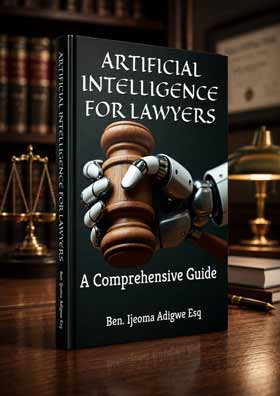 The book also examines Nigeria's legal ecosystem, focusing on the LPELR and NBA AI Guidelines. As a bonus, every purchase comes with a FREE eBook titled: How to Use the AI Features in LegalPedia and LawPavilion.
Ohio Books Ltd praises the publication, stating:
"....this is the only Nigerian book I know of on the topic."
How to Order:
📞 Call, Text, or WhatsApp: 08034917063 | 07055285878
📧 Email: benadigwe1@gmail.com
🌎 Website: www.benadigwe.com
Ebook Version: Access it directly online at https://selar.com/prv626
Authored by Ben Ijeoma Adigwe Esq., ACIarb (UK), LL.M, Dip. in Artificial Intelligence, Director at the Delta State Ministry of Justice, Asaba, Nigeria.
_______________________________________________________________________
“Enhance Legal Practice With Authoritative Reports” — Alexander Payne Offers Comprehensive Law Reports, Spanning Over A Century Of Nigerian Jurisprudence
The book also examines Nigeria's legal ecosystem, focusing on the LPELR and NBA AI Guidelines. As a bonus, every purchase comes with a FREE eBook titled: How to Use the AI Features in LegalPedia and LawPavilion.
Ohio Books Ltd praises the publication, stating:
"....this is the only Nigerian book I know of on the topic."
How to Order:
📞 Call, Text, or WhatsApp: 08034917063 | 07055285878
📧 Email: benadigwe1@gmail.com
🌎 Website: www.benadigwe.com
Ebook Version: Access it directly online at https://selar.com/prv626
Authored by Ben Ijeoma Adigwe Esq., ACIarb (UK), LL.M, Dip. in Artificial Intelligence, Director at the Delta State Ministry of Justice, Asaba, Nigeria.
_______________________________________________________________________
“Enhance Legal Practice With Authoritative Reports” — Alexander Payne Offers Comprehensive Law Reports, Spanning Over A Century Of Nigerian Jurisprudence
 Interested buyers are encouraged to place their orders and enquiries via:
0704 444 4777, 0704 444 4999, 0818 199 9888
Website: www.alexandernigeria.com
Interested buyers are encouraged to place their orders and enquiries via:
0704 444 4777, 0704 444 4999, 0818 199 9888
Website: www.alexandernigeria.com