Senior Advocate of Nigeria, Mr. Jibrin Okutepa, SAN, who recently served as lead counsel to Senator David Mark, has declared that the Federal High Court judgment ordering the deregistration of the African Democratic Congress (ADC) and four other political parties set aside on appeal less than 24 hours later by a unanimous three-member panel of the Court of Appeal was a textbook case of “judicial insubordination” and “judicial impertinence” that ought not to have been allowed to happen.


Okutepa SAN made the wide-ranging declarations during an appearance on Arise Television Prime Time on Friday night, in which he engaged with the constitutional and legal questions raised by the Federal High Court ruling, the Court of Appeal’s intervention, the role of the Independent National Electoral Commission (INEC) as the sole constitutional body empowered to deregister political parties, and the broader implications of the unfolding judicial clash for Nigeria’s democracy ahead of the 2027 general elections.
At the outset, Okutepa SAN politely corrected two introductory descriptions used by the anchor. “Let me correct two mistakes. I am not a constitutional lawyer. I’m a lawyer. I don’t want that appellation. Secondly, I was a lawyer to Senator David Mark, not to the ADC,” he said.
Asked how serious it was, in legal terms, for the Court of Appeal to have held that the trial court presided over by Justice Peter Lifu had violated the principles of judicial hierarchy by proceeding with judgment despite a subsisting order staying proceedings, the senior advocate was unsparing.
“Well, I do not want to fall into the temptation of the language that is ringing bell in my head. But to borrow the language of their lordships of the Supreme Court, what happened appears to be judicial insubordination, judicial impertinence, and it ought not to be so and should not be so,” he said.
He explained that under Nigerian law, the High Court is “obligated, mandatory to obey the orders of the Court of Appeal and enforce it without question whether or not it believes that that order was rightly given or wrongly given, or whether their lordships who made that order in the estimation of the lower court committed grievous error of law.”
“The duty under our law is for the lower court to bow, to pay due obedience to an order from the higher court,” he said.
He drew an analogy: “It is just like if the High Court makes an order staying proceedings in an Area Court, Magistrate Court it will amount to judicial insubordination for the Magistrate Court or Area Court to start to proceed to go on as if no order was given.”
The senior advocate stressed that the entire architecture of the rule of law collapses where the orders of superior courts are disobeyed.
“Where the rule of law holds sway, no one, no matter your status, has the authority, the audacity of arrogance to question an order of court,” he said.
“That is why in a civilised society, even a mere process in court suffices for parties who have turned over their disputes to court to hold on pending when the wise men and women created by our constitution render opinion.”
He added: “The unique role of the legal profession and the judiciary is so enormous that the Nigerian Constitution devoted a considerable proportion of its portion to creating the judicial arm of government, only to be populated by legal practitioners of considerable experience.”
On the doctrine of stare decisis, Okutepa SAN was emphatic.
“It is called precedent. The precedent is that a decision of the Supreme Court, no matter how erroneous you think it is, binds the Court of Appeal. The decision of the Court of Appeal, no matter how erroneous you think it is, binds the trial court,” he said.
He cited a Supreme Court decision in which the apex court was, in his words, “very hard on a judge who attempted to say that their lordships needs to have a second look at their decision and tried to navigate through it.” That, he said, “is judicial indiscipline. You don’t.”
Applying the principle to the facts of the case at hand, Okutepa SAN said the Court of Appeal had, on 22 May 2026, stayed the proceedings before the Federal High Court and that the trial court’s duty in those circumstances was clear and absolute.
“Even if the notice of the order was given to his lordship when he arrives in the court and was about reading the judgment, and a lawyer stands up and says, ‘My Lord, the Court of Appeal has stayed the proceeding in this case,’ all he needs to do is, ‘let me see a copy of the order.’ The moment he sees the copy of the order, without any further ado, he must stop reading the judgment at that stage — because proceeding stay includes judgment delivery. It is the reading of judgment in open court to the hearing of everyone that concludes proceeding,” he said.
He drew a careful distinction between an oral interjection by counsel asking a judge to suspend his own judgment which a judge can ignore and an order of a superior court staying proceedings, which cannot be ignored.
“Therefore, the principle of law that you cannot arrest judgments does not apply to a superior order of court. It can only apply when a lawyer decides to file a motion and says, ‘My Lord, I have a motion for you to suspend your judgment.’ That cannot be entertained, that can be ignored, it can proceed to deliver the judgment.
“But in a situation where there is an appeal against your proceedings, and the Court of Appeal in a contested motion on notice, not ex parte, after all parties were heard, took their time, looked at the point of law raised in the notice and grounds of appeal appeal have been entered and an order that proceedings be stayed. It is a violation of Nigerian Constitution Section 287 for the trial court to ignore that order and proceed to deliver judgment. So if I was sitting in the seat of their lordships, I would have been harder,” he declared.
Beyond the question of judicial hierarchy, Okutepa SAN went into a meticulous analysis of the substance of the case, raising fundamental questions about whether the suit ought to have been entertained at all.
He pointed out that INEC the constitutionally empowered body had, on 4 May 2026, filed a counter-affidavit in which it placed before the court records and evidence that the political parties in question, including the African Democratic Congress (ADC), Accord Party, Zenith Labour Party, AA, and APP, had all met the constitutional requirements for continued registration.
“In Paragraph 7J [INEC] said the objective of the plaintiff has nothing to do with the cause of action here, hence the plaintiff does not have the locus standi to file this action. The case of the plaintiff does not disclose any reasonable cause of action, and this honourable court, INEC says so, has no jurisdiction to entertain the case. And INEC, in my view, was on a firm terrain to have said so,” he said.
He praised INEC for the firmness and neutrality of its position: “When two parties are disputing over an issue and INEC, that is a neutral body, comes to court with evidence, that evidence is treated with some degree of infallibility because it is supposed to be neutral, and in this case it was neutral.”
Okutepa SAN then turned to the constitutional provision on which deregistration is based, namely Section 225A introduced by the Fourth Alteration Act No. 9 of 2017.
He explained that the provision empowers INEC to deregister political parties that fail to meet certain conditions, and that the word “or” in the section is disjunctive meaning that a party only needs to satisfy any one of the conditions to escape deregistration.
“Section 225A of the Constitution was introduced by the Fourth Alteration Act Number Nine. That gave INEC power to deregister political parties that did not meet the requirement of registration, that fail to win a seat either in the national presidential, governor or House of Assembly or National Assembly or State House of Assembly, or councillor as the case may be. And the word used in the Constitution is ‘or, or’ which means you just need to meet one requirement. And once you meet one requirement, it is a disjunctive construction. Not that you must have won a presidential [election],” he said.
In a sharp reductio ad absurdum of the reasoning behind the failed deregistration suit, Okutepa SAN underscored the impossibility of using the failure to win the presidency as a yardstick for deregistration.
“After all, two parties cannot win the presidential election. It must be one. So if therefore failure to win presidential election means that all other political parties will be deregistered, then it means that only APC can remain. That cannot be a logical constitutional construction,” he declared.
He pointed out that INEC’s own evidence before the court had disclosed concrete wins by the affected parties at lower legislative levels.
“INEC came supplied evidence, said from my record, and even gave statistics of what who won what in Abia Labour, Zenith Labour Party. Statistics was given of the election they won in Kogi. Even the deaf should be able to hear that ADC won two House of Representatives members from Kogi State. It is of a living memory. So what is the basis for the litigation?” he asked.
Okutepa SAN further asked what locus standi the body that filed the suit described in court papers as “the incorporated trustees of national forum of former legislators” had to bring the action in the first place.
“INEC is the only one that has a constitutional duty to deregister a political party. And before you can go to court to get an order against an establishment as a constitutional duty to act, you must first of all exhibit evidence of failure to act and making a demand on that institution that you must act, otherwise I’ll go to court to command you. That’s what is called mandamus in law,” he explained.
“So what was the locus standi of these people that describe themselves as the incorporated trustees of national forum of former legislators? Where is their letter of demand? Where is the failure of INEC, when INEC came supplied evidence, said from my record…?” he asked.
Asked what message it sent to the public when one court appears to accuse another of disregarding the authority of a superior court, the senior advocate was direct.
“Of course, of course [it risks undermining confidence in the judiciary]. That is why the judges must be very careful in the manner in which they give judgment in matters that touch on the rule of law, democratic growth and development because the bedrock of any democracy is an independent, strong judicial institution,” he said.
“Where people are led to believe that the judiciary is not independent either by process of recruitments, or by the judgments that they deliver, which create more problems than solving it; or when people have a perception that Judge A, Judge B is an agent of a particular person, and that if you go to that court then your fate is already decided before the proceeding is filed in that case, confidence of the people is destroyed.”
On whether the matter had crossed the threshold from legal error into possible judicial misconduct, Okutepa SAN said: “I am not in a position to determine whether it is judicial misconduct or not, but it appears to be so. So those who feel aggrieved know what to do. I won’t use this medium to advise them.”
He stressed that “the disciplinary power of courts is inherent in all courts of records, including the Supreme Court,” and cited the principle in Dan v. Fugasen a decision dating back to “1898-something” to the effect that where a case is filed in court, a motion for injunction is pending, and a party who is aware of that pendency proceeds to “steal a match,” the court will invoke its disciplinary power to “pull down the structure erected in defiance of a pendency of a motion for injunction.”
“Not to talk about a party who is aware of the order of the Court of Appeal and still sat in court and allow the court to deliver judgment,” he said.
In one of his most striking interventions, Okutepa SAN argued that sanctions, where warranted, must extend not only to the judge but to the lawyer who moved the court.
“The legal profession must begin to think of visiting sanctions on some of us. Because we’re talking about his lordship. His lordship did not move himself somebody came to court to move the court. So the person who was in court, because of the duty we owe… even if his lordship knows what he knows about the hierarchy what about the lawyer? The lawyer also is a minister in the temple of justice. And by the Rules of Professional Conduct, you are not the mouthpiece of your clients. We are not cobblers. Rule 1 of the Rules of Professional Conduct enjoins us to promote the rule of law, the cause of justice, and must not do anything that will bring the justice system to ridicule,” he said.
Asked whether the bench should “bring the hammer down” especially in a case like this to establish a strong precedent, Okutepa SAN agreed and explained the failure of consequences as one of the roots of the present malaise.
“My take is that I think we are too lackadaisical in the disciplinary process. One of the reasons why we are where we are is the fact that there are no consequences for misbehaviour. If any of us knew that if you file frivolous processes and you can be called upon to question — and you are called upon to be questioned, and you are sanctioned after duly hearing you, not for you to first of all be the one to accuse, be the one to judge and be the one to apply sanction — so my take is this: as we journey towards 2027, I think the judiciary needs to have a rethink,” he said.
Asked, as the interview drew to a close, what concerned him more the attempt to deregister opposition parties or the allegation that a lower court may have disregarded the authority of a superior court Okutepa SAN said both concerned him, and explained why.
“In my view, both. Because if I were to sit as a judex and it used to be the position in those days a judge can suo motu raise an issue, ‘Mr. so-and-so, please address me on the justiciability or otherwise of this your matter.’ There are inbuilt systems. We are not using it, because once a matter is outrightly provocative, outrightly frivolous, or appears downright to wear the colouration of a political vendetta, a judicial officer must be careful not to handle it.
“Secondly, that a litigant ran to a higher authority, and the higher authority looked at the circumstances upon a contested application which is on notice, not ex parte, and made an order saying ‘stay proceedings.’ Stay proceedings means don’t touch. And once that is ordered, then to proceed to deliver a judgment in the face of a valid order in defiance of that order is equivalent to saying that a child looks at his father directly to the face and says, ‘Daddy, you are stupid.’ On that, he shouldn’t be encouraged.”
The interview came against the backdrop of the Federal High Court judgment delivered just 24 hours earlier ordering the deregistration of the ADC and four other political parties the Accord Party, Zenith Labour Party, AA and APP a ruling that sent shock waves through Nigeria’s political landscape ahead of the 2027 general elections, and which a unanimous three-member panel of the Court of Appeal dramatically set aside the very next day.
The Court of Appeal, in its decision, ordered INEC to halt the execution of the trial court’s ruling, and went further to hold that the trial court had violated the principles of judicial hierarchy and precedent by delivering judgment in a matter over which the appellate court had already ordered a stay of proceedings.
The legal battle, as both the anchor and the senior advocate observed in the course of the interview, has now moved far beyond the fate of a handful of political parties and raises profound questions about the rule of law, the authority of superior courts, judicial discipline, and the integrity of Nigeria’s democratic process ahead of crucial elections in 2027.
For the African Democratic Congress, for Senator David Mark, for the Accord Party, the Zenith Labour Party, the AA, the APP, and for the wider Nigerian political and legal community, Okutepa SAN’s intervention on Arise Prime Time crystallises two enduring points around which the deregistration controversy must now be measured.
The first is that INEC and INEC alone is the constitutional repository of the power to deregister political parties in Nigeria; that the disjunctive construction of Section 225A of the Constitution means a party need only meet one of the prescribed conditions to escape deregistration; and that any interpretation that would make failure to win the presidential election a basis for deregistration would, by definition, leave only the APC standing an absurdity the framers of the Constitution could not have intended.
The second is that no court of trial may, with constitutional propriety, deliver a judgment in the teeth of a subsisting order of a superior court staying its proceedings; that the doctrine of stare decisis and the hierarchy of courts are not optional ornaments of judicial practice but the structural foundations of the rule of law; and that, in Okutepa SAN’s words, “the judges must be very careful in the manner in which they give judgment in matters that touch on the rule of law, democratic growth and development because the bedrock of any democracy is an independent, strong judicial institution.”
As Nigeria journeys towards 2027, those words from a senior advocate who has been at the heart of the unfolding deregistration battle as lead counsel to Senator David Mark will continue to echo across the bench, the bar, the political class, and the wider Nigerian public.
[A MUST HAVE] Evidence Act Demystified With Recent And Contemporary Cases And Materials

Available now for NGN 40,000 at ASC Publications, 10, Boyle Street, Onikan, Lagos. Beside High Court, TBS. Email publications@ayindesanni.com or WhatsApp +2347056667384. Purchase Link: https://paystack.com/buy/evidence-act-complete-annotation
______________________________________________________________________ “Enhance Legal Practice With Authoritative Reports” — Alexander Payne Offers Comprehensive Law Reports, Spanning Over A Century Of Nigerian Jurisprudence Interested buyers are encouraged to place their orders and enquiries via:
0704 444 4777, 0704 444 4999, 0818 199 9888
Website: www.alexandernigeria.com
Interested buyers are encouraged to place their orders and enquiries via:
0704 444 4777, 0704 444 4999, 0818 199 9888
Website: www.alexandernigeria.com
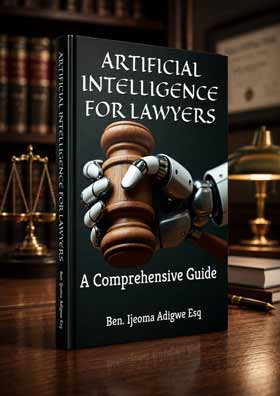 The book also examines Nigeria's legal ecosystem, focusing on the LPELR and NBA AI Guidelines. As a bonus, every purchase comes with a FREE eBook titled: How to Use the AI Features in LegalPedia and LawPavilion.
Ohio Books Ltd praises the publication, stating:
"....this is the only Nigerian book I know of on the topic."
How to Order:
📞 Call, Text, or WhatsApp: 08034917063 | 07055285878
📧 Email: benadigwe1@gmail.com
🌎 Website: www.benadigwe.com
Ebook Version: Access it directly online at https://selar.com/prv626
Authored by Ben Ijeoma Adigwe Esq., ACIarb (UK), LL.M, Dip. in Artificial Intelligence, Director at the Delta State Ministry of Justice, Asaba, Nigeria.
______________________________________________________________________
The book also examines Nigeria's legal ecosystem, focusing on the LPELR and NBA AI Guidelines. As a bonus, every purchase comes with a FREE eBook titled: How to Use the AI Features in LegalPedia and LawPavilion.
Ohio Books Ltd praises the publication, stating:
"....this is the only Nigerian book I know of on the topic."
How to Order:
📞 Call, Text, or WhatsApp: 08034917063 | 07055285878
📧 Email: benadigwe1@gmail.com
🌎 Website: www.benadigwe.com
Ebook Version: Access it directly online at https://selar.com/prv626
Authored by Ben Ijeoma Adigwe Esq., ACIarb (UK), LL.M, Dip. in Artificial Intelligence, Director at the Delta State Ministry of Justice, Asaba, Nigeria.
______________________________________________________________________