*As It Vacates Its Own Earlier Interim Order And Rules Party Disputes Are Beyond Judicial Jurisdiction

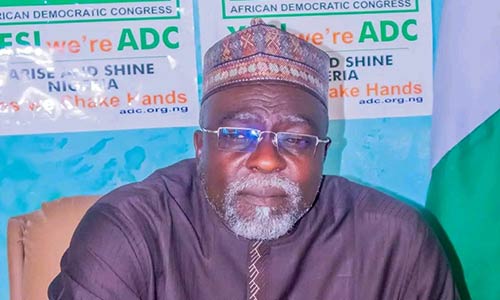
A Katsina State High Court sitting in Dutsin-Ma Judicial Division has struck out a suit filed by the former ADC State Chairman in Katsina, Alhaji Musa Usman Wamba, ruling that the case pertains to the internal affairs of a political party over which courts have no jurisdiction under Section 83(5) of the Electoral Act 2026.
Justice A.K. Tukur, delivering the ruling on Monday, held that the suit had no legal basis and lacked merit, declaring it an internal party matter that the ADC has the authority to handle through its own mechanisms. The judge also vacated an earlier interim order he had granted in the same case on April 7, 2026, effectively reversing his own previous decision after a fuller consideration of the law.
The ruling is significant as one of the first judicial decisions to apply Section 83 of the Electoral Act 2026 to strike out an ADC-related suit — vindicating the position advocated by the Nigerian Bar Association, multiple Senior Advocates of Nigeria, and a retired Court of Appeal Justice, all of whom have warned in recent days that courts should decline jurisdiction over internal political party disputes.
The suit, marked KTH/1035M/2026, was filed by Wamba in his capacity as State Chairman of the African Democratic Congress in Katsina State.
The defendants included Lawan Batagarawa (suing for himself and on behalf of so-called stakeholders of ADC Katsina State), Babangida Ibrahim Mahuta, the African Democratic Congress, and the Independent National Electoral Commission.
While the specific reliefs sought by Wamba were not detailed in the court order, the case arose from the internal leadership disputes within the ADC at the state level disputes connected to the broader national crisis involving the rival factions of David Mark and Nafiu Bala Gombe, and the competing claims over who controls state-level party structures.
On April 7, 2026, Justice Tukur had granted an ex parte interim order against the defendants an order obtained without the other parties being heard, as is standard in ex parte applications.
However, at the resumed hearing on April 14, the applicant’s counsel, Mr. A.D. Umar Esq., filed a motion seeking to vacate the earlier interim order. The court took the opportunity to examine not only the motion but the broader question of whether it had jurisdiction to entertain the case at all.
Justice Tukur’s ruling was grounded squarely in Section 83(5) of the Electoral Act 2026, which he cited verbatim in his order.
“The subject matter of this suit pertains to the internal affairs of a political party, of which by virtue of Section 83(5) of the Electoral Act, which provides that no court shall entertain jurisdiction over any suit or matter pertaining to the internal affairs of a political party, and where such action is brought, no interim or temporary orders shall be granted by the court,” Justice Tukur stated.
The judge made two consequential orders. First, the ex parte order made on April 7, 2026, was vacated and set aside. Second, the suit was struck out for want of jurisdiction.
By striking out the suit rather than merely dismissing the application, the court determined that the entire case was beyond its jurisdictional reach meaning no aspect of the dispute, whether heard ex parte or on notice, could be entertained by the court.
Section 83 of the Electoral Act 2026 has been at the centre of the national debate about judicial involvement in political party disputes, particularly in the context of the ADC crisis.
The provision explicitly bars courts from entertaining cases relating to the internal affairs of political parties and further prohibits the granting of interim or temporary orders in any such case that is brought.
The NBA, in a statement signed by President Afam Osigwe SAN, had warned that “the disturbing involvement by lawyers and courts in the internal affairs of political parties despite the clear provisions of the Electoral Act 2026” was undermining democracy. The NBA threatened disciplinary action against lawyers who file such cases and called on the National Judicial Council to sanction judges who assume jurisdiction in barred matters.
Multiple Senior Advocates including Olu Daramola SAN, Olalekan Ojo SAN, and Dr. Wahab Shittu SAN supported this position, stressing that courts should not interfere in internal party affairs and that judges must exercise restraint.
A retired Justice of the Court of Appeal had described the trend of judicial involvement as “judicial overreach” and warned it could “delegitimise the judiciary.”
Justice Tukur’s ruling in Katsina represents a practical application of these warnings a court recognising the limits of its jurisdiction and declining to entertain a matter that the law expressly places beyond its reach.
The Katsina ruling stands in contrast to the approach taken by several Federal High Court judges in Abuja, who have entertained multiple ADC-related suits, granted interim orders, and issued status quo directives actions that critics argue violate the same Section 83 that Justice Tukur relied upon.
Currently, ADC leadership disputes are before Justice Emeka Nwite (adjourned indefinitely pending the Supreme Court), Justice Musa Liman (judgment pending in the Abejide suit), Justice Joyce Abdulmalik (status quo order issued, hearing fixed for April 23), Justice Peter Lifu (ruling pending on the deregistration amendment), and the Supreme Court itself (hearing fixed for April 22).
Additionally, the Adamawa State High Court had earlier issued a restraining order against ADC congresses in that state, before the Katsina court took the opposite approach and declined jurisdiction entirely.
The divergent judicial responses to essentially similar disputes highlight the inconsistency that the NBA and senior lawyers have warned about — and that Justice Tukur’s ruling in Katsina sought to correct.
The Katsina ruling removes one of the multiple legal fronts in the ADC leadership battle. The striking out of the suit means the dispute over ADC structures in Katsina State will need to be resolved through internal party mechanisms rather than judicial intervention.
For the Mark-led faction, the ruling is favourable it removes a legal obstacle at the state level and supports the argument that internal party disputes should be resolved internally rather than through the courts.
For the broader ADC crisis, the ruling provides a judicial precedent at the state level for the application of Section 83 a precedent that could influence how other courts approach the remaining ADC-related suits, particularly at the Supreme Court hearing on April 22.
There is an irony in the Katsina ruling. It was the applicant’s own counsel Mr. A.D. Umar who filed the motion to vacate the earlier interim order, apparently recognising that the court lacked jurisdiction to have granted it in the first place.
This self-correction a lawyer asking a court to reverse an order his own client obtained reflects the growing awareness within the legal profession that Section 83 of the Electoral Act 2026 imposes clear jurisdictional limits that cannot be circumvented through creative pleading or ex parte applications.
Justice Tukur’s willingness to vacate his own earlier order and strike out the suit entirely demonstrates judicial integrity and adherence to the law the very qualities that the NBA and senior lawyers have been calling for across the judiciary in the handling of political party disputes.
 The book also examines Nigeria's legal ecosystem, focusing on the LPELR and NBA AI Guidelines. As a bonus, every purchase comes with a FREE eBook titled: How to Use the AI Features in LegalPedia and LawPavilion.
Ohio Books Ltd praises the publication, stating:
"....this is the only Nigerian book I know of on the topic."
How to Order:
📞 Call, Text, or WhatsApp: 08034917063 | 07055285878
📧 Email: benadigwe1@gmail.com
🌎 Website: www.benadigwe.com
Ebook Version: Access it directly online at https://selar.com/prv626
Authored by Ben Ijeoma Adigwe Esq., ACIarb (UK), LL.M, Dip. in Artificial Intelligence, Director at the Delta State Ministry of Justice, Asaba, Nigeria.
______________________________________________________________________
[A MUST HAVE] Evidence Act Demystified With Recent And Contemporary Cases And Materials
The book also examines Nigeria's legal ecosystem, focusing on the LPELR and NBA AI Guidelines. As a bonus, every purchase comes with a FREE eBook titled: How to Use the AI Features in LegalPedia and LawPavilion.
Ohio Books Ltd praises the publication, stating:
"....this is the only Nigerian book I know of on the topic."
How to Order:
📞 Call, Text, or WhatsApp: 08034917063 | 07055285878
📧 Email: benadigwe1@gmail.com
🌎 Website: www.benadigwe.com
Ebook Version: Access it directly online at https://selar.com/prv626
Authored by Ben Ijeoma Adigwe Esq., ACIarb (UK), LL.M, Dip. in Artificial Intelligence, Director at the Delta State Ministry of Justice, Asaba, Nigeria.
______________________________________________________________________
[A MUST HAVE] Evidence Act Demystified With Recent And Contemporary Cases And Materials

 Interested buyers are encouraged to place their orders and enquiries via:
0704 444 4777, 0704 444 4999, 0818 199 9888
Website: www.alexandernigeria.com
Interested buyers are encouraged to place their orders and enquiries via:
0704 444 4777, 0704 444 4999, 0818 199 9888
Website: www.alexandernigeria.com