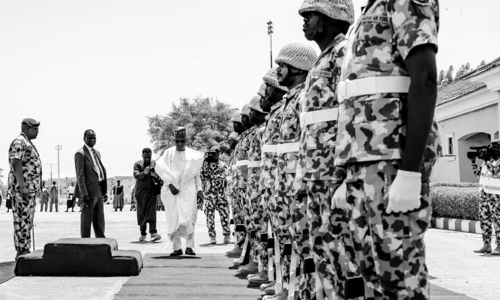
Governor Babagana Zulum of Borno State has made a startling revelation that intelligence regarding a potential terrorist attack on the 15 Task Force Brigade in Benisheikh was available approximately three days before the deadly assault that killed Brigade Commander Brigadier General OO Braimah and several soldiers — raising disturbing questions about why the information did not prevent the attack.

The governor’s disclosure came during a sympathy visit to Benisheikh on Saturday, hours before Vice President Kashim Shettima made an unscheduled visit to Maiduguri on behalf of President Bola Tinubu to commiserate with the Nigerian Army and the Borno State Government over the loss.
The attack, carried out by suspected Boko Haram and Islamic State West Africa Province fighters on Friday morning, targeted both the military formation and the town of Benisheikh in Kaga Local Government Area along the strategic Maiduguri-Damaturu highway.
Zulum described the attack as one of the most surprising he has witnessed in recent times not because it was unexpected, but precisely because it was expected and yet was not prevented.
“This is one of the most surprising attacks that I have witnessed in recent times,” Zulum stated, emphasising the need to review security protocols given that credible intelligence about the impending attack had been available for approximately three days.
During his visit, the governor questioned local leadership about their awareness of the intelligence. The local chairman confirmed that reports had indeed been received ahead of the attack a confirmation that prompted Zulum to publicly lament the lapse that allowed the assault to proceed despite prior warnings.
The revelation raises fundamental questions about the military’s intelligence-to-action pipeline: how intelligence that a specific formation was about to be attacked could be available for 72 hours without triggering adequate defensive preparations or reinforcements.
Zulum called on the military to conduct a comprehensive review of its security architecture to address emerging threats within its areas of responsibility more effectively.
The call for a review suggests the governor believes the current operational framework from intelligence processing to force deployment to defensive preparedness — has systemic weaknesses that contributed to the success of the attack.
Zulum assured troops of the Borno State Government’s continued support in protecting lives and property. He added that his administration would take steps to strengthen the resilience of local vigilantes, security personnel, and affected communities to ensure Benisheikh does not fall to Boko Haram.
The governor’s pledge to strengthen local vigilantes alongside conventional security forces reflects a longstanding reality in the Northeast — that the Civilian Joint Task Force and local vigilante groups play a critical role in the security architecture, often serving as the first line of intelligence and defence in communities across the region.
Vice President Kashim Shettima, himself a former Borno State Governor with deep personal knowledge of the insurgency, made an unscheduled visit to Maiduguri on Saturday to commiserate with the military and the state government.
According to a statement by Stanley Nkwocha, Senior Special Assistant to the President on Media and Communications in the Office of the Vice President, Shettima visited on behalf of President Tinubu and expressed deep sorrow over the loss of the gallant officers, describing their sacrifice as “a painful reminder of the cost of securing the nation.”
Addressing troops and government officials during the visit, Shettima paid tribute to the fallen soldiers in emotional terms.
“These men wore the uniform for all of us. They stood to protect our communities, our families, and the future of our children. Their courage reminds us that peace and security often come at a very high cost,” the Vice President stated.
He assured the military of the Federal Government’s unwavering support in the ongoing fight against insurgency, stressing that the Tinubu administration remains resolute in its commitment to restoring lasting peace across the country.
Shettima conveyed President Tinubu’s directive that security agencies intensify efforts to track down the perpetrators of the Benisheikh attack, vowing that those responsible would be brought to justice.
“Criminals will have no hiding place under this administration,” the Vice President declared.
The directive for intensified pursuit of the attackers suggests the government views the Benisheikh assault as requiring a specific military response beyond routine operations, potentially signalling a targeted offensive against the insurgent formations responsible.
Governor Zulum’s disclosure that intelligence was available three days before the attack transforms the narrative surrounding the Benisheikh assault from a question of capability whether the military had the resources to defend the formation to a question of response why actionable intelligence did not translate into effective defensive action.
Several critical questions remain unanswered.
Who received the intelligence, and through what channels was it transmitted to the formation’s command? What defensive preparations, if any, were put in place in response to the intelligence? Were reinforcements requested or deployed to the formation after the intelligence was received? Did the intelligence accurately predict the scale, timing, and direction of the attack? And what systemic failures allowed a formation that had been warned of an impending attack to be overwhelmed?
These questions gain additional weight in the context of surviving soldiers’ accounts, published earlier, in which troops described the attack as having been carried out by insurgents who appeared to have “studied our positions for weeks” and who attacked “from different directions at the same time.”
If the attackers had indeed conducted extensive reconnaissance of the military positions, and if intelligence of an impending attack was available to Nigerian security forces, the failure to prevent the assault represents a breakdown at multiple levels of the intelligence and operational chain.
Brigadier General Braimah’s death adds to a growing list of senior military officers killed in the Northeast insurgency, including Brigadier General Musa Uba in 2025, Brigadier General Dzarma Zirkusu in 2021, Colonel Dahiru Chiroma Bako in 2020, and several other field-grade officers.
The official military casualty count of two officers and two soldiers has been disputed by survivors and residents, who described a far more devastating engagement that lasted over 90 minutes, involved simultaneous attacks on multiple positions, and resulted in the destruction of military facilities and civilian property.
The Benisheikh attack comes during a period of heightened insurgent activity in Borno State, including the March 16 suicide bombings in Maiduguri that killed 23 people and injured over 100, and the coordinated assaults on Ngoshe and Pulka in Gwoza Local Government Area that destroyed entire communities.
Senator Ali Ndume, representing Borno South, has publicly stated that soldiers are being outgunned by insurgents due to inadequate equipment a claim the Presidency has responded to by urging Ndume to share intelligence confidentially rather than on television.
Governor Zulum’s public disclosure of the intelligence failure and his call for a security architecture review represent a more direct challenge to the military’s operational effectiveness than any previous public statement by a Borno governor and one that will be difficult for the military establishment to dismiss, given Zulum’s firsthand knowledge of the security situation and his consistent engagement with affected communities.
[A MUST HAVE] Evidence Act Demystified With Recent And Contemporary Cases And Materials

Available now for NGN 40,000 at ASC Publications, 10, Boyle Street, Onikan, Lagos. Beside High Court, TBS. Email publications@ayindesanni.com or WhatsApp +2347056667384. Purchase Link: https://paystack.com/buy/evidence-act-complete-annotation
______________________________________________________________________ “Enhance Legal Practice With Authoritative Reports” — Alexander Payne Offers Comprehensive Law Reports, Spanning Over A Century Of Nigerian Jurisprudence Interested buyers are encouraged to place their orders and enquiries via:
0704 444 4777, 0704 444 4999, 0818 199 9888
Website: www.alexandernigeria.com
Interested buyers are encouraged to place their orders and enquiries via:
0704 444 4777, 0704 444 4999, 0818 199 9888
Website: www.alexandernigeria.com