By Sir, Agabaidu Chukwuemeka Jideani:

Legislative Practice and Procedure Expert.
Recent controversies surrounding the four Tax Reform Acts of 2025, the Nigeria Tax Act, Nigeria Tax Administration Act, Nigeria Revenue Service (Establishment) Act, and Joint Revenue Board (Establishment) Act, have thrust into sharp relief the dangers of alleged post-passage alterations. These bills, originated by the Executive in late 2024, underwent rigorous scrutiny, were harmonised and passed by both chambers of the National Assembly in early 2025, received presidential assent from His Excellency President Bola Ahmed Tinubu, GCFR, in June 2025, and were subsequently gazetted. Yet, on 17 December 2025, Honourable Abdussamad Dasuki raised a point of privilege in the House of Representatives, contending that the gazetted versions contain substantive deviations from the harmonised texts approved in the Votes and Proceedings. Alleged discrepancies encompass expanded enforcement powers, modifications to tax scopes, alterations to appeal mechanisms, and changes impacting oversight and funding structures. So much for the background.
Now, Nigeria is a Constitutional democracy anchored on the doctrine of Separation of Powers. In ordinary and common language, the powers of the Nigerian state were enumerated and shared, by the Constitution, amongst the three arms of government, viz, the Legislature, the Executive and the Judiciary and between the three tiers of government: the Federal, the State and the Local Governments respectively.
Now, the Constitution of the Federal Republic of Nigeria (CFRN) (1999) vests legislative powers in the National Assembly, comprising the Senate and the House of Representatives[1] and the various State Houses of Assembly[2].
The Constitution, having granted law making powers to the National Assembly, immediately circumscribed the exercise of the powers so granted. In Section 58, it provides that the legislative powers granted by section 4(1) is exercisable by way of ‘Bills” passed by the Senate and the House of Representatives and assented to by the President[3].
Under our laws in Nigerian, a bill becomes an Act only after it is passed by both chambers of the National Assembly in identical form and assented to by the President[4]. It should be noted that the law-making role of the President under the Constitution is limited to granting or withholding assent[5]; there is no constitutional authority for the President or any executive official to amend, alter, or rewrite the content of a passed bill post-passage.
Post-passage alterations, (the unauthorized changes to the text of a bill after its final legislative approval but before or during official publication), pose a profound threat to democratic accountability, separation of powers, and public trust. Such alterations could arise from clerical errors, intentional tampering, or procedural lapses, potentially introducing provisions never debated or approved. This clothes the tainted enactment with Constitutional infirmity.
It is important to note that post-passage alterations could be perpetrated in the process of transmission of the harmonized bill to the President or during the return of the assented Act to the National Assembly and it could be done by any or a combination of more than one of executive and/or legislative branch functionaries.
In all of these the central figure is the Clerk of National Assembly.
The Legislative practice in Nigeria, empowers the Clerk of the National Assembly to employ procedural safeguards, including certification protocols, creation of multiple authenticated copies, enrollment in official records, and conclusive evidential rules, to mitigate these risks[6].
In doing so the legislative practice creates a verifiable “master” version of the law, dispersing authority across branches of government and establishing presumptions of authenticity that courts uphold.
This Nigerian legislative practice is anchored on a solid statutory foundation, provided by the Acts Authentication Act (Cap. A2, Laws of the Federation of Nigeria 2004).
The Acts establishes a structured process to authenticate legislation after passage by the National Assembly, ensuring the integrity and accuracy of enacted laws before presidential assent and prior to publication.
Its primary safeguards against post-passage alterations are found in the empowerment of the Clerk of the National Assembly, to take the following steps:
- Certification[7]: Soon after a bill is passed in identical form by both the Senate and House of Representatives (harmonised version), the Clerk must prepare a clean copy incorporating all agreed amendments. The Clerk then endorses and signs a certificate on the bill stating: “I certify… that this is a true copy of the bill passed by both Houses of the National Assembly.” This certificate is conclusive evidence that the transmitted text accurately reflects the legislature’s decisions. It prevents unauthorised changes by creating an official, authenticated record.
- Distribution[8]: Section 5 of the Act provides for distribution protocols, here the Clerk of the National Assembly is empowered to prepare multiple identical copies (triplicate), one retained for National Assembly records, one sent to the President, and one to the Chief Justice of Nigeria for enrolment in the Supreme Court. All subsequent printed copies must initially be impressions from the same authenticated form, ensuring uniformity. The tripartite distribution across legislative, executive, and judicial branches allows cross-verification, deterring unilateral alterations.
These mechanisms vest control firmly with the National Assembly’s Clerk, an independent legislative officer, to prevent executive or administrative tampering between passage and assent/publication.
In essence, while the Act provides robust procedural checks through certification and controlled distribution, a breach could occur if authenticated copies are altered subsequently without legislative re-approval, as allegedly happened in this case.
The alleged post-passage alterations of the relevant Tax Reform Legislation, if substantiated, will erode public trust in the fiscal reforms aimed at broadening revenue amid economic pressures. It risks protracted litigation, delayed implementation (originally slated for 1 January 2026), and constitutional crisis.
Ultimately, preserving legislative sanctity demands vigilance: laws must emanate solely from the people’s representatives, unadulterated by post-passage sleight. The ongoing investigation offers a pivotal opportunity to reaffirm this principle, ensuring Nigeria’s enactments withstand scrutiny as true expressions of democratic will.
Resolutions may involve legislative corrections by way of amendments, judicial invalidation of unauthorized as well as altered provisions, or presidential repudiation of the allegedly altered and gazetted enactment.
Agabaidu Chukwuemeka Jideani, a Legislative Practice and Procedure Expert (amongst others) serve as the Director General of the Abuja Chamber of Commerce and Industry.
[1] Section 4(1), CFRN 1999
[2] Section 4(6) CFRN 1999
[3] Section 58(1) CFRN 1999
[4] Community reading of sections 58 and 59 CFRN 1999
[5] Section 59 CFRN
[6] Acts Authentication Act, Cap. A2, Laws of the Federation of Nigeria 2004.
[7] Section 2 Acts Authentication Act
[8] Section 5 Acts Authentication Act
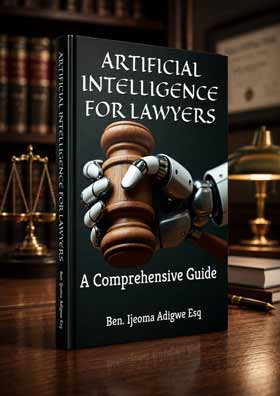 The book also examines Nigeria's legal ecosystem, focusing on the LPELR and NBA AI Guidelines. As a bonus, every purchase comes with a FREE eBook titled: How to Use the AI Features in LegalPedia and LawPavilion.
Ohio Books Ltd praises the publication, stating:
"....this is the only Nigerian book I know of on the topic."
How to Order:
📞 Call, Text, or WhatsApp: 08034917063 | 07055285878
📧 Email: benadigwe1@gmail.com
🌎 Website: www.benadigwe.com
Ebook Version: Access it directly online at https://selar.com/prv626
Authored by Ben Ijeoma Adigwe Esq., ACIarb (UK), LL.M, Dip. in Artificial Intelligence, Director at the Delta State Ministry of Justice, Asaba, Nigeria.
_______________________________________________________________________
“Enhance Legal Practice With Authoritative Reports” — Alexander Payne Offers Comprehensive Law Reports, Spanning Over A Century Of Nigerian Jurisprudence
The book also examines Nigeria's legal ecosystem, focusing on the LPELR and NBA AI Guidelines. As a bonus, every purchase comes with a FREE eBook titled: How to Use the AI Features in LegalPedia and LawPavilion.
Ohio Books Ltd praises the publication, stating:
"....this is the only Nigerian book I know of on the topic."
How to Order:
📞 Call, Text, or WhatsApp: 08034917063 | 07055285878
📧 Email: benadigwe1@gmail.com
🌎 Website: www.benadigwe.com
Ebook Version: Access it directly online at https://selar.com/prv626
Authored by Ben Ijeoma Adigwe Esq., ACIarb (UK), LL.M, Dip. in Artificial Intelligence, Director at the Delta State Ministry of Justice, Asaba, Nigeria.
_______________________________________________________________________
“Enhance Legal Practice With Authoritative Reports” — Alexander Payne Offers Comprehensive Law Reports, Spanning Over A Century Of Nigerian Jurisprudence
 Interested buyers are encouraged to place their orders and enquiries via:
0704 444 4777, 0704 444 4999, 0818 199 9888
Website: www.alexandernigeria.com
Interested buyers are encouraged to place their orders and enquiries via:
0704 444 4777, 0704 444 4999, 0818 199 9888
Website: www.alexandernigeria.com