By Douglas Ogbankwa

Justices, judges, magistrates, and presidents of Area and District Customary Courts in Nigeria are very powerful.
What they say and write is the law, which must be obeyed. The latitude and discretion, however, given to My Lords, Their Worships, and Their Honours are sometimes too wide and unfettered. This can create room for abuse and perversion of justice. It was Lord Atkins who said, “Power corrupts, and absolute power corrupts absolutely.”
The following are some practices and procedures in the justice delivery system in Nigeria that require clear guidelines to ensure uniformity in the application of law and discretion. Currently, these are being abused or misapplied by some:
1. Ex Parte Orders or Interim Injunctions
Ex parte orders or interim injunctions are temporary measures, usually issued to provide relief to a person in an urgent situation, where failure to act may result in the destruction of the subject matter. This procedure is often abused by some Nigerian judges, magistrates, and court presidents, who sometimes determine the main issues at the ex parte stage.
There are no standardized guidelines for issuing or refusing ex parte orders. Judicial officers often hide under the vague concept of “discretion” to act as they wish, even when not allowed by law. My Noble Lord, the Chief Justice of Nigeria (CJN), must urgently provide a practice direction to establish clear parameters for granting or refusing ex parte injunctions.
This should resemble the guidance previously issued to prevent conflicting judgments. Clear criteria will help delimit the ambit of the law on this subject and make the process of granting or refusing interim injunctions ascertainable. For example, judges should consider:
“What will go wrong if the opposing party is put on notice? Will the heavens fall?”
The current “anything goes” approach contributes to the public’s negative perception of the legal profession in Nigeria. While judges should not base their verdicts on public opinion, the judiciary should recognize that the public are the customers of the judicial system. Feedback is necessary to improve services. There must be alignment between the law and society.
2. Need for Sentencing Guidelines
Sentencing is created by statute and case law. If the law allows for a fine, a judicial officer should not impose imprisonment unnecessarily. The needless imprisonment of citizens contributes to overcrowded prisons.
A uniform sentencing guideline should be issued to all judicial and presiding officers. Cases with similar facts and circumstances should be treated consistently. This will prevent abuse of sentencing powers and ensure punishments are neither excessive nor too lenient.
3. Granting of Bail
Bail is one of the most abused discretionary powers. It is no longer entirely at the court’s discretion, as the Administration of Criminal Justice Act (ACJA) and corresponding state laws specify matters where bail must be granted. Denying bail in such cases infringes on the defendant’s rights.
To ensure uniformity, clear guidelines should specify offenses and conditions for granting bail in accordance with statute, preventing allegations of bias or malice.
4. Election Petitions
Election petition cases are sui generis but are often handled inconsistently. Cases with identical facts in the same state or different constituencies may receive conflicting judgments from the same panel. This is unacceptable, as these cases impact the governance of local, state, and federal institutions.
Only retired justices and judges should handle election petition matters and appeals. Penalties should apply to tribunal members who fail or refuse to follow judicial precedents. The same principle applies to the Court of Appeal and Supreme Court, which occasionally reverse decisions without new facts or law, creating uncertainty.
Supreme Court justices and Court of Appeal judges should no longer serve as members of the National Judicial Council (NJC). Instead, retired CJNs and PCAs should serve as chair and vice-chair, with retired justices of good standing as members. This reform will help prevent conflicts of interest in the NJC.
5. Tendering of Documents
Documents submitted in court must meet statutory and case law standards for admissibility. Admission is mandatory when documents satisfy relevance and admissibility criteria. Guidelines should standardize the process to ensure uniformity in admitting or rejecting documents during trials.
Conclusion
Implementing these principles will ensure procedural certainty and fairness in Nigeria’s judicial system, which is currently vulnerable to abuse. For instance, during the recent United States elections, cases filed by Donald Trump’s team were dismissed based on established precedents. A similar scenario in Nigeria could yield different outcomes.
Justice Chukwudifu Oputa, a former Supreme Court justice, aptly summarized the dilemma Nigerians face:
“We are not final because we are infallible; we are infallible because we are final.”
Author: Douglas Ogbankwa, Esq., lawyer, writer, policy analyst, and convener of the Vanguard for the Independence of the Judiciary (V4IJ).
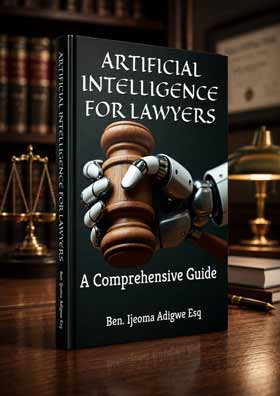 The book also examines Nigeria's legal ecosystem, focusing on the LPELR and NBA AI Guidelines. As a bonus, every purchase comes with a FREE eBook titled: How to Use the AI Features in LegalPedia and LawPavilion.
Ohio Books Ltd praises the publication, stating:
"....this is the only Nigerian book I know of on the topic."
How to Order:
📞 Call, Text, or WhatsApp: 08034917063 | 07055285878
📧 Email: benadigwe1@gmail.com
🌎 Website: www.benadigwe.com
Ebook Version: Access it directly online at https://selar.com/prv626
Authored by Ben Ijeoma Adigwe Esq., ACIarb (UK), LL.M, Dip. in Artificial Intelligence, Director at the Delta State Ministry of Justice, Asaba, Nigeria.
______________________________________________________________________
[A MUST HAVE] Evidence Act Demystified With Recent And Contemporary Cases And Materials
The book also examines Nigeria's legal ecosystem, focusing on the LPELR and NBA AI Guidelines. As a bonus, every purchase comes with a FREE eBook titled: How to Use the AI Features in LegalPedia and LawPavilion.
Ohio Books Ltd praises the publication, stating:
"....this is the only Nigerian book I know of on the topic."
How to Order:
📞 Call, Text, or WhatsApp: 08034917063 | 07055285878
📧 Email: benadigwe1@gmail.com
🌎 Website: www.benadigwe.com
Ebook Version: Access it directly online at https://selar.com/prv626
Authored by Ben Ijeoma Adigwe Esq., ACIarb (UK), LL.M, Dip. in Artificial Intelligence, Director at the Delta State Ministry of Justice, Asaba, Nigeria.
______________________________________________________________________
[A MUST HAVE] Evidence Act Demystified With Recent And Contemporary Cases And Materials

 Interested buyers are encouraged to place their orders and enquiries via:
0704 444 4777, 0704 444 4999, 0818 199 9888
Website: www.alexandernigeria.com
Interested buyers are encouraged to place their orders and enquiries via:
0704 444 4777, 0704 444 4999, 0818 199 9888
Website: www.alexandernigeria.com