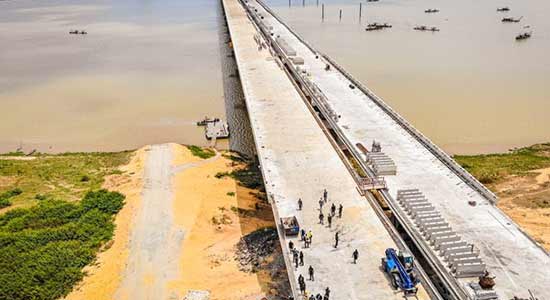
For over four decades, there has been an ongoing agitation for the construction of a second bridge to complement the aging Niger Bridge, which has served as the primary link road between the West and the East of Nigeria since its completion in 1965.

The need for a new bridge arose due to concerns over the old bridge’s age, excessive axle load, and the increasing traffic congestion resulting from economic activities along the South-East/South-West transport corridor. Especially during the Yuletide season, travelers often endure lengthy delays and traffic gridlock on the old bridge, making their journeys to and from festive celebrations nightmarish.
A Long Journey:
The push for a second Niger Bridge began during the military era but gained significant momentum during the return to civilian rule in 1999. It became a campaign promise for politicians, including former President Olusegun Obasanjo. While Obasanjo ceremoniously flagged off the bridge’s construction during his second tenure in 2007, progress was slow. The official groundbreaking ceremony finally took place on March 10, 2014, during President Goodluck Jonathan’s administration. However, the project faced delays during President Muhammadu Buhari’s first term. It wasn’t until Buhari’s second term that the Nigerian Sovereign Investment Authority (NSIA) took over the major part of the project, aiming for its completion by August 2022.
Project Specifications and Expansion:
In April 2022, the NSIA released specifications for the N427 billion second Niger Bridge project, outlining its scope and features. On November 12, 2020, President Buhari approved the second phase of the project, which included the construction of approach roads (2A – Benin to Asaba Expressway and 2B – Onitsha to Enugu Expressway) to improve traffic flow to and from the bridge.
Partial Commissioning and Usage Challenges:
On May 23, 2023, President Buhari commissioned the 1st phase of the second Niger Bridge project, marking a significant milestone. While the bridge was opened for temporary use, its limited usage has raised concerns. Only a few vehicles currently ply the new bridge, leading to continued congestion on the old Niger Bridge.
Security Concerns and Criminal Activities:
Worryingly, the new bridge has also become a target for criminals. Reports indicate cases of vandalism, particularly the removal of metal railings on the bridge. Additionally, criminal activities such as armed robbery and kidnapping have been reported on the bridge. The fear of insecurity has discouraged transporters and motorists from using the bridge.
Transporters’ Reluctance:
Uchenna Nebuwa, the National President of the Heavy Duty Drivers’ Association, cited the increasing incidents of robbery, kidnapping, and insecurity as reasons why their members avoid the second Niger Bridge. He also pointed out the deplorable condition of the Obosi-Owerri Road as a contributing factor.
Lack of Adequate Lighting:
Transporters and motorists have voiced concerns about the lack of adequate lighting on the bridge, making nighttime travel particularly daunting. This lack of illumination adds to the anxiety of using the bridge, especially during the dark hours.
Efforts to Address Concerns:
Efforts are being made to address these issues. Authorities have initiated patrols and security measures on the bridge, with a joint task force from Anambra and Delta states Police Command working to ensure safety. The Federal Ministry of Works has also reached out to security agencies for increased surveillance.
Continued Construction and Completion:
While the first phase of the second Niger Bridge has been commissioned, the project is far from complete. The second and third phases, which include road components, have not yet commenced. The completion of these phases is essential to fully alleviate traffic congestion and ensure the bridge’s viability.
Call for a National Steel Policy:
Authorities and experts have called for the implementation of a National Steel Policy to deter vandalism of critical components. By regulating the sale and purchase of steel components, it could help curb theft and vandalism.
Conclusion:
The second Niger Bridge, a long-awaited and crucial infrastructure project, has faced delays, security challenges, and underutilization. The completion of the remaining phases and the implementation of adequate security measures are necessary to ensure the bridge serves its purpose and enhances transportation between Nigeria’s West and East.
[A MUST HAVE] Evidence Act Demystified With Recent And Contemporary Cases And Materials

Available now for NGN 40,000 at ASC Publications, 10, Boyle Street, Onikan, Lagos. Beside High Court, TBS. Email publications@ayindesanni.com or WhatsApp +2347056667384. Purchase Link: https://paystack.com/buy/evidence-act-complete-annotation
______________________________________________________________________ “Enhance Legal Practice With Authoritative Reports” — Alexander Payne Offers Comprehensive Law Reports, Spanning Over A Century Of Nigerian Jurisprudence Interested buyers are encouraged to place their orders and enquiries via:
0704 444 4777, 0704 444 4999, 0818 199 9888
Website: www.alexandernigeria.com
Interested buyers are encouraged to place their orders and enquiries via:
0704 444 4777, 0704 444 4999, 0818 199 9888
Website: www.alexandernigeria.com