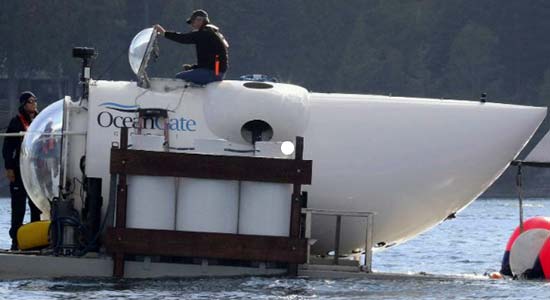
The safety of the tourist submersible that went missing on its way to the site of the Titanic has allegedly been a matter of concern before.


The Titan, carrying five passengers to the wreckage site 900 miles east of Cape Cod in the North Atlantic, went missing on June 18, according to the First Coast Guard District’s official Twitter account.
The excursion was part of OceanGate Expeditions — a company that hosts a “Titanic Expedition” to the historic site — and according to court documents obtained by The New Republic, a former employee had reportedly expressed concern several years ago about the sub’s capabilities.
Aboard the submersible was OceanGate CEO Stockton Rush, who was piloting the voyage; British-Pakistani businessman Shahzada Dawood and his son Suleman Dawood; and British billionaire Hamish Harding. Titanic expert Paul-Henri Nargeolet was also aboard the sub, according to the New York Times, ITV, and the BBC.
According to the 2018 breach of contract suit, former OceanGate employee David Lochridge, a submersible pilot and director of marine operations at the time, alleged that the sub could not safely reach the depths it needed for guests to see the Titanic wreckage — an estimated 13,000 feet underwater, TNR reported.
This information surfaced when Lochridge was reportedly fired and was sued by OceanGate after he allegedly refused to green-light “manned tests of the early model of the submarine” because he believed it was unsafe, and for allegedly disclosing confidential information, according to TNR.
He then countersued alleging he was wrongfully terminated for being a “whistleblower,” according to TNR.
An OceanGate spokesperson told PEOPLE that they were “unable to provide any additional information at this time” on Tuesday evening.
According to TNR, Lochridge’s counterclaim alleged: “Given the prevalent flaws in the previously tested 1/3 scale model, and the visible flaws in the carbon end samples for the Titan, Lochridge again stressed the potential danger to passengers of the Titan as the submersible reached extreme depths.”
The counterclaim alleged “the constant pressure cycling” would subsequently weaken any “existing flaws resulting in large tears of the carbon. Non-destructive testing was critical to detect such potentially existing flaws in order to ensure a solid and safe product for the safety of the passengers and crew.”
Lochridge alleged in his counterclaim that he was not the only employee who feared the safety of the vessel.
The counterclaim also alleged that “over the course of the next several days, Lochridge worked on his report and requested paperwork from the Engineering Director regarding the viewport design and pressure test results of the viewport for the Titan, along with other key information. Lochridge was met with hostility and denial of access to the necessary documentation that should have been freely available as part of his inspection process.”
According to the counterclaim, he claimed to voice his concerns and offered potential solutions to OceanGate management only to be allegedly ignored until a meeting was reportedly called in 2018 with the CEO, human resources director, engineering director, Lochridge, and the operations director, TNR reported.
Per the publication, the complaint further alleged: “At the meeting Lochridge discovered why he had been denied access to the viewport information from the Engineering department — the viewport at the forward of the submersible was only built to a certified pressure of 1,300 meters, although OceanGate intended to take passengers down to depths of 4,000 meters.”
“OceanGate refused to pay for the manufacturer to build a viewport that would meet the required depth of 4,000 meters,” the complaint alleged.
Per their website, expeditions to the Titanic site began in the summer of 2023 with a total of 18 dives planned.
“Each team of 6 Mission Specialists will join the expedition for a 10-day mission (8 Days at Sea),” the website explained, as “the entire expedition is comprised of 5 mission legs.”
According to the BBC, a seat on the submersible costs each participant $250,000.
The Titan launched Sunday before communication was lost between the submersible and the Canadian expedition vessel Polar Prince “approximately 1 hour and 45 minutes” into the dive, U.S. Coast Guard Captain Jamie Frederick said at a press conference on Tuesday.
The U.S. Coast Guard is conducting the search and rescue operation, in close collaboration with the Canadian Coast Guard, according to CBS News.
No seats and one toilet: What it’s like inside the submersible
The missing submersible is a small vessel designed to only hold five people for a day — two hours down, several hours exploring the Titanic and two hours back to the surface.
Last year, the founder of tour operator OceanGate Expeditions showed a CBS team the inside of a submersible used to visit the Titanic’s wreckage. The CBS video shows a small chamber, with about as much space as a minivan.
There are no chairs or seats and the passengers sit cross-legged on the floor, having taken off their shoes before entering.
For such an advanced submersible, the interior is mostly bare and simple, with just one button and a screen on the wall. The rest of the vessel’s operations are run on a handheld controller that looks remarkably similar to a gaming console, complete with colorful buttons.
There’s only one small toilet in the vessel’s front, which “doubles as the best seat in the house,” according to an OceanGate webpage that’s no longer available. It added that when the toilet is being used, they install a privacy curtain “and turn the music up loud.”
It recommended that passengers restrict their diet before and during the dive “to reduce the likelihood that you will need to use the facilities.”

Rear Adm. John Mauger, who is overseeing the search-and-rescue mission for the missing submersible, told reporters Monday that the Canadian Coast Guard has deployed multiple sonar buoys capable of detecting the submersible even at the bottom of the Atlantic.
Mauger has also acknowledged that it is possible that the Titan might have gotten stuck in the 111-year-old wreckage of the Titanic lying 12,500 feet deep in the ocean
Titanic’s fate has long been a source of fascination. Here are some key facts about the luxury liner
The submersible that has gone missing in the North Atlantic was part of an expedition to view the wreckage of the RMS Titanic, perhaps the most famous shipwreck in the world.
More than 100 years after its disastrous maiden voyage, the fate of the luxury liner has long served as a source of fascination, and been the backdrop for countless books, fiction and non-fiction and, of course, a blockbuster movie.
The ship set sail from Southampton, England, to New York on April 10, 1912.
Then, between April 14 to 15, it hit an iceberg around midnight and sank in less than three hours.
A total of 1,517 people died and 706 survived out of 2,223 passengers and crew, according to the US Senate report on the disaster.
Here are more interesting facts about the Titanic:
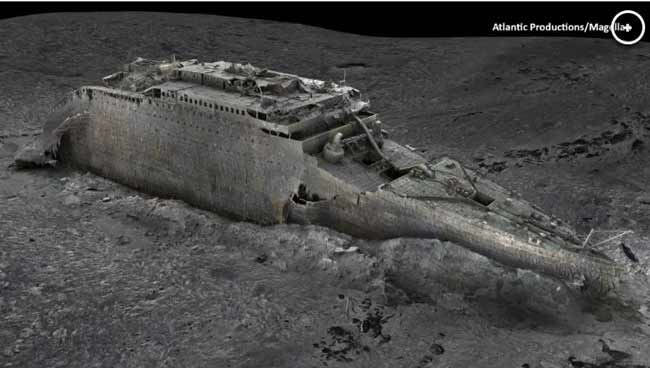
The ship: The estimated cost of construction was $7.5 million. At the time, the RMS Titanic was the largest passenger ship afloat. The ship’s length was 882 feet, 9 inches, and it weighed 46,328 tons. Its top speed was 23 knots. The wreckage is located about 350 miles off the southeast coast of Newfoundland.
How the Titanic sank: The iceberg punctured five of 16 supposedly watertight compartments designed to hold water in case of a breach to the hull. Investigations at the time blamed Capt. Edward Smith for going too fast in dangerous waters, initial ship inspections that had been done too quickly, insufficient room in the lifeboats for all passengers, and a nearby ship’s failure to help. Many maritime safety reforms were implemented as a result of the findings of the investigations.
Smith went down with the ship, and his body was never recovered.
Key dates post-shipwreck:
September 1, 1985: Scientists from Woods Hole Deep Submergence LAB in Massachusetts, led by Dr. Robert Ballard, and IFREMER, the French Institute Francais de Recherche pour l’Exploitation des Mers, led by Jean Jarry, locate the wreckage of Titanic.
July 13, 1986: Ballard and his crew use the manned deep-ocean research submersible Alvin to explore the wreckage. The Alvin is accompanied by a remotely operated vehicle named Jason Jr. to conduct photographic surveys and further inspections.
May 31, 2009: The last known survivor, Millvina Dean, dies at age 97.
April 8-20, 2012: The 100th anniversary of the Titanic’s voyage. The MS Balmoral traces the ship’s route from Southampton to New York and holds a memorial service, above the wreck, on April 15.
Summer, 2022: Deep sea investigators Magellan and filmmakers Atlantic Productions use deep sea mapping to create “an exact ‘Digital Twin’ of the Titanic wreck for the first time.”
 The book also examines Nigeria's legal ecosystem, focusing on the LPELR and NBA AI Guidelines. As a bonus, every purchase comes with a FREE eBook titled: How to Use the AI Features in LegalPedia and LawPavilion.
Ohio Books Ltd praises the publication, stating:
"....this is the only Nigerian book I know of on the topic."
How to Order:
📞 Call, Text, or WhatsApp: 08034917063 | 07055285878
📧 Email: benadigwe1@gmail.com
🌎 Website: www.benadigwe.com
Ebook Version: Access it directly online at https://selar.com/prv626
Authored by Ben Ijeoma Adigwe Esq., ACIarb (UK), LL.M, Dip. in Artificial Intelligence, Director at the Delta State Ministry of Justice, Asaba, Nigeria.
_______________________________________________________________________
The book also examines Nigeria's legal ecosystem, focusing on the LPELR and NBA AI Guidelines. As a bonus, every purchase comes with a FREE eBook titled: How to Use the AI Features in LegalPedia and LawPavilion.
Ohio Books Ltd praises the publication, stating:
"....this is the only Nigerian book I know of on the topic."
How to Order:
📞 Call, Text, or WhatsApp: 08034917063 | 07055285878
📧 Email: benadigwe1@gmail.com
🌎 Website: www.benadigwe.com
Ebook Version: Access it directly online at https://selar.com/prv626
Authored by Ben Ijeoma Adigwe Esq., ACIarb (UK), LL.M, Dip. in Artificial Intelligence, Director at the Delta State Ministry of Justice, Asaba, Nigeria.
_______________________________________________________________________
“Order Justice Omolaye-Ajileye’s Electronic Evidence Books Now” — Essential Guides On Evidence Act, Case Law And Digital Proof
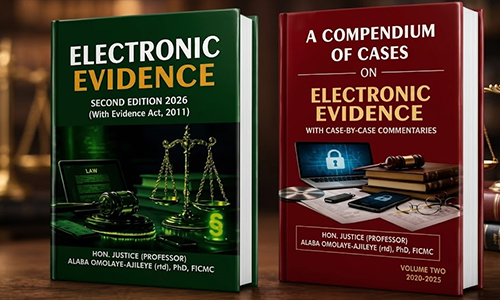

 Interested buyers are encouraged to place their orders and enquiries via:
0704 444 4777, 0704 444 4999, 0818 199 9888
Website: www.alexandernigeria.com
Interested buyers are encouraged to place their orders and enquiries via:
0704 444 4777, 0704 444 4999, 0818 199 9888
Website: www.alexandernigeria.com