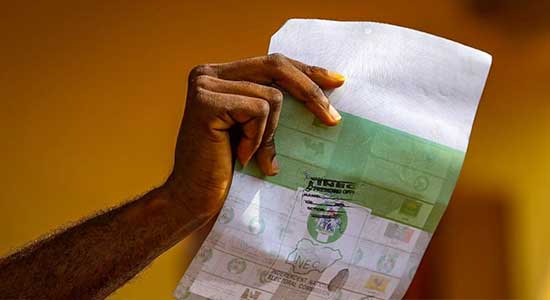
Justice Binta Nyako of a Federal High Court, Abuja, on Monday adjourned till January 30, the decision whether to compel the Independent National Electoral Commission (INEC) to allow registered voters without Permanent Voters Cards (PVCs) participate in the forthcoming general election.


Justice Nyako fixed the date for judgment shortly after lawyers representing parties in the matter ended their submissions for and against the case.
In the event that the plaintiffs’ case succeeds, the court is expected to either order INEC to ensure all registered voters get their PVCs before the general election, which commences with the presidential and National Assembly elections or in the alternative allow the use of temporary voters card or Voters Identification Number (VIN).
The Incorporated Trustees of International Society for Civil Liberties and the Rule of Law, Mr Emmanuel Chukwuka and Mr Bruno Okeahialam, had, in their suit asked the court to determine whether INEC can, as a consequence of its own contraption, bottleneck, compromise or negligence disenfranchise or deprive Nigerians the right or opportunity to vote in the forthcoming general election, having regard to the true intention of Section 47(1) of the Electoral Act, 2022.
In the suit marked: FHC/ABJ/CS/2022, the plaintiffs are asking the court to declare that having duly registered and captured in the INEC register of voters and electronic database of registered voters, they and the persons they represent in the suit are entitled to vote in the general election.
The plaintiffs’ lawyer, Mr Max Uzoaka, in his argument, urged the court to declare that all persons who have duly registered with INEC as voters and whose names are contained in its register of voters and, or electronic data base of registered voters should not be deprived of the right to vote in the forthcoming elections.
The lawyer claimed that the cause of action was triggered by a statement attributed to the INEC Chairman, Prof. Mahmood Yakubu, wherein he acknowledged that INEC facilities were attacked and razed down.
Uzoaka said INEC’s concept of ‘no PVC, no vote’ will deprive eligible voters whose PVCs were burnt during the attacks on INEC’s offices the opportunity of voting during the election.
He told the court that the BVAS machine introduced by INEC can accept the last six digits on the Temporary Voter Card to display the biometrics of people who are registered for the purpose of voting.
INEC, he said, has the responsibility of ensuring the safety of PVCs which are sensitive materials used during election.
In a counter affidavit, INEC, through its counsel, Abdulaziz Sani (SAN), prayed the court to dismiss the case of the plaintiffs for being frivolous, because it was based on a newspaper report, which the Supreme Court had cautioned against relying upon.
He said the memorandum of the first plaintiff did not show whether their mandates include the case they brought before the court.
According to him, the BVAS machine do not require the last six digits to work, saying that it is the PVC that enables the machine to recognise a voter.
The senior lawyer submitted that the plaintifffs did not prove that PVCs in INEC offices were burnt, adding that: “As far as this suit is concerned, there is nothing to show that any PVC was burnt as claimed by the plaintiffs.”.
He said the plaintiffs’ amended originating summons was premature and speculative and should be dismissed by the court.
After adoption of written addresses of counsel and their submissions, Justice Nyako adjourned till January 30 for judgement.
The plaintiffs had prayed the court for an order “compelling the defendant (INEC) to release forthwith the Permanent Voter Cards (PVCs) of the plaintiffs and all members of their class to enable them vote in the forthcoming general elections”.
On the alternative, the plaintiffs want the court to direct the electoral body to reprint, distribute and release their PVCs and all the persons they represent in the suit or, allow them to vote with their old (temporal) voter cards or registration slips already issued and released to them by INEC.
[A MUST HAVE] Evidence Act Demystified With Recent And Contemporary Cases And Materials

Available now for NGN 40,000 at ASC Publications, 10, Boyle Street, Onikan, Lagos. Beside High Court, TBS. Email publications@ayindesanni.com or WhatsApp +2347056667384. Purchase Link: https://paystack.com/buy/evidence-act-complete-annotation
______________________________________________________________________ “Enhance Legal Practice With Authoritative Reports” — Alexander Payne Offers Comprehensive Law Reports, Spanning Over A Century Of Nigerian Jurisprudence Interested buyers are encouraged to place their orders and enquiries via:
0704 444 4777, 0704 444 4999, 0818 199 9888
Website: www.alexandernigeria.com
Interested buyers are encouraged to place their orders and enquiries via:
0704 444 4777, 0704 444 4999, 0818 199 9888
Website: www.alexandernigeria.com