By Anthony S. Aladekomo

It is a notorious fact that a face-off is ongoing between the Governments of Rivers, Lagos and a few other States of Nigeria, on the one hand, and the Federal Government of Nigeria and its Federal Inland Revenue Service (FIRS), on the other hand, over who is lawfully entitled to administer value added tax (VAT) in the country. It has been dubbed the “VAT war” by the press. VAT had been collected from the various States and channelled into the Federation Account from where it is then unequally or “fairly” shared to all the States of the Federation. =N=15 billion VAT was generated in Rivers State, South-South, in June 2021 only for the Rivers State Government to get =N=4.7 billion VAT return whereas =N=2.8 billion VAT was generated in Kano State, North-West, then, only for the Kano State Government to get =N=2.8 billion return. Lagos State in the South-West was hit harder than Rivers State in the sharing.
Though recurring consumption tax legal battles between Nigerian State Governments—particularly Ogun and Lagos—and the Federal Government is traceable to the early 1960s as exemplified by such cases as Attorney-General of Ogun State v Aberuagba (1985) 1 NWLR (Pt. 3) 395, Nigeria Soft Drinks Company Limited v Attorney-General of Lagos State (1987) 2 NWLR (Pt 57) 444 CA and Attorney-General of Lagos State v Eko Hotels Limited (2017) 12 SC (Pt 1) 107; ALL NTC p. 333, among others, the latest “VAT war” was precipitated by the August 9, 2021 judgment of Justice Stephen Pam of the Federal High, Port Harcourt Division, Rivers State, in FHC/PH/CS/149/2020: Attorney-General of Rivers State v FIRS. The judgment was sequel to a suit filed by the Rivers State Government contesting the Federal legislation on and imposition of valued added tax and collection of it by its FIRS. The judgment went in favour of the Rivers State Government.
The result of the latest VAT case is that Southern States like Rivers, Lagos, Ogun and Cross Rivers, from which the lion share of VAT accrues to the Federation Account, have swiftly enacted or about enacting their VAT Laws. Those Laws leverage on the said judgment by vesting the imposition, collection and exclusive utilisation of the VAT derived from those States in their State Governments. The foregoing developments have jolted some Northern State Governors; perhaps only Kano and Kaduna are the Northern States that can bear the immediate consequences of the fiscal implications of that judgment. Some aggrieved Northern Governors or elements have since resorted to verbal attacks or legal shenanigans in order to maintain “business as usual”. What has been very disturbing to some members of the legal profession is that some have smartly resorted to what many have described as forum shopping. Really, why on earth should the appellants in the case shun the Port Harcourt Division of the Court of Appeal and file their appeal at the Abuja Division of the appellate court? The appellate court has speedily ordered the Rivers and Lagos State Governments to maintain the status quo, meaning that their hands are now tied from administering VAT in their States even after they had validly enacted the necessary enabling Laws under section 4 of the Constitution.
But are the Governments of Rivers, Lagos and the others States really entitled to administer VAT in their States? I think so, even though many tax law experts did not advert their minds to this for decades. We seemed to have just been carried away by the fact that a military Decree imposed the value added tax in 1993. But the law is that no military Decree is superior to the Nigerian Constitution. It is trite law that, as section 1 (3) of the 1999 Nigerian Constitution provides, “if any other law is inconsistent with the provisions of this Constitution, this Constitution shall prevail, and that other law shall, to the extent of the inconsistency, be void.” Moreover, while customs and excise duties (item 16), (Federal) stamp duties (item 58) and company income tax, (Federal) personal income tax and capital gains tax (item 59) are expressly and categorically named as taxes collectible by the Federal Government in the Exclusive Legislative List in Part I of the Second Schedule to the 1999 Nigerian Constitution, VAT or even sales tax or consumption tax is never so named therein. VAT cannot even really be read into item 62, which vests jurisdiction over “trade and commerce” in the Federal Government, because neither VAT nor sales tax is specifically mentioned under the particulars under it. The principle of interpretation of statures would not allow you to read into the Constitution what it does not expressly contain. In Attorney-General of the Federation v Attorney-General of Lagos State [2013] 16 NWLR (Pt. 1380) 249 SC, the Supreme Court enjoins Nigerian courts to normally give words their ordinary and natural meanings. In Tukur v Government of Gongola State (1989) 4 NWLR (Pt 117) 517, it was held that the principle of interpretation states that the maker of any law, be it a constitution or a statute, does not use any words in vain, nor does he indulge in tautology or surplussage in the use of the words. That one is not allowed to make extraneous reading into the provisions of a statute is even more sacred in tax law than in any other branch of law. There is no implied statutory provision for a tax. That is why, whereas there is law of taxation under common law, there is no common law of taxation. As Rowlat J memorably held in Cape Brandy Syndicate v IRC (1921) 1 KB 64, one has to look merely at what is expressly written in the law; no presumption or intendment or equity can be read into a tax statute. Neither FIRS nor its principal, the Federal Government, can escape from this immutable legal position. Obviously, that is why the Executive Chairman of the FIRS surreptitiously wrote a letter, dated July 1, 2021, to the Chairman of the House of Representatives Constitution Review, who is also the House Deputy Speaker, Alhaji Idris Wase, urging the National Assembly to add VAT to item 58 on the Exclusive Legislative List. Perhaps, the FIRS leadership forgot that section 9 (2) of the Constitution makes such an amendment very rigid. How will they get the “resolution of the Houses of Assembly of not less than two-thirds of all the States” to support the intended constitution amendment? In a nutshell, fiscal federalism or fiscal restructuring had already been embedded in the 1999 Constitution, at least as far as VAT is concerned. Let us admit this and ease the current tension in the Federation. No lawyer, arbiter, government official or Jupiter should allow himself to be prejudiced by sectional, regional, ethnic or religious sentiments in the VAT matter. As a matter of fact, my own State of origin would be one of the hardest hit if the judgment is upheld, but, as I have done here, I must hold the truth sacred.
In the light of the foregoing, the parties concerned have got to allow the constitutional position or silence on VAT to run its course. They all need to admit that the Value Added Tax Act 1993 as amended, Chapter V1, Laws of the Federation of Nigeria 2004, is inconsistent with the 1999 Nigerian Constitution. It is submitted that no amount of forum shopping, legal gymnastics or delay tactics can make it look otherwise. Since the Constitution is silent on it in both the Exclusive and the Concurrent Lists, VAT is residual and accordingly a matter for the State. Perhaps, we should also all commend the radical lawyer Governor Nyesom Wike of Rivers State and Justice Stephen Pam, whose courage to ruffle feathers in the interest of justice, has opened our eyes to this tax, fiscal and legal position. To me, there is neither victor nor the vanquished in the so-called “VAT war.” Let all the States go back to the drawing board and leverage on the areas of productivity and revenue generation where they have a comparative advantage. God bless Nigeria!
Anthony S. Aladekomo is a Lagos-based law lecturer.
 Interested buyers are encouraged to place their orders and enquiries via:
0704 444 4777, 0704 444 4999, 0818 199 9888
Website: www.alexandernigeria.com
Interested buyers are encouraged to place their orders and enquiries via:
0704 444 4777, 0704 444 4999, 0818 199 9888
Website: www.alexandernigeria.com

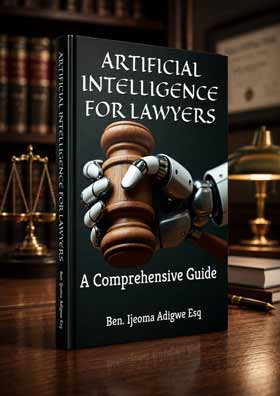 The book also examines Nigeria's legal ecosystem, focusing on the LPELR and NBA AI Guidelines. As a bonus, every purchase comes with a FREE eBook titled: How to Use the AI Features in LegalPedia and LawPavilion.
Ohio Books Ltd praises the publication, stating:
"....this is the only Nigerian book I know of on the topic."
How to Order:
📞 Call, Text, or WhatsApp: 08034917063 | 07055285878
📧 Email: benadigwe1@gmail.com
🌎 Website: www.benadigwe.com
Ebook Version: Access it directly online at https://selar.com/prv626
Authored by Ben Ijeoma Adigwe Esq., ACIarb (UK), LL.M, Dip. in Artificial Intelligence, Director at the Delta State Ministry of Justice, Asaba, Nigeria.
_______________________________________________________________________
The book also examines Nigeria's legal ecosystem, focusing on the LPELR and NBA AI Guidelines. As a bonus, every purchase comes with a FREE eBook titled: How to Use the AI Features in LegalPedia and LawPavilion.
Ohio Books Ltd praises the publication, stating:
"....this is the only Nigerian book I know of on the topic."
How to Order:
📞 Call, Text, or WhatsApp: 08034917063 | 07055285878
📧 Email: benadigwe1@gmail.com
🌎 Website: www.benadigwe.com
Ebook Version: Access it directly online at https://selar.com/prv626
Authored by Ben Ijeoma Adigwe Esq., ACIarb (UK), LL.M, Dip. in Artificial Intelligence, Director at the Delta State Ministry of Justice, Asaba, Nigeria.
_______________________________________________________________________