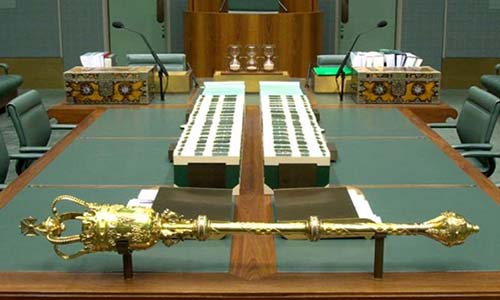
The legislature of any country is an assemblage of men of honour and integrity adjudged worthy by the people to represent their interest in Parliament. Thus, legislative acts ought to, at all times, represent the interest of the people.

It therefore goes without saying that the legislators or members of parliament should at all times be guided by good conscience and should not by collusion or connivance breach the Constitution which is not their exclusive property but the property of all Nigerians. See A. G, Abia & Lors v. A. G, Federation (2004 – 2007) 3 LLRN p. 1260. [Page 1336, para 35]. In Danladi v. T.S.H.A (2015)2 NWLR (pt. 1442) p.103, the Supreme Court said, “…legislative acts should be seen at all times as in the best interest of the country and not to settle political scores…”
Now, can it be said that the order issued by the House of Reps for a fresh proclamation on Edo House of Assembly is in the best interest of the people? In our view, the issuance of the said order cannot serve the interest of the people being an unconstitutional act. Section 105(1) of the 1999 Constitution provides that a House of Assembly shall stand dissolved at the expiration of a period of four years commencing from the date of the first sitting of the House.
Clearly, the first session of the 7th Edo State House of Assembly commenced after the governor first issued a proclamation. The fresh proclamation ordered by the House of Reps is unknown to law. The governor does not have the power to proclaim the holding of the first session of the House of Assembly more than once whether or not the proclamation and holding of the first session was properly done.
Thus, it is legally impossible for the governor to comply with the said order having exhausted his power in that wise when he first proclaimed the holding of the first session in which the principal members of the House were elected. Indeed, the word proclamation is not intended to be used and, as a matter of law, cannot be used again when the House has previously been proclaimed. See Hon. Michael Balonwu v. Gov., Anambra State (2007 – 2010) 4 LLRN p. 2081.
Assuming, without conceding, that the governor still retains the power to issue a fresh proclamation, it will be inappropriate for him to do so in violation of injunctive orders of court, in respect of the matter, as doing so will be foisting upon the court complete helplessness and legal paralysis where there can be no return to the Status quo ante. It must be understood by the honourable members of House of Reps that a legislative order which will stifle the discretion of the court in a pending litigation is not condonable by courts. The court is known to resort to its inherent powers to discipline the erring party in order to maintain, restore and preserve the dignity and respect for judicial authority. See A.P.C. v. Karfi (2018) 6 NWLR (Pt. 1616) 479.
Moreover, the said order carries with it all the trappings of chaos and disorder not only because it was given in disobedience to valid orders of a competent court but complying with it is capable of distorting the date of the first sitting of the Edo House of Assembly for the purpose of computation of the tenure of the 7th Assembly. Section 105(3) of the 1999 Constitution which provides for the issuance of a proclamation by an elected governor for the commencement of legislative business provides:
“Subject to the provision of this Constitution, the person elected as the governor of a State shall have power to issue a proclamation for the holding of the first session of the House of assembly of the State concerned immediately after being sworn in, or for its dissolution as provided in this section.”
Thus, within the context of section 105(3) of the 1999 Constitution, the word proclamation simply announces the first assemblage of the House of Assembly. It is done to kick-start legislative business. When an elected governor of a State has issued a proclamation for the first session of the House of Assembly, legislative business begins. The legality or otherwise of such proclamation is not a subject of lawful or legitimate exercise of legislative power of the National Assembly when such matter is sub judice together with the fact that the House of Assembly can hold meetings and transact business.
We do, however, hold the view that since the matter is of public interest, even though the matter is sub judice, the general public including the House of Reps may pass fair comments or criticisms which should be limited to what is reasonably necessary for that purpose. In Kalu v. F.R.N. (2014) 1 NWLR 479, the court said:
“It is commonly supposed that once a writ is issued, it puts a stop to discussion. If anyone wishes to canvass the matter in the press or in public, it cannot be permitted. It is said to be sub judice. However that is a misconception. If it is a matter of public interest, it can be discussed at large without fear of their being in contempt of court. Criticisms can continue to be made and can be repeated. Fair comment does not prejudice a fair trial…”
The unfortunate position of the House of Reps on a matter already before the court, in our view, makes nonsense of the principle of separation of powers which is the pride of a constitutional democracy. The essence of separation of powers is that one organ should act as check on the abuse of power by another organ. See Olisa Agbakoba v. National Assembly & Anor (2007 – 2010) 4 LLRN p. 2078. See also A. G, Abia State v. A. G, Federation & Ors (2003) 4 NWLR (pt. 809) 124 at 177-178 F-C. In Gadi v. Male (2010) 7 NWLR (pt. 1193) p. 225, SAULAWA, J.C.A said:
“The Constitution is founded upon the well cherished principle of the separation of powers. And by virtue of that principle, neither the Executive nor the Judiciary can interfere with, or take away, from the legislature functions that are strictly and exclusively assigned thereto by the Constitution. In the same vein, the legislature has no power to usurp the functions that are exclusively and strictly assigned thereto by the Constitution in question…”
The House of Reps has no business being on the legislative runway of the Edo State House of Assembly in the circumstance. The situation contemplated in section 11 of the 1999 Constitution cannot be said to have appeared in the Edo political space. Section 11 of the 1999 Constitution is never intended to give a complete and unabridged jurisdiction to the National Assembly over matters relating to “good government” when the House of Assembly can meets and transact legislative business, worse still when the House of Reps singlehandedly without the Senate, transacted in an unholy legislative business.
It is our humble view that the House of Reps should quickly retrace its steps in order not to be seen as constituting a hindrance to progress, good government and the growth of a healthy democratic culture in Nigeria.
Basil Momodu Esq., Legal Research & law Publishing., lindabasil@yahoo.com
[A MUST HAVE] Evidence Act Demystified With Recent And Contemporary Cases And Materials

Available now for NGN 40,000 at ASC Publications, 10, Boyle Street, Onikan, Lagos. Beside High Court, TBS. Email publications@ayindesanni.com or WhatsApp +2347056667384. Purchase Link: https://paystack.com/buy/evidence-act-complete-annotation
______________________________________________________________________ “Enhance Legal Practice With Authoritative Reports” — Alexander Payne Offers Comprehensive Law Reports, Spanning Over A Century Of Nigerian Jurisprudence Interested buyers are encouraged to place their orders and enquiries via:
0704 444 4777, 0704 444 4999, 0818 199 9888
Website: www.alexandernigeria.com
Interested buyers are encouraged to place their orders and enquiries via:
0704 444 4777, 0704 444 4999, 0818 199 9888
Website: www.alexandernigeria.com