By Femi Falana SAN

By virtue of section 2 of the National Youth Service Act, every citizen who has graduated at any tertiary institution in and outside Nigeria and is not 30 years old shall be mobilised for the one year compulsory national youth service. Any person above 30 is not eligible to participate in the national youth service .
Section 13 of the Act provides that any person who fails to report for service in the service corps in the manner directed by the Directorate or who refuses to make himself available for service in the service corps is guilty of an offence and liable on conviction to a fine of N2,OOO or to imprisonment for a term of 12 months or to both such fine and imprisonment.
A person who is disqualified by law to be a lawmaker is also disqualified to be appointed as a minister. The Constitution appears to have set the same qualifications and disqualifications for the two offices. Specifically, section 147(6) of the Constitution provides that no person shall be appointed as a Minister of the Government of the Federation unless he is qualified for election as a member of the House of Representatives. Any person who did not participate in the national youth service is not qualified to be a member of the House of Representatives.
In the case of MODIBO v. USMAN & Ors (2019)LPELR-59096(SC) where the appellant contested and won election into the House of Representatives while he was undergoing the national youth service. The Federal High Court ruled that a youth corps member was not qualified to contest election in Nigeria. The Court of Appeal set aside the judgment on the ground that a youth corps member is not constitutionally disqualified from contesting election. But the Supreme Court held that the Court of Appeal erred in law and proceeded to affirm the decision of the trial court. In the leading judgment of the Supreme Court in Modibbo v Usman, Eko JSC stated inter alia:
“It appears that the lower court had suggested quite obliquely that the appellant, an undoubted NYSC member and indeed any NYSC member, could combine the full time activities as a member of the House of Representatives. That to me appears absurd. The lower court failed to be guided by the overall public policy in the National Youth Service Act.
Neither the lower court nor the appellant satisfactorily addressed the point raised by the trial court and the 1st Respondent/cross appellant that public policy “under National Youth Service Corps (NYSC scheme and the Bye-Law (Revised) 2011 made pursuant to the NYSC Act forbids a corps member from going into politics” or holding a partisan political appointment.”
In his contribution to the leading judgment, Okoro JSC had this to say;
“Also, it is not in dispute that the appellant was still a serving corps member at the time he contested and “won” the primary election. This was a clear violation of section2(1)and(3)of the National Youth Service Corps Act and section 4(9) of the National Youth Service Corps Bye-Laws (Revised 2011). The court below was wrong to suggest that the appellant could combine the fulltime activities as a member of the House of Representatives with his primary assignment as a Corps member. By virtue of section 2 of the NYSC Act, a person called upon to serve in the service Corps is under an obligation to serve for a continuous period of one year from the date specified in the call-up letter. Section 4(9) of the NYSC Bye Laws (Revised 2011) provides as follows:
‘Every member shall “Not take part in partisan politics. Any member who takes part in partisan politics is liable to extension of service for a period not less than three (3) months without pay.’
By section 13(i)(3) and (5) of the NYSC Act, it is an offence F not to make oneself available for the service for a continuous period of one year as prescribed in section 2 of the Act. The section also prescribes punishment for an employer which aids or abets a Corps member to contravene the provisions of the Act.
It is instructive to note that the National Youth Service Corps Decree has been validated by section 315 (5) of the 1999 Constitution. The appellant could therefore not be eligible to contest the said primary election while still undergoing the compulsory one year service period. The law will not allow the appellant in this appeal to benefit from his wrongful act. See Solanke v Abed (1962) 1 SCNLR 37.”
Having been proved to have contravened some provisions of the National Youth Service Act and Bye-Laws, Augie JSC said:
“With a prison sentece hanging over his head, if he refuses to make himself available for his NYSC, the appellant cannot be a member of the House of Representative and Youth Corper at the same time.”
In justifying the annulment of the election of the Appellant, Abba-Aji JSC asserverated thus:
“It is without dispute that the appellant has been a beneficiary of the Federal Government NYSC Allowance or salary as at the time he contested. Partisan political involvement and participation even – to the level of occupying a political seat is forbidden and prohibited by the law because every political position is a position of utmost trust and confidence and the sole business and allegiance of a politician is to the people who voted him into power and whom he represents and that does not admit of jack of all trades but master of none.
The politician is expected to concentrate fully in his political activities and functions and in this case, a very crucial function of law making. It is in this contemplation that many other services to the Federal Government do not admit or allow participation into politics or other engagements during the pendency of that service. To be a Corps member and a law maker at the same time can not be allowed. Thus, the Constitution came to give a guideline as follows in section 66 (1)(f) of the Constitution of the Federal Republic of Nigeria 1999 (as amended):
‘No person shall be qualified for election to the Senate or the House of Representatives if … he is a person employed in the public service of the Federation or of any State and has not resigned, withdrawn, or retired from such employment thirty days before the date of election.’
It is the unchallenged and undisputed fact that the appellant’s political position or office was the House of Representatives for Yola South/Yola North/Girei Federal Constituency of Adamawa State. This office was contested by him when he was in active NYSC service and has not passed out or resigned or withdrawn from it. Being paid by the public fund, he therefore qualified to be a public office holder if he discharges any duty in the discharge of which the public are interested, more clearly if he is paid out of a fund provided by the public.”
It is crystal clear from the authoritative pronouncements of the Supreme Court in the case of Modibbo v Usman (supra) that a youth corps member is not competent to contest any election in Nigeria. In the same vein, a person who has not completed the compulsory one year youth service is not competent to be appointed a Minister in Nigeria since the Constitution has prescribed the same qualifications and disqualifications for election into the House of Representatives and appointment into the post of a Minister.
 _______________________________________________________________________
[A MUST HAVE] Evidence Act Demystified With Recent And Contemporary Cases And Materials

Available now for NGN 40,000 at ASC Publications, 10, Boyle Street, Onikan, Lagos. Beside High Court, TBS. Email publications@ayindesanni.com or WhatsApp +2347056667384. Purchase Link: https://paystack.com/buy/evidence-act-complete-annotation
______________________________________________________________________ ARTIFICIAL INTELLIGENCE FOR LAWYERS: A COMPREHENSIVE GUIDE
Reimagine your practice with the power of AI “...this is the only Nigerian book I know of on the topic.” — Ohio Books Ltd
Authored by Ben Ijeoma Adigwe, Esq., ACIArb (UK), LL.M, Dip. in Artificial Intelligence, Director, Delta State Ministry of Justice, Asaba, Nigeria.
Bonus:
Get a FREE eBook titled “How to Use the AI in Legalpedia and Law Pavilion” with every purchase.
ARTIFICIAL INTELLIGENCE FOR LAWYERS: A COMPREHENSIVE GUIDE
Reimagine your practice with the power of AI “...this is the only Nigerian book I know of on the topic.” — Ohio Books Ltd
Authored by Ben Ijeoma Adigwe, Esq., ACIArb (UK), LL.M, Dip. in Artificial Intelligence, Director, Delta State Ministry of Justice, Asaba, Nigeria.
Bonus:
Get a FREE eBook titled “How to Use the AI in Legalpedia and Law Pavilion” with every purchase.
How to Order: 📞 Call, Text, or WhatsApp: 08034917063 | 07055285878 📧 Email: benadigwe1@gmail.com 🌐 Website: www.benadigwe.com
Ebook Version: Access directly online at: https://selar.com/prv626
______________________________________________________________________ “Bridging Theory And Courtroom Practice” — Hagler Sunny Okorie, Nathaniel Ngozi Ikeocha Unveil ‘Functional’ Tort Law Book For Nigerian Legal System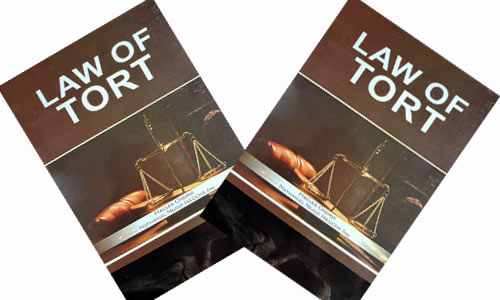 The book, titled The Law of Torts in Nigeria: A Functional Approach, authored by Professor Hagler Sunny Okorie Ph.D and Ikeocha, Nathaniel Ngozi Esq, offers law students, practitioners, and academics a comprehensive guide to understanding and applying tort law in Nigerian courts. Interested buyers can place orders via the following contact numbers: 08028636615, 08037667945, 08032253813, or +234 902 196 2209.
______________________________________________________________________
“Enhance Legal Practice With Authoritative Reports” — Alexander Payne Offers Comprehensive Law Reports, Spanning Over A Century Of Nigerian Jurisprudence
The book, titled The Law of Torts in Nigeria: A Functional Approach, authored by Professor Hagler Sunny Okorie Ph.D and Ikeocha, Nathaniel Ngozi Esq, offers law students, practitioners, and academics a comprehensive guide to understanding and applying tort law in Nigerian courts. Interested buyers can place orders via the following contact numbers: 08028636615, 08037667945, 08032253813, or +234 902 196 2209.
______________________________________________________________________
“Enhance Legal Practice With Authoritative Reports” — Alexander Payne Offers Comprehensive Law Reports, Spanning Over A Century Of Nigerian Jurisprudence
 Interested buyers are encouraged to place their orders and enquiries via:
0704 444 4777, 0704 444 4999, 0818 199 9888
Website: www.alexandernigeria.com
Interested buyers are encouraged to place their orders and enquiries via:
0704 444 4777, 0704 444 4999, 0818 199 9888
Website: www.alexandernigeria.com