*Demand Independent Investigation

Nigerians across the political spectrum have overwhelmingly rejected the Independent National Electoral Commission’s announcement that a forensic probe has cleared its Chairman, Professor Joash Amupitan SAN, of allegations relating to a partisan social media account with lawyers, activists, and ordinary citizens citing the fundamental legal principle of nemo judex in causa sua (no one should be judge in their own cause) and describing the self-conducted investigation as “ridiculous,” “farcical,” and a violation of basic principles of justice.
The backlash expressed across X, Instagram, and other social media platforms has been near-universal, with Nigerians pointing out that INEC set up the investigation committee, INEC’s chairman authorised payment for it, INEC received the report, and INEC announced the findings making the commission simultaneously the accused, the investigator, the judge, and the announcer of its own acquittal.
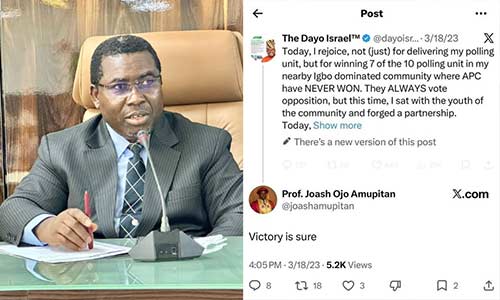
The reaction marks the latest and potentially most damaging chapter in the controversy that has engulfed the INEC chairman since the resurfacing of a “Victory is sure” social media post allegedly made under an APC-aligned tweet a controversy that has already drawn calls for resignation from former NHRC Chairman Chidi Odinkalu, demands for a National Assembly investigation from SERAP, and an inadvertent confirmation of the tweet’s authenticity from Senate President Godswill Akpabio.
The most consistent legal objection raised by Nigerians centres on the ancient and universally recognised legal principle that no person or institution should be a judge in their own cause.
“Nemo judex in causa sua this means, in law, INEC cannot be a judge in its own cause,” a legal commentator posting under the handle @Barristerstreet stated, adding that he had read the entire press release “to find out who authored the investigation, and all I can see are repeated references to ‘an independent forensic’ without identifying the investigators.”
“INEC cannot be a judge in its own case and expect Nigerians to believe the outcome,” another user stated.
“You cannot be the judge, jury and executioner. This pseudo-democracy you guys are practising has become evident,” another wrote.
“How can INEC be the judge over its own case? Una just dey play,” another stated in a mix of English and Pidgin that captured the exasperation felt by many.
The legal principle one of the twin pillars of natural justice alongside the right to fair hearing applies not only to courts but to any investigative or quasi-judicial process where the outcome affects the rights, reputation, or status of the person being investigated. An institution investigating its own chairman and announcing that he has been cleared violates this principle regardless of what the investigation actually found.
Meanwhile, a source told our correspondent that they have written to X, citing privacy concerns for not releasing the information, and noted that such details can only be disclosed upon a court order, as the platform holds the full records of the account in question.
While, the most frequently asked question across social media was simple: who actually conducted the forensic investigation?
“Who conducted the forensic probe, and what are the criteria used?” one user asked.
“Forensic probe by who? Would a thief declare himself guilty?” another asked.
“Which forensic probe? How did they come to the conclusion? Lies everywhere,” another stated.
“We need independent forensic and not a fake one set up by the said INEC itself,” another demanded.
“Chidubem.O” asked pointedly: “Who conducted the forensic in the first place?”
The absence of clear, independently verifiable information about the identity of the forensic investigators, their terms of reference, their methodology, and their findings has deepened suspicion that the investigation was designed to produce a predetermined outcome rather than to establish the truth.
Several Nigerians captured the absurdity of the situation in a single phrase.
“The caption should have been ‘Amupitan clears Amupitan’ case closed!” one user wrote, encapsulating the public perception that the INEC chairman effectively investigated and acquitted himself.
“INEC chairman set up a committee to investigate his alleged misconduct and he authorised payment for same and the report was submitted to him. What happens to the principle of law that you cannot sit as a judge over your own case? What happens to suspension from office pending investigation?” another user asked, raising the additional point that in any credible accountability framework, a person under investigation should step aside during the process rather than overseeing it.
“APC via INEC probing themselves and also clearing themselves,” another observed with laughing emojis.
“This APC flag bearer can never be a referee in a game he is also a player. The more you try to deny it, the more you complicate your issues. #AmupitanMustGo,” another wrote.
Beyond the legal objections, Nigerians questioned the institutional competence of INEC to conduct forensic digital investigations in the first place.
“This is funny. INEC did forensic of Amupitan’s tweet. When did INEC add forensic investigation to their job?” one user asked, highlighting that the commission’s mandate is to organise and conduct elections — not to conduct digital forensic investigations.
The observation underscores the broader concern: INEC is an electoral body, not a forensic investigation agency. If the commission genuinely wanted to establish the truth about the social media account, the investigation should have been conducted by an independent forensic firm with no connection to INEC, or by a body with statutory investigative authority such as the National Assembly exercising its oversight powers.
Dr. Bello Saleh, a PhD holder who had been commenting on the controversy, offered perhaps the most damning assessment.
“This non-defence is ridiculous, farcical and shameful. And these are the lot we expect to deliver a free and fair election in 2027!” Saleh stated.
He had earlier posted: “Refusing to remove a compromised INEC chairman sends one message: ‘The outcome matters more than the process.’ That’s not democracy. That’s choreography.”
The “choreography” metaphor captured the growing public perception that INEC’s actions from the initial denial, to the self-investigation, to the self-clearance are not genuine accountability measures but rehearsed performances designed to maintain the status quo while creating the appearance of due process.
Several Nigerians advised INEC that continued self-defence was making the situation worse rather than better.
“Stop fooling yourselves APC! This is the digital age! When you are in a hole, stop digging! Just let Amupitan resign!” one user wrote.
“I didn’t need to read it to know you will tweet another lie. Just look at what a commission that is supposed to be independent is doing. Even with all the available evidence, you chose to stand on business. Not like you had any reasonable credibility before, but this is the straw,” another stated.
“INEC has been compromised. They shouldn’t waste their time in 2027. They can announce Tinubu as winner,” another wrote in a tone of bitter resignation.
Underlying the outrage is a sense that the available evidence which linking the @joashamupitan account to Amupitan’s personal Yahoo email from his University of Jos CV, the rapid changes to the account (username change, locking, “Parody Account” relabelling) at the exact moment the controversy erupted, and Senate President Akpabio’s implicit confirmation that the tweet was genuine has not been adequately addressed by INEC’s self-conducted probe.
“Una go explain tire, evidence dey,” one user stated simply meaning “you’ll get tired of explaining, the evidence exists.”
The point is that the public evidence linking the account to Amupitan is detailed, specific, and verifiable while INEC’s forensic clearance is vague, self-directed, and lacking in publicly disclosed methodology or findings.
The hashtags #AmupitanMustGo and #AmupitanMustResign continue to trend, with Nigerians maintaining that no amount of self-investigation can substitute for the kind of independent, transparent inquiry that SERAP has demanded from the National Assembly.
The fundamental demand remains unchanged: either an independent body investigates the allegations and publishes its findings transparently, or Amupitan resigns to preserve whatever remains of INEC’s institutional credibility ahead of the 2027 elections.
As one user summarised: “INEC cannot be the judge, jury and executioner in its own case. Nigerians reject this kangaroo forensic probe.”
The commission’s decision to investigate and clear its own chairman rather than submitting to independent scrutiny has not resolved the controversy. It has deepened it, confirming the very perception of institutional capture that the investigation was presumably meant to dispel.
For an institution whose name begins with “Independent,” the inability to demonstrate independence in investigating its own chairman raises the question that now haunts every aspect of Nigeria’s electoral preparation: if INEC cannot be independent about its own chairman, how can it be independent about the elections?
[A MUST HAVE] Evidence Act Demystified With Recent And Contemporary Cases And Materials

Available now for NGN 40,000 at ASC Publications, 10, Boyle Street, Onikan, Lagos. Beside High Court, TBS. Email publications@ayindesanni.com or WhatsApp +2347056667384. Purchase Link: https://paystack.com/buy/evidence-act-complete-annotation
______________________________________________________________________ “Enhance Legal Practice With Authoritative Reports” — Alexander Payne Offers Comprehensive Law Reports, Spanning Over A Century Of Nigerian Jurisprudence Interested buyers are encouraged to place their orders and enquiries via:
0704 444 4777, 0704 444 4999, 0818 199 9888
Website: www.alexandernigeria.com
Interested buyers are encouraged to place their orders and enquiries via:
0704 444 4777, 0704 444 4999, 0818 199 9888
Website: www.alexandernigeria.com