By Hameed Ajibola Jimoh Esq.

This year 2024 marks the 25th year of Democracy in Nigeria. The Nigerian Federal Government had proposed her anniversary Public Lecture with the Theme: ’25 Years of Enduring Democracy: The Prospect for the Future’, held in the Federal Capital Territory, Abuja, held on Tuesday, 11th June, 2024 (in preparation for the 12th od June’s Democracy Day Anniversary Celebration). This paper has couched its topic around this theme for a better contribution to the subject matter. Hence, this paper.
Former President Muhammadu Buhari had directed that effective 2019 Nigeria’s Democracy Day, marked every May 29 for the past 18 years, be shifted to June 12 to honour Moshood Abiola, the winner of the 1993 presidential election. Hence, June 12 of every year has been declared as the ‘Democracy Day Anniversary’ in Nigeria. I therefore (by this paper) wish to congratulate and celebrate the said ‘Democracy Day Anniversary’ with Nigeria, the Nigerian government and all Nigerians (home and abroad) on this occasion!
The word ‘Democracy’ according to President Abraham Lincoln, the then President of the United States of America, is ‘a government of the people, by the people and for the people’. In other words, ‘Democracy’ is: (i) a government made up of the generality or representatives of the people; (ii) a government formed and installed by the people; and (iii) a government that exists for the welfare of the people’. See: Ese Malemi, The Nigerian Constitutional Law, Princeton Publication Co., Ikeja, Lagos, Nigeria, First Edition, 2006, page: 30. There is no doubt that in Nigeria, as of the moment, the types of democracy practiced is ‘the Indirect/Representative Democracy,’ which is a system of democracy where all persons of voting age are expected to vote to form the government by electing persons into government who will represent and act on their behalf, especially in the executive and legislative arms of government, which elected persons are expected to properly constitute all the other organs and agencies of government, and generally manage the affairs of government for the welfare of the people’. See: Ese Malemi (op cit) at page 31. As has been said above, government is then a joint function of: (i) the Executive; (ii) Legislature; (iii) and the Judiciary. Furthermore, democracy seems to human rights activists and or lawyers a better alternative for Nigeria, after her experiences with the Military Forces of the Military leadership. According to section 14 of the Constitution of the Federal Republic of Nigeria, 1999 (as amended)- herein after referred to as the Constitution-, the democratic principles are well laid down as follows (which means that democracy in Nigeria is more a constitutional concept than it appears as an academic discourse):
14.—(1) The Federal Republic of Nigeria shall be a State based on the principles of democracy and social justice.
(2) It is hereby, accordingly, declared that—
(a) sovereignty belongs to the people of Nigeria from whom government through this Constitution derives all its powers and authority;
(b) the security and welfare of the people shall be the primary purpose of government; and
(c) the participation by the people in their government shall be ensured in accordance with the provisions of this Constitution.
(3) The composition of the Government of the Federation or any of its agencies and the conduct of its affairs shall be carried out in such manner as to reflect the federal character of Nigeria and the need to promote national unity, and also to command national loyalty thereby ensuring that there shall be no predominance of persons from a few States or from a few ethnic or other sectional groups in that government or in any of its agencies.
(4) The composition of the Government of a State, a Local Government council, or any of the agencies of such Government or council, and the conduct of the affairs of the Government or council or such agencies shall be carried out in such manner as to recognise the diversity of the people within its area of authority and the need to promote a sense of belonging and loyalty among all the peoples of the Federation.’.
Under this 25 years of democracy in Nigeria, I wish to humbly observe, that Nigeria has been driven by some few privileged individuals who ascend powers at each of the three tiers of government: the Executive; the Legislature; and the Judiciary. Therefore, as one of the challenges bedeviling Nigeria, in my humble submission, there has been denial of ‘social justice’ to the ‘People’ of Nigeria. This situation has been the same in this regard over the years. The definition of ‘Democracy’ propounded above has been changed to or taken to mean ‘a government of the people, by these few privileged individuals (who are just a few among the people of Nigeria), and for the benefits of the so called few among the people! Under the Nigerian democratic system/government, there have been various occasions showing a clear denial of the concept of ‘Social justice’. After having shared a deep thought on this issue of ‘social justice’ and my observation of the facts that many, if not majority of Nigerians, have almost always been denied their due share of social justice by the Nigerian government and by those few privileged who see power as ‘hereditary’ and as ‘their family property’ at the: Executive; Legislative; and Judicial Arm of the government, against the democratic concept propounded by Abraham Lincoln (the Former President of the United States of America) to the effect that ‘democracy is the government of the people, by the people and for the people’, this paper is compelled to inquire into why has Nigeria been this retrogressive rather than being progressive?!
‘Social Justice’ (as identified as one of the retrogressive nature of Nigeria over the past 25 years of her democracy), and for a more understanding of the concept, according to Wikipedia online,
‘is a concept of fair and just relations between the individual and society, as measured by the distribution of wealth, opportunities for personal activity, and social privileges. In Western as well as in older Asian cultures, the concept of social justice has often referred to the process of ensuring that individuals fulfill their societal roles and receive what was their due from society. In the current global grassroots movements for social justice, the emphasis has been on the breaking of barriers for social mobility, the creation of safety nets and economic justice. Social justice assigns rights and duties in the institutions of society, which enables people to receive the basic benefits and burdens of cooperation. The relevant institutions often include taxation, social insurance, public health, public school, public services, labor law and regulation of markets, to ensure fair distribution of wealth, and equal opportunity. Interpretations that relate justice to a reciprocal relationship to society are mediated by differences in cultural traditions, some of which emphasize the individual responsibility toward society and others the equilibrium between access to power and its responsible use. Hence, social justice is invoked today while reinterpreting historical figures such as Bartolomé de las Casas, in philosophical debates about differences among human beings, in efforts for gender, ethnic, and social equality, for advocating justice for migrants, prisoners, the environment, and the physically and developmentally disabled. The United Nations calls social justice “an underlying principle for peaceful and prosperous coexistence within and among nations”. The United Nations’ 2006 document Social Justice in an Open World: The Role of the United Nations, states that “Social justice may be broadly understood as the fair and compassionate distribution of the fruits of economic growth …’. The term “social justice” was seen by the U.N. “as a substitute for the protection of human rights [and] first appeared in United Nations texts during the second half of the 1960s. At the initiative of the Soviet Union, and with the support of developing countries, the term was used in the Declaration on Social Progress and Development, adopted in 1969. The same document reports, “From the comprehensive global perspective shaped by the United Nations Charter and the Universal Declaration of Human Rights, neglect of the pursuit of social justice in all its dimensions translates into de facto acceptance of a future marred by violence, repression and chaos. The report concludes, “Social justice is not possible without strong and coherent redistributive policies conceived and implemented by public agencies. The same UN document offers a concise history: “The notion of social justice is relatively new. None of history’s great philosophers—not Plato or Aristotle, or Confucius or Averroes, or even Rousseau or Kant—saw the need to consider justice or the redress of injustices from a social perspective. The concept first surfaced in Western thought and political language in the wake of the industrial revolution and the parallel development of the socialist doctrine. It emerged as an expression of protest against what was perceived as the capitalist exploitation of labour and as a focal point for the development of measures to improve the human condition. It was born as a revolutionary slogan embodying the ideals of progress and fraternity. Following the revolutions that shook Europe in the mid-1800s, social justice became a rallying cry for progressive thinkers and political activists…. By the mid-twentieth century, the concept of social justice had become central to the ideologies and programmes of virtually all the leftist and centrist political parties around the world’. (Underlining is mine for emphasis).
A survey of the Nigerian democratic system (for the past 25 years of her democracy) reveals that ‘there is minimum observance of social justice’. The Constitution of the Federal Republic of Nigeria, 1999 (as amended)-herein after referred to as the Constitution- provides for social justice in section 14 of the Constitution thus ‘
14.—(1) The Federal Republic of Nigeria shall be a State based on the principles of democracy and social justice.
(2) It is hereby, accordingly, declared that— (a) sovereignty belongs to the people of Nigeria from whom government through this Constitution derives all its powers and authority; (b) the security and welfare of the people shall be the primary purpose of government ; and (c) the participation by the people in their government shall be ensured in accordance with the provisions of this Constitution.
(3) The composition of the Government of the Federation or any of its agencies and the conduct of its affairs shall be carried out in such manner as to reflect the federal character of Nigeria and the need to promote national unity, and also to command national loyalty thereby ensuring that there shall be no predominance of persons from a few States or from a few ethnic or other sectional groups in that government or in any of its agencies.
(4) The composition of the Government of a State, a Local Government council, or any of the agencies of such Government or council, and the conduct of the affairs of the Government or council or such agencies shall be carried out in such manner as to recognise the diversity of the people within its area of authority and the need to promote a sense of belonging and loyalty among all the peoples of the Federation.’. (Underlining is mine for emphasis).
Furthermore, the African Charter on Human and Peoples Rights Adopted in Nairobi June 27, 1981 Entered into Force October 21, 1986, which Nigeria has adopted and having the force of law in Nigeria is a document and or code emphasizing the concept of ‘social justice’. The words ‘Every individual…’ used in this Charter is a clear emphasis on the need for ‘justice for all’ and ‘national privileges and opportunities for all’. Also see the use of the words ‘Everyone …’ used under the United Nations Universal Declaration of Human Rights Resolution 219A (III) of 10 December, 1948. These laws in my humble view, means that ‘social justice’ as a concept is both locally (under Nigerian Constitution) and under the African and United Nations’ laws as applicable to member States supported and emphasized. The one very big issue in regard to ‘social justice’ under the Constitution is its inclusion in the CHAPTER II which provides on FUNDAMENTAL OBJECTIVES AND DIRECTIVE PRINCIPLES OF STATE POLICY, which also surprisingly compels every arm of government to observe and apply the provisions therein contained thus
- It shall be the duty and responsibility of all organs of government and of all authorities and persons, exercising legislative, executive or judicial powers to conform to, observe and apply the provisions of this Chapter of this Constitution.’
Though, nevertheless the above section 13 of the Constitution, which I view that is ‘advisory’ rather than ‘directive’ and ‘mandatory’ because the Nigerian courts have held in plethora of cases (judicial precedent) that the said provisions of the entire Chapter II of the Constitution are ‘not justiciable i.e. unenforceable by citizens’. The solution here in my humble view, is where such suit compelling and or enforcing the relevant provisions of the Chapter II of the Constitution is also contained in and or brought under other international human rights laws such as for instance: the African Charter on Human and People’s Rights and the United Nations Universal Declaration of Human Rights Resolution 219A (III) of 10 December, 1948. The query here is ‘why did the Nigerian Constitution give the right to social justice with one hand and take it away by the other hand?!’. This in my humble view a great injustice to Nigerians, hence, calls for constitutional amendment for the permissibility of enforcing the provisions regarding ‘social justice’!
Furthermore, denial of ‘social justice’ in Nigeria has led to ‘social injustice’ and denial of ‘justice for all’ and has led to ‘justice for the few privileged’! It is indisputable that no Nigerian government has upheld the concept of social justice even those democratic governments. There is domination of the majority unprivileged citizens by the very few privileged citizens. Political powers have always been accumulated and made to circulate only within a specific ethnic and geographical people. The wealth of the nation is being corruptly and abusively diverted into personal use by some few privileged citizens in power and or in leadership without accountability. The judiciary is quick to dispense justice to the rich and the few privileged citizens. Judicial appointments at all levels of government have become a ‘family affairs’ as if there were some ‘purported evils’ to hide or shield sby restricting non-family members or relatives from holding judicial offices in Nigeria! Electoral matters are even held much more important and fast to conclude than human rights enforcements of citizens. See my article by google search: NIGERIAN JUDICIARY AND THE CONCEPT OF SOCIAL JUSTICE: WHY THE JUDICIARY SEEM TO HAVE GRADUALLY BEEN LOSING ITS STATUS AS THE LAST HOPE OF THE COMMON MAN, By: Hameed Ajibola Jimoh Esq.’. It is as if everyone were concerned about himself and not about the society and or others (self-centredness). When a sect or individual of citizens do not get their share, they complain but where power and or leadership turns to them, they see no reason why anyone should complain about denial of social justice. Social justice in my humble view is very important considering the facts that Nigeria is a diverse nation with diverse ethnic, language, geography etc., amalgamated together as one Nigeria to live in ‘unity and faith, peace and progress’ but have Nigerians agreed and or accepted to unite and live as a social citizens upholding the concept of social justice?!
Furthermore, ‘corruption’ has been a cankerworm in the Nigerian system almost generally. The fight against corruption seems not effective. The law enforcement and security agencies of government established to tackle corruption in Nigeria have to be provided adequate facilities that it requires to fight this corruption successfully. However, what has happened in the past 25 years of Nigeria’s Democracy has been a battle won more than a million times by ‘corruption’. According to a paper on the topic ‘ANTI-CORRUPTION FIGHT IN NIGERIA: A LOST BATTLE OR A WORK IN PROGRESS?’ delivered by PROFESSOR MAXWELL M. GIDADO, SAN, OON, KSM, MEI (UK), PROFESSOR OF CONSTITUTIONAL LAW, FACULTY OF LAW, NASARAWA STATE UNIVERSITY, KEFFI – NIGERIA, BEING PAPER PRESENTED AT THE ONE-DAY SYMPOSIUM ON ANTI-CORRUPTION ORGANISED BY THE ANTI-CORRUPTION AND RULES OF LAW COMMITTEE IN COLLABORATION WITH THE LAW REFORM COMMITTEE OF THE NIGERIAN BAR ASSOCIATION (NBA) BWARI BRANCH (CRADLE BAR), ON 8TH DECEMBER, 2023, at the GADIS EVENT CENTRE, DUTSE ABUJA, to mark the international Anti-Corruption Day on the 9th December, 2023, ‘corruption’ was said to encapsulate three core elements:
- Abuse – violation of norms of conduct or professional obligation-decision making without due impartiality against public interest;
- Entrusted Power – Misuse of authority derived from all kinds formal or informal sectors;
- Personal gain: private gain with family and friends.
Furthermore, according to the learned Professor of Law in his paper,
‘Corruption is a complex social, political and economic phenomenon that affects all countries. Corruption undermines democratic institutions, slows economic development and contributes to governmental instability.
Corruption attacks the foundation of democratic institutions by distorting electoral processes, perverting the rule of law and creating bureaucratic quagmires, whose only reason for existing is the soliciting of bribes. Economic development is stunted, because foreign direct investment is discouraged and small businesses within the country often find it impossible to overcome the “start-up cost” required, because of corruption.’.
Nigeria has not been different from this corrupt practices all the years past till today. The learned Professor, identified the following as acts of corruption in Nigeria:
‘1. Diversion of N40 billion from Federation Account;
- Additional Revenue of $1.5 billion payable to Federation Account;
- Outstanding royalties of $62 billion;
- FG denied revenue of $500 million by a group of corrupt public officers;
- Sale of public assets and enterprises;
- $7 billion fixed in 14 banks;
- Sale of Heritage Bank, Keystone Bank, Union Bank and Polaris Bank by CBN;
- Theft of Crude oil;
- Theft of gold and other solid minerals;
- AMCON is owed N5.4 trillion by the rich;
- Indiscriminate import duty waivers;
- Effort to track and monitor tankers conveying fuel sabotage by NNPC;
- N10 trillion diverted by CEOs of Government enterprises;
- N6 trillion unpaid ground rents by buyers of Government properties;
- Stolen crude oil valued at $29.17 billion;
- Oil theft of N16.25 trillion;
- Deduction of collection costs by FIRS & NCS;
- Diversion of $6.065 billion approved for turn-around maintenance of refineries;
- Investment in Dangote refinery and rehabilitation of 4 refineries;
- Special salaries for top public officers, security votes, and pension for governors;
- Diversion of dividend and feed gas of $33 billion by NNPCL;
- Diversion of trillions of Naira through fuel subsidy fund.’
Furthermore, the learned Professor held as follows
‘It is crystal clear from the foregoing that members of the ruling class are heavily subsidized by the peripheral capitalist system while the masses are subjected to excruciating economic pains. We are therefore compelled to call on the Nigeria Labour Congress and Trade Union Congress as well as the progressive extraction of the civil society to mount pressure on the federal government to stop the dollarisation of the national economy, indiscriminate grant of duty waivers, theft of crude oil, gold, and other mineral resources and recover the nation’s looted wealth. In other words, these ‘subsidies’ should be recovered while the nation’s refineries are fixed so that the country can provide genuine subsidies that can make life livable in Nigeria.
Note:
There is also the recent NIGERIA AIR open looting and the case of FEDERAL REPUBLIC OF NIGERIA VS PROCESS & INDUSTRIAL DEVELOPMENT LTD (2020) EWHC 2379 Para 226 Alias the case of P&ID V. NIGERIA.’.
Some causes of corruption in Nigeria and their effects on Nigeria and the Nigerians have been identified by the learned Professor thus
- Poverty;
- Greed;
- Decline in Moral Values and Virtues of the Society;
- The Abuse of the Established Rules and Regulations for taking actions and Decisions in every Establishment or Organisation;
- Home and Foreign Support;
- The Family and Societal Expectations.
Some of the identified effects of corruption by the learned Professor are as follows:
‘With respect to the negative effects of corruption on Nigeria, it largely accounts for the numerous incidents of political instability Nigeria has undergone from January 1966 to May 29, 1999 when power was returned to a democratic government in the country. It has also contributed to the destruction of the electoral process so that some of the people in Nigeria that have occupied the seat of power, are not actually people who should be in such positions. This explains why some members of the National Assembly have been identified as people with criminal records, false educational qualifications, and falsification of their ages, leading to their elections in the Senate or House of Representatives. The destruction of the electoral process by this evil has largely affected the right of franchise conferred on the citizens by the constitution, [Section 14(1)(2)(3), Constitution of the Federal Republic of Nigeria 1999 (as amended). Note also the falsification of age and qualification by the first Speaker of the House of Representatives of the Fourth Republic and records of conviction involving Evans Ewerem, the First Senate President of the Fourth Republic]:
1) DESTRUCTION OF THE EDUCATION SYSTEM:
2) THE SECURITY SYSTEM:
3) THE COLLAPSE OF BASIC INFRASTRUCTURE:
- a) The Transport System:
- b) Health Sector:
- c) The Railway System:
- d) Degrading and Dehumanizing Treatment on Nigerians in Many Foreign Countries:
- e) External Debts: Also the external debt problem, which Nigerian has grabbled with for a long time, is a product of corruption. In most of the debts, there are no records to establish the authenticity of these debts, due to collaboration and connivance of Nigerian public officers that represent the country in reaching those agreements. To confirm the above, Akinboye maintained that:
“There have also being instances in which external source loans were diverted to private hands while privately initiated loans have, in other cases, been contracted by past military leaders in the country’s name. Similarly, corrupt politicians and military dictators have, over the years used a variety of conduits to systematically hijack the proceeds of the national wealth with invoicing fraud. Over-invoicing in particular, serves as a conduit pipe to siphon resources away from the country. Import licences, because they provided success to foreign currencies, were frivolously used as patronage to reward political service. The practice had a serious impact on the nation’s foreign reserves and external debt”.’
The other factors against Nigeria’s progress is ‘insecurity’. On the 15th July, 2022, the Nigerian Bar Association Human Rights Institute held a Human Rights Summit on the State of Human Rights in Nigeria with the theme ‘Human Rights & Insecurity: Assessing the future of governance and Sustainable Livelihood in Nigeria’. Fortunately, I was present at the event and even I was the first contributor among the participants among the audience. At the event, I had enquired from the organisers as to ‘the reason why an important theme touching on human rights and insecurity in Nigeria has been discussed without the Chief Justice of Nigeria or His Lordship’s representative(s) and or the Chief Judges of various States and or their representatives being present and or invited?!’ Disappointingly to me, I got no answer to this important question from the organisers! In fact, those executive, legislative and judicial State actors were not present at the event and it seemed that they were not invited by the organisers (for the reasons best known to the organisers)! With due respect, in my humble view, the theme would have touched lives to the highest effect had the State actors who are concerned with human rights and security were present! Some of us (as activists) do not appreciate a ‘talk without action’ as we wish that whatever that has been discussed is put to strict and pro-active action! I therefore humbly advise the Human Rights Institute and the National NBA to take note of this recommendation for subsequent planning! Now, introductorily, and in line with my slogan ‘Hear my voice! Hear me out!’, there have been several allegations of human rights violation and insecurity in Nigeria, and rising daily! It is therefore, a clear fact that there is no more what can be called ‘security’ in the real sense on the land, sea and the air of Nigeria! The homes are being deserted by their occupants and those still in their various residences are under tension of imminent attacks on them by some suspected terrorists (including myself being in tension of invasion too)! Citizens are becoming homeless and internally displaced in their ‘Motherland’! Security architectures are being compromised with some few insiders becoming informant and or members of some of the suspecting terrorists terrorizing the nation, perhaps a result of a corrupt recruitment into the public security service of the federation! Kidnapping, rape, armed robbery, internet/cyber fraud affecting the hard-earned property of citizens, and all other heinous offences are becoming the trend of the day! A victim of today was indeed a safe person of yesterday and no one knows who is the next victim! In as much as we pray to God Almighty for security, peace and unity, the human rights violation cases in Nigeria and the insecurity experienced by citizens can only be a scenario of a ‘failed government’ in Nigeria! For instance, when a citizen is kidnapped, some of the victim’s fundamental rights are being held hostage too such as: right to his personal liberty; freedom of association, fair hearing, freedom of movement, right to family and private life, property (such as: money (which many times run into millions of naira) paid as ransom and property sold to secure the ransom), even life, etc.! While section 14(2)(b) of the Constitution, has made ‘security and welfare of the people’ as primary purpose of government, the past and the current governments of Nigeria, with due respect to them, and very regrettably, have failed in these primary purposes hence, the question this paper raises, as to ‘WHO IS TO BE BLAMED’ FOR THE HIGH LEVEL OF THE HUMAN RIGHTS VIOLATION AND DEADLY INSECURITY IN NIGERIA?! That is why I wish my voice to be echoed and heard by the Nigerian government, the citizens and the international human rights community, as well as other appropriate authorities for a lasting solution to these decadence!
As stated above, in as much as we pray to God Almighty for security, peace and unity, the human rights violation cases in Nigeria and the insecurity experienced by citizens can only be a scenario of a ‘failed government’ of Nigeria! Therefore, it is clear from the above discussion, that ‘the government of Nigeria is to be blamed for every violation of any citizen’s fundamental rights and whatever insecurity such as: kidnapping, armed robbery, rape, cyber-fraud, etc., that any citizen might have suffered because the government has failed in its primary purposes’. While I also humbly submit that in the circumstance of section 14(2)(b) of the Constitution, human rights safeguard of the citizens is a form of ‘welfare’ which is a primary purpose of government as either Federal, State or Local Government.
Furthermore, the African Charter on Human and Peoples Rights Adopted in Nairobi June 27, 1981 Entered into Force October 21, 1986, in Part I which provides for ‘Rights and Duties’. Article 1 provides thus ‘The Member States of the Organization of African Unity parties to the present Charter shall recognize the rights, duties and freedoms enshrined in this Charter and shall undertake to adopt legislative or other measures to give effect to them.’ (underlining is mine for emphasis). Article 4 also provides thus
‘Article 4 ‘Human beings are inviolable. Every human being shall be entitled to respect for his life and the integrity of his person. No one may be arbitrarily deprived of this right.’.
Also, Article 5
‘Every individual shall have the right to the respect of the dignity inherent in a human being and to the recognition of his legal status. All forms of exploitation and degradation of man particularly slavery, slave trade, torture, cruel, inhuman of degrading punishment and treatment shall be prohibited.’.
Article 6
‘Every individual shall have the right to liberty and to the security of his person. No one may be deprived of his freedom except for reasons and conditions previously laid down by law. In particular, no one may be arbitrarily arrested or detained.’. Also, see Articles: 10, 11 and 12 of the African Charters.
A summary of the above submissions is to the effect that the Nigerian government has failed the citizens in ensuring and safeguarding the primary purposes of security and welfare of the citizens, hence, the Nigerian government must be held ‘accountable’ and is ‘blameworthy’ for whatever the citizens suffer in these regards!
Therefore, I humbly submit and recommend that our Nigerian courts (as the last hope of the common man- i.e. the citizens) should always hold the Nigerian government accountable and blameworthy for every Nigerian’s life lost to insecurity, property destroyed to insecurity and lack of poor welfare of any citizen! It is worse to recall the event that even Justices (i.e. Judges) of the courts have one way or the other been victims of kidnapping! Also, whatever amount of money any victim of kidnapping and other forms of insecurity has expended as ransom should be recoverable from the Nigerian government either by the victim or his family! These are to hold the Nigerian government ‘accountable’ for its primary purposes and to put the government on its toes to always perform its responsibilities! The issue of ‘non-justiciability’ of suit likely to be raised by the government against the suit is not a defence to the Applicant’s claims! More so, the ‘security’ and ‘welfare’ have been provided for in the African Charter as international obligations upon the Nigerian government by virtue of Article 1 of the Charter, which is recognized as a binding international law by the Fundamental Rights (Enforcement Procedure) Rules, 2009, having the force of the Constitution as the Constitution itself and some judicial precedents of Nigerian courts. For instance, in the case of Abia State University, Uturu v Anyaibe (1996) 3 NWLR (pt. 439) 646 at 661, per Katsina-Alu, JCA (as he then was) held that ‘
the Fundamental Rights (Enforcement Procedure) Rules made pursuant to the Constitution, have the force of law as the Constitution itself; and overrides the provisions of any other enactment to the contrary. In which case, such a provision has equal force of law as the Constitution itself. Furthermore, I humbly submit that fundamental rights suits are sui generis (i.e. of their own Rules and Procedures).’ See the case of: Enukeme v Mazi (2015)17 NWLR (1488)411 C.A. at page 434 paras. A-C.
To this extent, I humbly recommend that the NBA and human rights lawyers should always liaise with victims of human rights violation, victims of kidnapping, victims of jungle justice, etc., on legal aid to the victims and or their families against the Nigerian government either in Nigerian courts or the ECOWAS Court for damages among other reliefs (the challenge to judgments of the ECOWAS Court which is not appealable to any other court is that there is no realistic enforcement procedure for judgments of ECOWAS in Nigeria). I therefore humbly recommend further that, having regard to the provisions of Article 1 of the African Charter (supra) for emphasis, which provides thus
‘The Member States of the Organization of African Unity parties to the present Charter shall recognize the rights, duties and freedoms enshrined in this Charter and shall undertake to adopt legislative or other measures to give effect to them.’ (underlining is mine for emphasis).
By this emphasis in Article 1 of the African Charter (supra) as follows ‘… and shall undertake to adopt legislative or other measures to give effect to them’, I humbly recommend that the Nigerian National Assembly is duty-bound to repeal and or amend the Sheriffs and Civil Process Act, 2004 (which is long over-due for a repeal) to inculcate the enforcement of the judgements of the ECOWAS Court, in the interest of justice! The Nigerian National Assembly should also remove the clause for the request for ‘consent of the Attorney-General’ to enforce monetary judgments against the government in the interest of justice for all.
Furthermore, for some years past, ‘terrorism’ (another challenge to Nigeria’s progress) which risks security of Nigeria and her citizens has continued to rise beyond control. A law prohibiting Terrorism was also enacted to curb and punish terrorism and its perpetrators. Then, of recent, other crimes affecting the security of the nation have come to complement terrorism vis-à-vis: kidnapping, rape, armed robbery, bribery and corruption, fraud (of whatever category), etc. The government has been making efforts to eradicate these menaces of insecurity and terrorism but some of the efforts have almost become futile. This paper is of the view that government really needs to really give adequate effects to the provisions in the Chapter II of the Constitution of the Federal Republic of Nigeria, 1999 (as amended)-herein after referred to as the Constitution- on the socio-economic rights of the citizens so that these curbing efforts can be effective, else, it might just be a form of crocodile tears and afflictions heightened by this stylish denial of those guaranteed but unprotected socio-economic rights of the citizens which causes the twin menaces of ‘terrorism’ and ‘insecurity’ to befall the country to the effects that it is becoming that there is no single area that is safe and secure in Nigeria.
As an introduction, the Constitution by the Chapter II on FUNDAMENTAL OBJECTIVES AND DIRECTIVE PRINCIPLES OF STATE POLICY in section 13 of the Constitution has guaranteed the socio-economic rights of the citizens as contained in the said Chapter and mandates all the arms or organs of government to conform to, observe and apply the provisions thus
‘It shall be the duty and responsibility of all organs of government and of all authorities and persons, exercising legislative, executive or judicial powers to conform to, observe and apply the provisions of this Chapter of this Constitution.’.
Very unfortunately, the said socio-economic rights have been left unprotected by virtue of the provisions in section 6(6)(c) of the Constitution which restricts the judicial powers of a court of law to adjudicate on the enforcement of the said socio-economic rights thus
‘(6) The judicial powers vested in accordance with the foregoing provisions of this section— (c) shall not, except as otherwise provided by this Constitution, extend to any issue or question as to whether any act or omission by any authority or person or as to whether any law or any judicial decision is in conformity with the Fundamental Objectives and Directive Principles of State Policy set out in Chapter II of this Constitution; …’.
When one considers the socio-economic rights that have been left unprotected but were actually guaranteed, it would show clearly that the law has been made to do injustice to the Nigerian citizens considering the benefits of those socio-economic rights were they to have been enforceable and or implemented by the government, which was in my humble view, a stylish way of taking away by the left hand from the citizens what the rights hand had guaranteed to the citizens which in my humble view, is responsible or is most likely be responsible for the heightened insecurity and terrorism in the country leading to the loss of thousands of lives, destruction of more than billions of naira worth of property, displacement of settlers from their communities and homelessness of some thousands (if not millions) of Nigerian citizens and the destruction of the Nigerian economy and destabilization of government and its policies such becoming a regular and unavoidable afflictions in the land! I therefore humbly recommend the amendment of the said Section 6(6)(c) of the Constitution to give effects and implementation to the impacts of the socio-economic rights of the citizens as a way of eradicating these twin: ‘insecurity’ and ‘terrorism’.
Some of the socio-economic rights as socio-economic rights are to:
- democracy; ii. social justice; iii. Security; iv. Welfare; v. participation in the government in accordance with the provisions of the Constitution; vi. the composition of the Government of the Federation or any of its agencies and the conduct of its affairs to be carried out in such manner as to reflect the federal character of Nigeria and the need to promote national unity, and also to command national loyalty thereby ensuring that there shall be no predominance of persons from a few States or from a few ethnic or other sectional groups in that government or in any of its agencies; vii. .the composition of the Government of a State, a Local Government council, or any of the agencies of such Government or council, and the conduct of the affairs of the Government or council or such agencies to be carried out in such manner as to recognise the diversity of the people within its area of authority and the need to promote a sense of belonging and loyalty among all the peoples of the Federation; viii. national integration; ix. Freedom from discrimination on the grounds of place of origin, sex, religion, status, ethnic or linguistic association or ties; x. provision of adequate facilities for and encourage free mobility of people, goods and services throughout the Federation; xi. Security of full residence rights for every citizen in all parts of the Federation; xii. Encouragement of inter-marriage among persons from different places of origin or of different religious, ethnic or linguistic associations or ties; xiii. promotion or encouragement of the formation of associations that cut across ethnic, linguistic, religious or other sectional barriers; xiv. Fostering of a feeling of belonging and of involvement among the various peoples of the Federation, to the end that loyalty to the nation shall override sectional loyalties. xv. Abolishment of all corrupt practices and abuse of power; xvi. Harnessing the resources of the nation and promote national prosperity and an efficient, a dynamic and self-reliant economy; xvi. control the national economy in such manner as to secure the maximum welfare, freedom and happiness of every citizen on the basis of social justice, equality of status and opportunity; xvii. without prejudice to its right to operate or participate in areas of the economy, other than the major sectors of the economy, manage and operate the major sectors of the economy; xviii. Protection of the right of every citizen to engage in any economic activities outside the major sectors of the economy without prejudice to the right of any person to participate in areas of the economy within the major sectors of the economy; xix. Direction of government’s policy towards ensuring— (a) the promotion of a planned and balanced economic development ; (b) that the material resources of the Nation are harnessed and distributed as best as possible to serve the common good ; (c) that the economic system is not operated in such a manner as to permit the concentration of wealth or the means of production and exchange in the hands of a few individuals or of a group ; and (d) that suitable and adequate shelter, suitable and adequate food, reasonable national minimum living wage, old age care and pensions, and unemployment, sick benefits and welfare for the disabled are provided for all citizens; xx. setting up a body by an Act of the National Assembly which shall have power— (a) to review from time to time, the ownership and control of business enterprises operating in Nigeria and make recommendations to the President on same ; and (b) to administer any law for the regulation of the ownership and control of such enterprises. xxi. ideals of Freedom; xxii. Equality; xxiii. Justice; xxiv. equality of rights, obligations and opportunities before the law ; xxv. the sanctity of the human person and human dignity; xxvi. humane government’s actions ; non-exploitation of human or natural resources in any form whatsoever for reasons other than the good of the community shall be prevented; xxvii. Security and maintenance of the independence, impartiality and integrity of courts of law, and easy accessibility thereto; xxviii. formulation of policy towards ensuring that— (a) all citizens without discrimination on any group whatsoever, have the opportunity for securing adequate means of livelihood as well as adequate opportunities to secure suitable employment ; (b) conditions of work are just and humane, and that there are adequate facilities for leisure and for social, religious and cultural life ; (c) the health, safety and welfare of all persons in employment are safeguarded and not endangered or abused; (d) there are adequate medical and health care facilities for all persons ; (e) there is equal pay for equal work without discrimination on account of sex, or on any other ground whatsoever ; (f) children, young persons, the aged are protected against any exploitation whatsoever, and against moral and material neglect ; (g) provision is made for public assistance in deserving cases or other conditions of need ; and (h) the evolution and promotion of family life is encouraged; xxix. Formulation of policy towards ensuring that there are equal and adequate educational opportunities at all levels; xxx. Promotion of science and technology; xxxi. Eradication of illiteracy; xxxii. provision of: (a) free, compulsory and universal primary education ; (b) free secondary education ; (c) free university education ; and (d) free adult literacy programme. Xxxiii. Direction of the foreign policy objectives towards— (a) promotion and protection of the national interest; (b) promotion of African integration and support for African unity; (c) promotion of international cooperation for the consolidation of universal peace and mutual respect among all nations and elimination of discrimination in all its manifestations ; (d) respect for international law and treaty obligations as well as the seeking of settlement of international disputes by negotiation, mediation, conciliation, arbitration and adjudication ; and (e) promotion of a just world economic order; xxxiv. Promotion and improvement of the environment and safeguard of the water, air and land, forest and wild life of the country; xxxv. protection, preservation and promotion of the Nigerian cultures which enhance human dignity and are consistent with the fundamental objectives as provided in the said Chapter II of the Constitution; xxxvi. Encouragement of development of technological and scientific studies which enhance cultural values; xxxvii. Freedom of the Press, Radio, Television and other agencies of the mass media to uphold the fundamental objectives contained in the said Chapter and uphold the responsibility and accountability of the Government to the people; xxxviii. Duties to: (a) abide by this Constitution, respect its ideals and its institutions, the National Flag, the National Anthem, the National Pledge, and legitimate authorities ; (b) help to enhance the power, prestige and good name of Nigeria, defend Nigeria and render such national service as may be required ; (c) respect the dignity of other citizens and the rights and legitimate interests of others and live in unity and harmony and in the spirit of common brotherhood ; (d) make positive and useful contributions to the advancement, progress and well-being of the community where he resides ; (e) render assistance to appropriate and lawful agencies in the maintenance of law and order ; and (f ) declare his income honestly to appropriate and lawful agencies and pay his tax promptly.
Therefore, while some of the above listed items are duties of government, others are duties of the citizens while the others are socio-economic rights of the citizens. What this paper considers much more is the duties of the government towards its people and in other words, the socio-economic rights of the citizens, which the government is urged to consider in order to eradicate the twin menaces of ‘insecurity’ and ‘terrorism’.
Having identified the challenges confronting Nigeria over the 25 years of democracy such as: i. denial of social justice to her people;
- corruption;
iii. insecurity; and
terrorism (possibly there are others worse than the above mentioned challenges bedeviling Nigeria over the past years till date), which are indications that Nigeria over the past 25 years of democracy in Nigeria, has been retrogressive more than she has been retrogressive. Nevertheless, there is hope as all hopes have not been lost that Nigeria shall continue to progress, by God’s grace! I consider it necessary to proffer some recommendations as solutions to the above identified menaces and or challenges (in addition to others already being proffered in this paper) for Nigeria’s progress as follows:
- The identified denial of social justice should be improved upon;
- Fight against corruption should not be compromised by the government. In fact, I humbly recommend that ‘corruption’ should be made a ‘capital offence’ that carries a penalty of ‘death’ and that there shall be no opportunity of ‘Executive Pardon’ granted to any person accused of having committed corruption. The said suspect should be allowed to prove his innocence before the court of law subject to his success at the trial. Our law makers and the executive arms of government have this role to play;
- Insecurity should be tackled especially using technology: the insecurity seems developed beyond the traditional means of apprehension, hence, other means especially technologically should be used;
- Terrorism is no more a news. Hence, the Nigerian government should put in place (not only the law) those machineries for an effective fight against terrorism as terrorism breeds ‘insecurity’.
Finally, as I rejoice with her, I wish the Federal Republic of Nigeria, the Nigerian public and myself ‘a happy 25th Democracy Day Anniversary’! Nigeria, we hail thee! Nigeria may be blessed!
God bless the Federal Republic of Nigeria! God bless the Nigerian citizens!
Email: hameed_ajibola@yahoo.com 08168292549
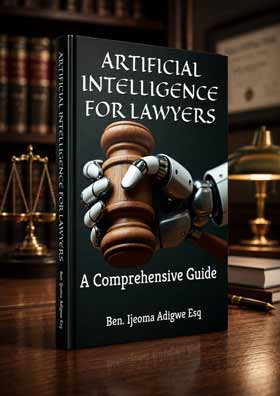 The book also examines Nigeria's legal ecosystem, focusing on the LPELR and NBA AI Guidelines. As a bonus, every purchase comes with a FREE eBook titled: How to Use the AI Features in LegalPedia and LawPavilion.
Ohio Books Ltd praises the publication, stating:
"....this is the only Nigerian book I know of on the topic."
How to Order:
📞 Call, Text, or WhatsApp: 08034917063 | 07055285878
📧 Email: benadigwe1@gmail.com
🌎 Website: www.benadigwe.com
Ebook Version: Access it directly online at https://selar.com/prv626
Authored by Ben Ijeoma Adigwe Esq., ACIarb (UK), LL.M, Dip. in Artificial Intelligence, Director at the Delta State Ministry of Justice, Asaba, Nigeria.
_______________________________________________________________________
“Enhance Legal Practice With Authoritative Reports” — Alexander Payne Offers Comprehensive Law Reports, Spanning Over A Century Of Nigerian Jurisprudence
The book also examines Nigeria's legal ecosystem, focusing on the LPELR and NBA AI Guidelines. As a bonus, every purchase comes with a FREE eBook titled: How to Use the AI Features in LegalPedia and LawPavilion.
Ohio Books Ltd praises the publication, stating:
"....this is the only Nigerian book I know of on the topic."
How to Order:
📞 Call, Text, or WhatsApp: 08034917063 | 07055285878
📧 Email: benadigwe1@gmail.com
🌎 Website: www.benadigwe.com
Ebook Version: Access it directly online at https://selar.com/prv626
Authored by Ben Ijeoma Adigwe Esq., ACIarb (UK), LL.M, Dip. in Artificial Intelligence, Director at the Delta State Ministry of Justice, Asaba, Nigeria.
_______________________________________________________________________
“Enhance Legal Practice With Authoritative Reports” — Alexander Payne Offers Comprehensive Law Reports, Spanning Over A Century Of Nigerian Jurisprudence
 Interested buyers are encouraged to place their orders and enquiries via:
0704 444 4777, 0704 444 4999, 0818 199 9888
Website: www.alexandernigeria.com
Interested buyers are encouraged to place their orders and enquiries via:
0704 444 4777, 0704 444 4999, 0818 199 9888
Website: www.alexandernigeria.com