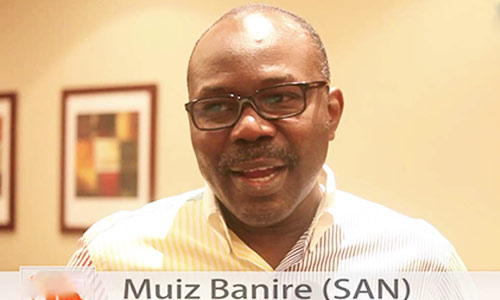
By Muiz-Banire SAN

In the unfolding narrative of national development, few sectors possess the transformative capacity of transportation. It is not merely a support system for economic activity; it is the very architecture upon which commerce, integration, and productivity are built. For a nation of immense geographic spread, demographic weight, and economic aspiration such as Nigeria, the question is no longer whether to invest in transportation infrastructure, but which mode of transport should anchor that investment.
When examined through the lenses of efficiency, safety, sustainability, and long-term economic value, the answer is both clear and compelling: rail transportation must assume that central role. To advocate that the Government of Nigeria should place a premium on rail transport above other modes is not an exercise in theoretical preference; it is a position rooted firmly in economic logic and developmental urgency. Recent data underscores this reality. As at 2025, rail freight movement stood at 878,780 metric tonnes, while passenger traffic reached 3,588,343.
These figures, modest as they may appear in relation to national demand, are in fact a testament to what is possible, even within the constraints of chronic underfunding and systemic neglect. The first and perhaps most compelling argument for rail prioritisation lies in its unrivalled capacity for mass movement. Rail systems are purpose-built for volume. A single freight train can transport what would otherwise require hundreds of articulated trucks on our highways. In a country striving to diversify its economy beyond oil, the efficient movement of agricultural produce, solid minerals, and manufactured goods is not optional.
In fact, to save the investment on roads, it is critical to equally diversify the movement of petroleum products to rail, it is existential.
As noted by Kayode Opeifa, efficient rail connectivity is indispensable to the success of Nigeria’s maritime reforms, particularly the expansion of deep seaports. Without a functional rail backbone, ports risk becoming congested monuments rather than gateways of commerce. Equally urgent is the human cost of our current overdependence on road transport. The haulage of petroleum products and heavy cargo across Nigerian highways has become not only economically burdensome but tragically lethal. The frequency of tanker explosions and fatal accidents involving articulated vehicles is a grim and recurring national experience.
These are not abstract statistics; they are preventable tragedies. One is compelled to ask: how many lives would have been spared if a substantial portion of this freight burden had been transferred to rail?
Beyond safety concerns lies a stark economic contradiction. The cost of constructing modern concrete highways now rivals that of rail infrastructure, yet roads, particularly under the relentless stress of heavy-duty vehicles, deteriorate far more rapidly. Rail systems, by contrast, offer durability, efficiency, and long-term cost advantages.
The argument, therefore, is not simply about expenditure, but about value. Nigeria’s overwhelming reliance on road transport has also inflicted severe structural damage on its infrastructure. Highways have become overstretched, congested, and dangerously degraded. Maintenance has turned into a perpetual fiscal drain. By reallocating bulk cargo movement to rail, government would not only extend the lifespan of existing roads but also redirect scarce resources toward more productive uses. There is also a moral dimension that cannot be ignored.
Transportation policy is, at its core, a question of human welfare. Road accidents continue to account for a significant proportion of avoidable deaths nationwide. Rail transport, globally acknowledged as one of the safest modes of transit, offers a pathway to drastically reduce this toll. Investing in rail is therefore not merely an economic decision; it is an ethical obligation. In an era increasingly defined by environmental consciousness, rail transportation offers yet another strategic advantage. It is significantly more energy-efficient and produces lower carbon emissions per tonne-kilometre than road transport.
For a developing nation seeking to reconcile industrial growth with environmental responsibility, this is no small consideration. A robust rail system aligns Nigeria with global sustainability benchmarks and reinforces its commitments within international climate frameworks.
The implications extend further into urban planning and national cohesion. Cities such as Lagos, Abuja, and Kano are groaning under the weight of rapid urbanisation and chaotic traffic systems. An efficient intra-city and inter-city rail network would not only decongest these urban centres but also enhance mobility, productivity, and quality of life. More importantly, it would bridge the enduring divide between rural production zones and urban consumption markets, fostering inclusive growth. From a security standpoint, the case is equally persuasive.
Nigeria’s highways have increasingly become theatres of vulnerability, exposing travellers and goods to banditry, kidnapping, and cargo theft. A modern rail system, properly secured and monitored, offers a more controlled and predictable transportation environment, thereby reducing exposure to these risks. There is also an institutional dividend. Prioritising rail demands discipline, long-term planning, technical competence, and continuity in execution. These are precisely the governance attributes that Nigeria must cultivate across sectors. Moreover, rail development naturally attracts private sector participation through concessions, public-private partnerships, and infrastructure financing instruments, reducing the burden on public finances.
This is still a virgin area that need to be tapped. Strategically, the implications transcend national borders. A functional rail network connecting Nigeria to its neighbours would position the country as a critical logistics hub in West Africa. It would deepen participation in the African Continental Free Trade Area and unlock the full potential of regional commerce, particularly where equally linked to the airports.
History offers instructive parallels. Nations such as China and India did not stumble into industrial prominence; they engineered it, in part, through deliberate and sustained investment in rail infrastructure. Their experience affirms a fundamental truth: no country achieves enduring industrial growth on the strength of road transport alone. It is important to acknowledge that Nigeria has made some progress in recent years. However, these efforts remain incremental and insufficient when measured against national demand.
What is required is not a continuation of piecemeal interventions, but a bold and comprehensive rail renaissance, anchored in a coherent national master plan, backed by predictable funding, and insulated from political discontinuity. To this end, the Government of Nigeria must adopt a deliberate and multi-layered strategy: prioritising rail in national budgets, establishing dedicated infrastructure funds, incentivising private capital, strengthening regulatory oversight, and institutionalising transparency in project execution. Equally critical is the development of local technical capacity and the entrenchment of a maintenance culture. This is not to diminish the importance of other modes of transportation. Roads, aviation, and waterways remain vital components of a balanced transport ecosystem.
However, they must function as complements, not competitors, to a rail-centric framework. In the final analysis, the argument for prioritising rail transportation in Nigeria is overwhelming. It is an answer to infrastructural decay, a lever for economic diversification, a safeguard for human life, a tool for enhancing national security, and a bridge to regional integration. The time for hesitant steps has passed. What is required now is clarity of vision and firmness of purpose. For ultimately, the tracks we choose to lay today will determine not only the direction of our movement, but the destiny of our nation.
[A MUST HAVE] Evidence Act Demystified With Recent And Contemporary Cases And Materials

Available now for NGN 40,000 at ASC Publications, 10, Boyle Street, Onikan, Lagos. Beside High Court, TBS. Email publications@ayindesanni.com or WhatsApp +2347056667384. Purchase Link: https://paystack.com/buy/evidence-act-complete-annotation
______________________________________________________________________ “Enhance Legal Practice With Authoritative Reports” — Alexander Payne Offers Comprehensive Law Reports, Spanning Over A Century Of Nigerian Jurisprudence Interested buyers are encouraged to place their orders and enquiries via:
0704 444 4777, 0704 444 4999, 0818 199 9888
Website: www.alexandernigeria.com
Interested buyers are encouraged to place their orders and enquiries via:
0704 444 4777, 0704 444 4999, 0818 199 9888
Website: www.alexandernigeria.com