*As Supreme Court Sets April 22 For Accelerated Hearing And Federal High Court Adjourns Indefinitely

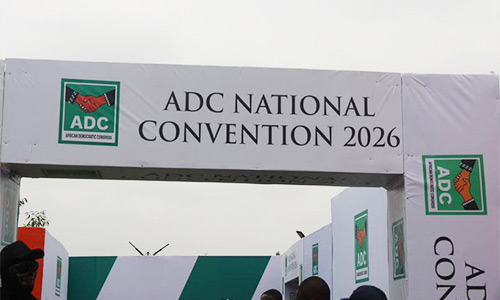
The David Mark-led faction of the African Democratic Congress held its national convention at the Rainbow Event Centre in Abuja on Tuesday without INEC monitoring, amid multiple active court cases, and after being denied access to major venues in a gathering that saw the party expel rival chairman Nafiu Bala Gombe and lawmaker Leke Abejide, claim the attendance of British and Chinese diplomats, and hear Mark declare the event a defining moment in Nigeria’s democratic journey.
However, the convention’s diplomatic claims were immediately undermined when the Chinese Embassy in Nigeria denied that its Ambassador Yu Dunhai attended the event, stating that an Asian man introduced by ADC officials Dino Melaye and Rauf Aregbesola as the Chinese envoy was unknown to the embassy.
The convention unfolded on the same day the Supreme Court ordered accelerated hearing of the ADC leadership appeal for April 22 with a 24-hour filing deadline, the Federal High Court adjourned Gombe’s suit indefinitely after the judge declared it would be “judicial rascality” to proceed while the Supreme Court is seized of the matter, and a third Federal High Court judge issued yet another status quo order in a separate suit filed by ADC state chairmen.
Despite INEC’s refusal to monitor the event, the denial of venues including Eagle Square and the National Stadium, and multiple court orders from competing jurisdictions, the Mark-led faction proceeded with its national convention at the Rainbow Event Centre.
The convention ratified the Mark-led National Working Committee, conducted party business, and took the dramatic step of expelling members accused of anti-party activities.
Mark described the gathering as a moment that would be remembered in Nigeria’s democratic history.
“Great moments of transformation do not announce themselves with a bang. They reveal themselves through the decisions that people make and the direction that political parties and politicians choose to take,” Mark stated.
“Years from now, Nigerians will look back at this day, Tuesday, April 14, 2026, and ask: where were you when the ADC stood up?” the former Senate President declared.
He accused unnamed forces of trying to prevent the convention through courts, institutional pressure, and bureaucratic obstruction.
“Forces that feared what a united ADC represents came for us through the courts, institutions and bureaucratic obstruction. They sought to stop this convention from happening,” Mark stated.
“We are here. Every attempt to suppress this party has only deepened the resolve of our members and widened our coalition,” he added.
Mark warned that the stakes extend beyond party politics: “What is at stake is not just about the ADC or the opposition. It is the survival of our democracy.”
He called for collaboration among opposition leaders across party lines and pledged that governance under the ADC would focus on delivering tangible benefits to citizens rather than personal ambition.
The convention approved a motion for the expulsion of Nafiu Bala Gombe, House of Representatives member Leke Abejide (Yagba Federal Constituency, Kogi State), Kenneth Ehiator, Stella Chukwu, Elias Adiukwu, Kingsley Temitope, Norman Obinna, and Kennedy Odion.
The motion was moved by Senator Binos Yaroe, representing Adamawa South Senatorial District, and seconded by Abdussamad Dasuki, representing Kebbi/Tambuwal Federal Constituency in the House of Representatives. It was adopted unanimously by the convention.
The party accused the affected members of engaging in conduct considered detrimental to the party’s unity and internal processes. Gombe was specifically cited for instituting court cases against the party’s leadership, while Abejide was cited for comments perceived as critical of the party and for supporting Gombe’s actions.
The expulsion of Gombe who has an active suit before the Federal High Court and whose case is now indirectly before the Supreme Court raises immediate legal questions about whether a party can expel a member who has pending litigation challenging its leadership, and whether the expulsion affects his standing to continue the suit.
The expulsion of Abejide whose separate suit before Justice Musa Liman also challenges Mark’s leadership and has judgment pending is similarly significant, as it targets the only serving ADC member of the House of Representatives.
The ADC’s claim of diplomatic attendance at the convention generated immediate controversy.
ADC National Secretary Rauf Aregbesola stated that the British High Commission was represented by a three-member delegation led by its Secretary (Political), Thomas Samson, with a Nigerian staff member, Damilola Oyedele, also part of the delegation. The British High Commission had not issued a response confirming or denying the attendance as of the time of this report.
However, the claim of Chinese diplomatic attendance collapsed quickly. Organisers claimed that Chinese Ambassador to Nigeria Yu Dunhai attended the event, with ADC officials Dino Melaye and Aregbesola publicly introducing an Asian man as the Chinese envoy.
The Chinese Embassy swiftly denied the claim. Embassy official Chen Yao stated that neither the ambassador nor any Chinese diplomat was present at the event, adding that the Asian man introduced as the ambassador was unknown to the embassy.
Independent verification confirmed that the Asian man introduced at the event was not the Chinese Ambassador to Nigeria an embarrassing revelation that raises questions about the convention’s credibility and the organisers’ willingness to misrepresent diplomatic attendance to bolster the event’s legitimacy.
It is unusual for foreign diplomats to attend political party events in Nigeria, making the claims and their partial unravelling particularly notable.
At the Supreme Court, a five-member panel led by Justice Mohammed Garba took decisive action to accelerate the resolution of the ADC crisis.
The court granted accelerated hearing in Mark’s appeal (SC/CV/180/2026) and imposed an exceptionally tight timeline. The Mark faction must file and serve all legal processes within 24 hours. Respondents must file responses within three days. Appellants have one day to reply. All briefs must be completed before April 20. The hearing was fixed for April 22.
In a significant procedural development, Jubril Okutepa SAN, counsel to the Mark faction, withdrew a motion earlier filed seeking to stay the execution of the Court of Appeal’s March 12 judgment, explaining it was no longer needed since the court had expedited the substantive appeal. The Supreme Court struck out the withdrawn motion.
At the Federal High Court, Justice Emeka Nwite adjourned Gombe’s suit (FHC/ABJ/CS/1819/2025) indefinitely after Gombe’s counsel, Lukman Fagbemi SAN, informed the court that an interlocutory appeal was pending at the Supreme Court.
Counsel for the ADC and for Mark had argued the trial court could proceed with hearing pending the Supreme Court’s decision, with Sulaiman Usman SAN describing it as “the best time management strategy.”
Justice Nwite rejected this approach emphatically.
“It would not serve any purpose if the jurisdiction of this honourable court is being challenged at the apex court. Indeed, it will be judicial rascality for this court to struggle with the issue of jurisdiction with the supreme court,” Justice Nwite ruled.
In yet another ADC-related case, Justice Joyce Abdulmalik of the Federal High Court ordered parties to maintain the status quo in Suit No. FHC/ABM/CS/582/2026, filed by Don Norman Obinna and six others representing ADC state chairmen.
The judge cautioned parties not to take any step to overreach the court, and adjourned to April 23 for definite hearing the same date the party primaries window opens.
This means the ADC now has status quo orders from multiple courts, each potentially restricting different aspects of the party’s activities.
The convention and court proceedings revealed that the ADC is now split into not two but three distinct factions.
The Mark faction the most prominent held the convention, ratified its leadership, and expelled rivals. The Gombe faction continues to claim the chairmanship through the courts, despite the indefinite adjournment. And a newly emerged Kachikwu faction, described as a “third way” group, has rejected both Mark and Gombe, supports INEC’s derecognition, and is calling for a neutral interim committee.
The three-way split complicates any potential resolution, as even a definitive Supreme Court ruling on the Mark-Gombe dispute would not necessarily address the third faction’s claims and concerns.
INEC stayed away from the convention entirely. The electoral commission, having delisted the Mark-led executive on April 1, declared it would not attend any activity of the faction pending the vacation of the court order upon which it took its derecognition decision.
INEC officials have consistently maintained that the commission is bound by its timetable and cannot accommodate parties entangled in unresolved disputes. A senior INEC official reiterated that the commission deals only with legally recognised party leaderships and validly conducted primaries, stressing that any party failing to meet deadlines risks exclusion regardless of circumstances.
The convergence of the Supreme Court’s April 22 hearing and the April 23 opening of the primaries window creates an extraordinarily tight timeline.
Observers warn that even if the Supreme Court delivers a favourable ruling for the Mark faction on April 22, the party would still need INEC to recognise the ruling, restore its leadership on the portal, and validate the convention and congress outcomes processes that could take days or weeks.
Wale Okunniyi, Convener of the Movement for Credible Elections, warned that if the judgment is not immediately executable or requires further procedural steps, the ADC could be technically locked out of the process regardless of the merit of its case.
A governorship aspirant in Imo State, David Mbamara, expressed concern that no serious coalition would anchor itself on a party facing existential legal uncertainty so close to a major electoral deadline, adding that key actors may migrate to more stable platforms.
Some aspirants are already quietly exploring fallback options with larger parties amid fears that prolonged litigation could render their ambitions void.
The Supreme Court hearing on April 22 now carries the entire weight of the ADC’s future.
If the court affirms the Mark leadership without requiring further processes, the party may salvage its position. If the ruling introduces ambiguity or requires fresh internal exercises, the ADC could be sidelined at the most critical moment.
As Mark told the convention: “At a time when democratic space is shrinking, the ADC will not bow, will not cower and will not retreat.”
Whether the Supreme Court gives the party the legal foundation to match that defiance will be known in eight days.
[A MUST HAVE] Evidence Act Demystified With Recent And Contemporary Cases And Materials

Available now for NGN 40,000 at ASC Publications, 10, Boyle Street, Onikan, Lagos. Beside High Court, TBS. Email publications@ayindesanni.com or WhatsApp +2347056667384. Purchase Link: https://paystack.com/buy/evidence-act-complete-annotation
______________________________________________________________________ “Enhance Legal Practice With Authoritative Reports” — Alexander Payne Offers Comprehensive Law Reports, Spanning Over A Century Of Nigerian Jurisprudence Interested buyers are encouraged to place their orders and enquiries via:
0704 444 4777, 0704 444 4999, 0818 199 9888
Website: www.alexandernigeria.com
Interested buyers are encouraged to place their orders and enquiries via:
0704 444 4777, 0704 444 4999, 0818 199 9888
Website: www.alexandernigeria.com