*”Our Youths Earning 50 Cents for Content Fetching $10 to $30 Per 1,000 Views in U.S.” — Natasha Highlights Inequality in Global Content Economy

In a bid to modernize Nigeria’s financial regulatory framework and address growing risks in the digital economy, the Senate on Thursday passed the second reading of the Banks and Other Financial Institutions Act (BOFIA) Amendment Bill, 2025 (SB 959). The legislation seeks to empower the Central Bank of Nigeria (CBN) with broader oversight over systemically important institutions, including rapidly expanding fintech companies, to safeguard consumers, enhance transparency, and close regulatory gaps.
Sponsored by Senator Mukhail Adetokumbo Abiru (APC, Lagos East), who chairs the Senate Committee on Banking, Insurance, and Other Financial Institutions, the bill aims to designate high-risk fintechs as Systemically Important Institutions (SIIs). This would subject them to enhanced supervision, including mandatory registration in a national registry to reveal beneficial ownership, stricter consumer protections, and safeguards for data sovereignty, much of which is currently stored offshore. Abiru emphasized that fintechs and mobile-money operators now process transaction volumes rivaling traditional banks, handling millions of dollars and billions of naira daily, yet operate largely under voluntary CBN guidelines rather than enforceable law.
“The law has not kept pace,” Abiru stated during the debate. “A dominant fintech can now pose as much risk as a bank.” He dismissed proposals for a standalone fintech regulator, arguing it would lead to duplication and inefficiency, and advocated reinforcing existing institutions in line with global best practices. The bill also seeks to improve accountability, operational safety, investor protection, and accurate revenue assessment for these firms, many of which evade traditional social responsibilities like employing local labor or maintaining physical branches.
Prominent Nigerian fintechs targeted by the reforms include Paga, Opay, Moniepoint, Kuda, Paystack, FairMoney, PalmPay, and PiggyVest. Unlike established banks such as First Bank, Access Bank, and Zenith Bank, whose directors are publicly known and accountable, these digital players often obscure ownership structures, raising concerns about crisis response if they fail.
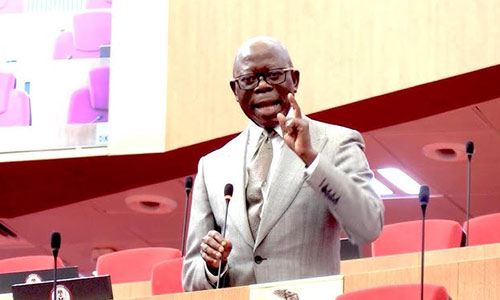
The debate took a personal turn when Senator Adams Oshiomhole (APC, Edo North), former president of the Nigeria Labour Congress (NLC), shared a harrowing account of his own account being hacked through fintech platforms. “When my account got hacked, I realized the scammers used Opay and Moniepoint, not the traditional banks,” Oshiomhole recounted. “I know the directors of First Bank, Access, and Zenith, but I don’t know the directors of Opay or Moniepoint.”
Oshiomhole, drawing from the recent hacking of an associate’s account, criticized the lack of traceability and social obligations in the sector. “They don’t have a branch in Abuja. They don’t employ labor. They bear no social responsibility,” he said. He warned that without proper regulation, the government would bear the burden of compensating victims if these firms collapse, leaving Nigerians duped without recourse. Urging the Senate to block all possible loopholes, Oshiomhole stressed that CBN guidelines lack the force of law and called for detailed scrutiny to ensure comprehensive coverage. “This law is not only timely, it is appropriate,” he concluded.
@thenigerialawyer“When My Account Got Hacked, Scammers Used Opay And Moniepoint” — Oshiomhole Says Fintechs Lack Branches, Labor, And Social Responsibility
Adding a fresh dimension to the discussion, Senator Natasha Akpoti-Uduaghan (PDP, Kogi Central) highlighted inequities faced by Nigeria’s burgeoning digital workforce. She stressed the quiet exploitation of young content creators on social media, arguing that unregulated online payment systems exacerbate income disparities in the global content economy.
“Our youths are earning 50 cents for content that fetches $10 to $30 per 1,000 views in the U.S.,” Natasha lamented. “This inequality must not be ignored as we reform our financial system. I am speaking for the content creators because social media has become a very critical source of income for our youths.”
She contended that Nigeria’s digital creators drive massive traffic to global platforms yet receive a fraction of the revenue, distorting financial inclusion and the broader economy. Natasha called for the bill to incorporate stronger regulatory engagement with international tech giants, demanding transparency, fair earning structures, and equitable practices. “Nigerian content creators should be able to earn as much as their U.S. counterparts, so online payment transactions need to be regularized,” she insisted, expanding the reform agenda to protect millions reliant on the sector.
The Senate unanimously referred the bill to the Committee on Banking, Insurance, and Other Financial Institutions for further legislative work, signaling strong bipartisan support. Proponents view the reforms as essential for fostering a safer, more inclusive financial ecosystem, particularly as fintechs have become critical national infrastructure amid Nigeria’s cashless push and the CBN’s 2024 crackdown on non-compliant operators.

 ARTIFICIAL INTELLIGENCE FOR LAWYERS: A COMPREHENSIVE GUIDE
Reimagine your practice with the power of AI “...this is the only Nigerian book I know of on the topic.” — Ohio Books Ltd
Authored by Ben Ijeoma Adigwe, Esq., ACIArb (UK), LL.M, Dip. in Artificial Intelligence, Director, Delta State Ministry of Justice, Asaba, Nigeria.
Bonus:
Get a FREE eBook titled “How to Use the AI in Legalpedia and Law Pavilion” with every purchase.
ARTIFICIAL INTELLIGENCE FOR LAWYERS: A COMPREHENSIVE GUIDE
Reimagine your practice with the power of AI “...this is the only Nigerian book I know of on the topic.” — Ohio Books Ltd
Authored by Ben Ijeoma Adigwe, Esq., ACIArb (UK), LL.M, Dip. in Artificial Intelligence, Director, Delta State Ministry of Justice, Asaba, Nigeria.
Bonus:
Get a FREE eBook titled “How to Use the AI in Legalpedia and Law Pavilion” with every purchase.
How to Order: 📞 Call, Text, or WhatsApp: 08034917063 | 07055285878 📧 Email: benadigwe1@gmail.com 🌐 Website: www.benadigwe.com
Ebook Version: Access directly online at: https://selar.com/prv626
________________________________________________________________________ The Law And Practice Of Redundancy In Nigeria: A Practitioner’s Guide, Authored By A Labour & Employment Law Expert Bimbo Atilola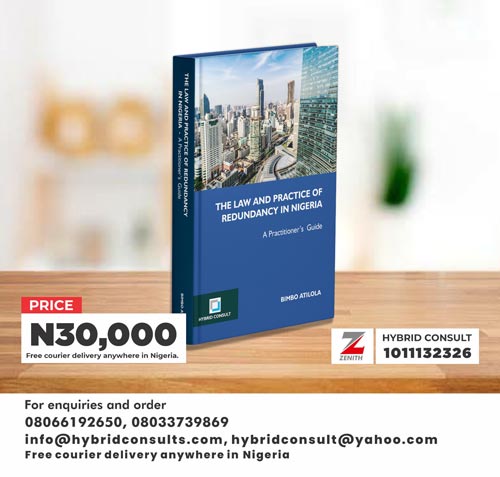 _______________________________________________________________________
New Year Promo: Get Five Maritime Law Books For N150,000 — 63% Discount
_______________________________________________________________________
New Year Promo: Get Five Maritime Law Books For N150,000 — 63% Discount
 The promotion, which commenced on January 8 and runs until February 8, 2026, offers five core maritime law books authored by Dr. Emeka Akabogu, SAN, ordinarily valued at N405,000, for just N150,000 — a 63% discount.
Interested buyers can place their orders through the following channels:
Phone: 0704 329 3271
Online Store: https://paystack.shop/aa-bookstore
Website: www.akabogulaw.com
______________________________________________________________________
The promotion, which commenced on January 8 and runs until February 8, 2026, offers five core maritime law books authored by Dr. Emeka Akabogu, SAN, ordinarily valued at N405,000, for just N150,000 — a 63% discount.
Interested buyers can place their orders through the following channels:
Phone: 0704 329 3271
Online Store: https://paystack.shop/aa-bookstore
Website: www.akabogulaw.com
______________________________________________________________________