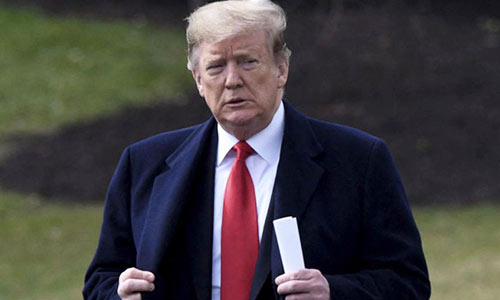
The US has announced it is expanding its curbs on immigration to include six more countries, including Nigeria, Africa’s most populous nation.

Citizens from Nigeria, Eritrea, Sudan, Tanzania, Kyrgyzstan and Myanmar will now be blocked from obtaining certain types of visas.
In 2018, the US issued twice as many immigration visas to Nigeria than to the other five nations combined.
An official said the new measures were the result of failures by the six countries to meet US security and information-sharing standards.
So many misinterpretations have been given to this development, with many concluding that Nigerians will no longer be allowed entry into the US.
However, here are what the new ban means:
1. Nigerians will not get visas that can lead to permanent residency.
2. This suspension shall come into effect on 21st February 2020.
3. The suspension is temporal and would be lifted if the government meet the minimum US security and information-sharing standards.
4. Nigerians will still be able to get non-immigrant visas given to people for temporary stays – including visitors, those doing business or people seeking medical treatment – would not be impacted by the new rules.
Q: Who is covered by the NEW Expanded Travel Ban? The New Expanded Travel Ban affects certain nationals from the following six countries:
| Kyrgyzstan: ALL immigrants, except Special Immigrants whose eligibility is based on having provided assistance to the United States Government
|
Nigeria: ALL immigrants, except Special Immigrants whose eligibility is based on having provided assistance to the United States Government
|
| Myanmar (Burma): ALL immigrants, except Special Immigrants whose eligibility is based on having provided assistance to the United States Government
|
Sudan: Immigrants under the Diversity Lottery Program |
The information contained in this fact sheet is provided for educational purposes only and not as part of an attorney-client relationship. It is not a substitute for legal advice.
| Eritrea: ALL immigrants, except Special Immigrants whose eligibility is based on having provided assistance to the United States Government | Tanzania: Immigrants under the Diversity Lottery Program |
Who was covered by Travel Ban 3.0 Before the Expansion? Since December 4, 2017, Travel Ban 3.0 has covered certain nationals from the following seven countries:
- Libya and Yemen: all immigrants and those entering as tourists or business travelers
- Iran: all immigrants and nonimmigrants, EXCEPT F, J and M visa holders (extra scrutiny)
- North Korea and Syria: all immigrants and nonimmigrants
- Somalia: immigrants (and nonimmigrants subject to extra scrutiny)
- Venezuela: certain nonimmigrants government officials and their family members
Please review this fact sheet for a more detailed description of Travel Ban 3.0.
Q: What is an immigrant or non-immigrant?
Immigrants refer to those who are seeking admission to the United States on a permanent basis through a family, employment, or through the Diversity Lottery Program.
Non-immigrants refer to those who are seeking admission to the United States on a temporary basis, such as business visitors, tourists, students, exchange students, scholars, and temporary workers. The New Expanded Travel Ban does not apply to nonimmigrants visa categories.
Q: Does the New Expanded Travel Ban Holders of a Valid Visa? No. For example, if you have a visa that was issued before the effective date, the ban does not apply to you.
Q: What is the effective date for the New Expanded Travel Ban? 12:01AM EST February 21, 2020
Q: Who is exempt from the New Expanded Travel Ban?
- Lawful permanent residents (green card holders) and United States Citizens
- Foreign nationals admitted or paroled to the United States on or after the effective date
- Foreign nationals with travel documents that are not visas that are valid before or issued after the effective date
- Dual nationals traveling on a passport that is not one of the affected countries
- Those traveling on a diplomatic or related visa
- Foreign nationals who have already been granted asylum, refugees who have already been granted admittance, and those who have been granted withholding of removal, advanced parole, or protections under the Convention Against Torture
Q: Am I eligible for a waiver under the New Expanded Travel Ban?
In order to obtain a waiver, an applicant must demonstrate: 1) undue hardship if entry were denied, 2) entry would not pose a threat to national security, and 3) entry is in the national interest. The decision of a consular officer to grant or deny a waiver is discretionary.
Q: How do I apply for a waiver under the New Expanded Travel Ban?
Waiver requests should be submitted to the consulate during a consular interview. They may also be mailed or emailed to a Consular post if a case is in administrative processing. For detailed instructions on how to prepare a waiver request packet, or for assistance, please consult with an immigration attorney. You can also consult this practice pointer from the American Immigration Lawyers Association (AILA).
Q: How does the new Expanded Travel Ban affect students?
The New Expanded Travel Ban does not include students from the six countries because they are nonimmigrants. However, students may still be subject to extra scrutiny, as we have seen in the case of Iranian citizens.
Q: How does the new Expanded Travel Ban affect families?
Every version of the travel ban has impacted families in significant ways. With the new Expanded Travel Ban, we anticipate that more families in qualifying relationships under the immigration statute will be separated, and that more parents and loved ones will be unable to travel to the United States to witness key events like the birth of a grandchild, or marriage of child.
Q: Why was the travel ban expanded?
The government’s position is that the new countries pose a national security risk or fail to meet baseline requirements. Critics of the ban argue that it is discriminatory and based on impermissible factors, such as national origin and religion.
Q: Was Travel Ban 3.0 ban ever challenged in a court before it was expanded?
Yes. Most significant, the U.S. Supreme Court in Hawaii v. Trump found that Travel Ban 3.0 was lawful under the immigration statute and the U.S. Constitution. Chief Justice Roberts held “The Proclamation is squarely within the scope of Presidential authority under the INA.” He described 8 U.S.C. §1182(f) as a “comprehensive delegation” which “exudes deference to the President in every clause.” For information on ongoing litigation, see this update from the National Immigration Law Center. Possibly, the New Expanded Travel Ban will be challenged in the courts, but the judicial outcome in Hawaii v. Trump will need to be followed.
Q: Where can you I find more resources? For more information please visit:
For assistance, please e-mail the Legal Department of the American-Arab AntiDiscrimination Committee: legal@adc.org.
Culled from Legal Department of the American-Arab AntiDiscrimination Committee:

Get your copy today and take the first step toward financial growth:👉 https://selar.co/4f16676016
_______________________________________________________________________ ARTIFICIAL INTELLIGENCE FOR LAWYERS: A COMPREHENSIVE GUIDE
Reimagine your practice with the power of AI “...this is the only Nigerian book I know of on the topic.” — Ohio Books Ltd
Authored by Ben Ijeoma Adigwe, Esq., ACIArb (UK), LL.M, Dip. in Artificial Intelligence, Director, Delta State Ministry of Justice, Asaba, Nigeria.
Bonus:
Get a FREE eBook titled “How to Use the AI in Legalpedia and Law Pavilion” with every purchase.
ARTIFICIAL INTELLIGENCE FOR LAWYERS: A COMPREHENSIVE GUIDE
Reimagine your practice with the power of AI “...this is the only Nigerian book I know of on the topic.” — Ohio Books Ltd
Authored by Ben Ijeoma Adigwe, Esq., ACIArb (UK), LL.M, Dip. in Artificial Intelligence, Director, Delta State Ministry of Justice, Asaba, Nigeria.
Bonus:
Get a FREE eBook titled “How to Use the AI in Legalpedia and Law Pavilion” with every purchase.
How to Order: 📞 Call, Text, or WhatsApp: 08034917063 | 07055285878 📧 Email: benadigwe1@gmail.com 🌐 Website: www.benadigwe.com
Ebook Version: Access directly online at: https://selar.com/prv626
________________________________________________________________________ The Law And Practice Of Redundancy In Nigeria: A Practitioner’s Guide, Authored By A Labour & Employment Law Expert Bimbo Atilola _______________________________________________________________________
[A MUST HAVE] Evidence Act Demystified With Recent And Contemporary Cases And Materials
_______________________________________________________________________
[A MUST HAVE] Evidence Act Demystified With Recent And Contemporary Cases And Materials