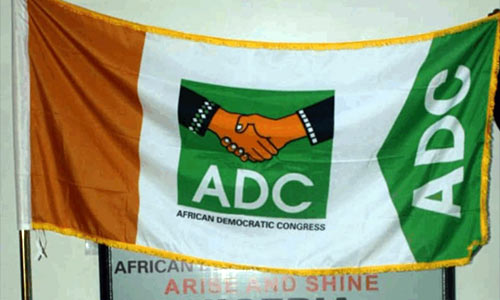
The African Democratic Congress is caught in a desperate race against time, with party congresses scheduled to begin in just four days, a court hearing set for eight days later, and the Independent National Electoral Commission refusing to recognise or monitor any of its activities.

At the Shehu Musa Yar’Adua Centre in Abuja, a packed hall of opposition figures, party members, and supporters gathered to chart a path forward — but the path remains unclear, the clock unforgiving, and the stakes existential.
The Timeline Crisis
The ADC has fixed dates for its internal processes:
- Congresses: April 9 to 12, 2026
- National Convention: April 14, 2026
- Primaries: April 23 to May 30, 2026
- Submission of Membership Register: May 10, 2026
Meanwhile, the court is expected to hear the substantive case again on April 17 — three days after the party’s planned national convention.
Miss these windows, and the race could be over before it even begins.
The party faces a brutal dilemma: Move ahead without INEC, and risk everything being voided later. Or wait for the courts, and risk missing the election entirely.
“We have given INEC 21 days’ notice. They have accepted the notice. So whether they come or not, we’ll continue with our congresses,” declared Bolaji Abdullahi, National Publicity Secretary of the ADC.
At the centre of the gathering stood Aisha Yesufu, frontline activist serving as Deputy Chairman of the committee overseeing Membership, Revalidation, Mobilisation and Registration within the ADC.
Dressed in her trademark blue-grey hijab, she stood composed, her posture firm, her gaze steady.
“We are not intimidated. We are not afraid. We are not thinking of giving up,” she said.
Then she added, more quietly but with weight: “Nigeria is at war. Going into 2027, Nigeria is at war, and we are fighting for our lives and the soul of this nation.”
The gathering drew an unprecedented assembly of opposition figures: Atiku Abubakar, Peter Obi, Rabiu Kwankwaso, Rauf Aregbesola, Rotimi Amaechi, Liyel Imoke, Dino Melaye, Solomon Dalung, and Victor Umeh.
Their presence was not mere attendance — it was a signal.
The crisis began on September 2, 2025, when a suit was filed at the Federal High Court questioning the legitimacy of the current ADC leadership.
The claimant, Nafiu Bala Gombe, is asking the court to recognise him as acting national chairman and to stop the current leadership under former Senate President David Mark from operating.
On March 12, 2026, the Court of Appeal made a key decision. It did not decide who is right. Instead, it ordered all parties to maintain the “status quo ante bellum” and warned against any action that could render the final judgment useless.
In simple terms: pause everything.
But politics rarely pauses just because the courts say so.
After the Court of Appeal ruling, INEC withdrew recognition from all sides. It stopped dealing with the party. It said it would not monitor any activities.
From a legal standpoint, the logic is straightforward: recognising one faction could amount to disobeying a court order.
But on the ground, the effect is devastating.
For party members across the country, it means planning in the dark — organising meetings, printing materials, mobilising supporters, without knowing if any of it will count.
In Abuja, one ward organiser, Moses Shekwolo, put it plainly: he has already postponed three meetings ahead of the upcoming congresses scheduled to commence on April 9.
“We don’t even know which list will eventually stand at the end of the day,” he said.
Beyond the leadership crisis, another legal battle looms — less visible, but potentially more final.
Before the Federal High Court in Abuja, a suit marked FHC/ABJ/CS/2637/25 is asking the court to compel INEC to deregister the African Democratic Congress and several other parties entirely.
The case was filed by the Incorporated Trustees of the National Forum of Former Legislators against INEC, the Attorney-General of the Federation, and the affected parties.
At its core is a constitutional question: whether INEC is not just empowered, but obligated, to strike off parties that fail to meet minimum electoral performance thresholds set by law.
If this case succeeds, the implications are immediate and absolute. The party ceases to exist, instantly. Its structures, its leadership disputes, its planned congresses and convention, even its role in the emerging opposition coalition — all of it collapses into irrelevance at once.
David Mark, Interim National Chairman of the ADC and former Senate President, demanded a change in the leadership of INEC, accusing the government of plotting a one-party state.
“We demand the immediate resignation or sack of the INEC Chairman, Professor Amupitan, and all the National Commissioners… This attack on democracy will not stand,” he said.
Mahmud Jega, a public affairs analyst, warned of a deliberate weakening of the opposition and urged caution from INEC.
“The impression INEC is giving is that it is part of the scheme to destroy all opposition parties. The opposition wanted the ADA; INEC sat on it for two years. Now they have moved to ADC, and they are coming up with something else. INEC has to be very careful,” he said.
Solomon Dalung, former Minister of Youth and Sports Development and an ADC chieftain, pushed back strongly against INEC’s warning and freeze.
“If INEC is confused, ADC cannot be confused. If INEC is a lawless organisation, ADC is not. We won’t surrender to Tinubu’s tyranny. INEC is on a hatchet mission,” he said.
Nigeria’s political history offers warnings.
The Peoples Democratic Party crisis of 2016 split the party between Ali Modu Sheriff and Ahmed Makarfi. The dispute lasted more than 14 months before the Supreme Court resolved it in July 2017. By then, the damage had been done.
Ahead of the 2019 elections, the All Progressives Congress faced a crisis in Rivers State. Parallel primaries led to a Supreme Court ruling that the party had conducted no valid primaries. The result: total exclusion from the ballot in the state.
And in February 2020, INEC deregistered 74 parties in one move, cutting the field from 91 to 18.
In each case, the crisis did not just weaken a party it reshaped the next general election itself.
Those crises unfolded over time. This one is compressed.
A live court case. A freezing order. A regulator stepping back. A deregistration threat. An election timetable measured in weeks.
Time is not stretching this crisis. It is tightening it squeezing every decision into a risk.
Several outcomes are possible:
- A swift court ruling could restore clarity
- A prolonged case could derail the timetable
- Proceeding without INEC could trigger fresh litigation
- A negotiated settlement could calm tensions
- A deregistration ruling could end it all
Each path carries risk. None offers certainty.
Back in the Yar’Adua Centre, the noise continues. People are still talking. Still arguing. Still calculating what comes next.
And at the centre of it, Aisha Yesufu remains steady. Not talking about court orders. Not talking about procedure. But about people — and what happens if all of this collapses.
Because right now, nothing is settled. Not the leadership. Not the legal battles. Not even the future of the party itself.
And in a room full of voices, one question hangs, unanswered and unavoidable: What happens if time runs out?
The ADC’s crisis is not merely a party leadership dispute it is a test of whether meaningful opposition can survive in Nigeria’s current political environment.
With congresses beginning April 9, a convention on April 14, and a court hearing on April 17, the party is attempting to complete its electoral preparations before the judiciary even rules on the underlying dispute.
INEC’s refusal to monitor creates a legal minefield: any congress or convention held without INEC’s supervision may be challenged later, potentially invalidating all candidates nominated through such processes.
The gathering of Atiku, Obi, Kwankwaso, and other opposition heavyweights signals that the ADC crisis is no longer just about one party — it is about whether a viable opposition platform will exist for 2027.
For Nigerians watching these developments, the coming days will reveal whether the opposition can navigate the legal, regulatory, and political obstacles in its path — or whether time will simply run out.
 Interested buyers are encouraged to place their orders and enquiries via:
0704 444 4777, 0704 444 4999, 0818 199 9888
Website: www.alexandernigeria.com
Interested buyers are encouraged to place their orders and enquiries via:
0704 444 4777, 0704 444 4999, 0818 199 9888
Website: www.alexandernigeria.com
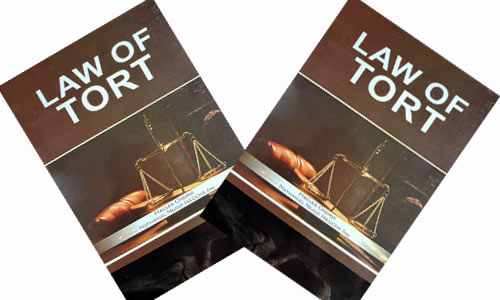 The book, titled The Law of Torts in Nigeria: A Functional Approach, authored by Professor Hagler Sunny Okorie Ph.D and Ikeocha, Nathaniel Ngozi Esq, offers law students, practitioners, and academics a comprehensive guide to understanding and applying tort law in Nigerian courts. Interested buyers can place orders via the following contact numbers: 08028636615, 08037667945, 08032253813, or +234 902 196 2209.
_______________________________________________________________________
The book, titled The Law of Torts in Nigeria: A Functional Approach, authored by Professor Hagler Sunny Okorie Ph.D and Ikeocha, Nathaniel Ngozi Esq, offers law students, practitioners, and academics a comprehensive guide to understanding and applying tort law in Nigerian courts. Interested buyers can place orders via the following contact numbers: 08028636615, 08037667945, 08032253813, or +234 902 196 2209.
_______________________________________________________________________
 ARTIFICIAL INTELLIGENCE FOR LAWYERS: A COMPREHENSIVE GUIDE
Reimagine your practice with the power of AI “...this is the only Nigerian book I know of on the topic.” — Ohio Books Ltd
Authored by Ben Ijeoma Adigwe, Esq., ACIArb (UK), LL.M, Dip. in Artificial Intelligence, Director, Delta State Ministry of Justice, Asaba, Nigeria.
Bonus:
Get a FREE eBook titled “How to Use the AI in Legalpedia and Law Pavilion” with every purchase.
ARTIFICIAL INTELLIGENCE FOR LAWYERS: A COMPREHENSIVE GUIDE
Reimagine your practice with the power of AI “...this is the only Nigerian book I know of on the topic.” — Ohio Books Ltd
Authored by Ben Ijeoma Adigwe, Esq., ACIArb (UK), LL.M, Dip. in Artificial Intelligence, Director, Delta State Ministry of Justice, Asaba, Nigeria.
Bonus:
Get a FREE eBook titled “How to Use the AI in Legalpedia and Law Pavilion” with every purchase.
How to Order: 📞 Call, Text, or WhatsApp: 08034917063 | 07055285878 📧 Email: benadigwe1@gmail.com 🌐 Website: www.benadigwe.com
Ebook Version: Access directly online at: https://selar.com/prv626
________________________________________________________________________ The Law And Practice Of Redundancy In Nigeria: A Practitioner’s Guide, Authored By A Labour & Employment Law Expert Bimbo Atilola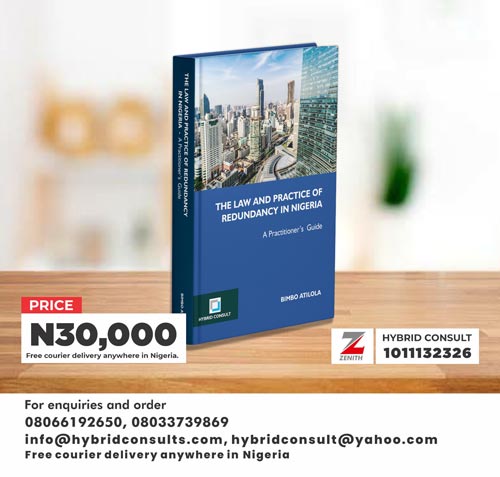 _______________________________________________________________________
[A MUST HAVE] Evidence Act Demystified With Recent And Contemporary Cases And Materials
_______________________________________________________________________
[A MUST HAVE] Evidence Act Demystified With Recent And Contemporary Cases And Materials