
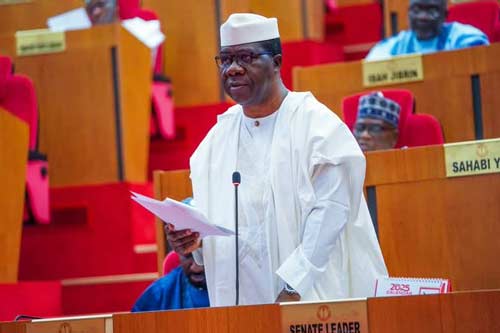
The Senate Leader, Senator Opeyemi Bamidele, has disclosed that the National Assembly is working with the executive arm of government on a new operational bill aimed at preventing the abuse of state police by governors and other political authorities.

Bamidele said the proposed legislation would establish clear rules, safeguards and institutional structures to ensure that state police formations were not used to intimidate political opponents or undermine democratic processes.
The senator, who represents Ekiti Central Senatorial District, made the disclosure on Thursday while responding to questions from Senate correspondents about growing concerns that state governors could exploit state police structures for political purposes.
According to him, the National Assembly recognises the fears surrounding the establishment of state police and is working towards creating a legal framework that would regulate their operations regardless of the political party or individual controlling a state government.
Bamidele maintained that political power was temporary and that laws governing security institutions must be designed to protect all Nigerians, irrespective of changes in political leadership.
“The ruling party might someday become an opposition party, while a party that is in opposition might also someday become the ruling party,” he said.
“It’s not up to the political party; it is up to the people and God Almighty as to which party wins an election.
“That’s why it is important to set standards and rules and establish laws that would be consistent regardless of which party is in control and regardless of which individual is in control.”
The Senate Leader explained that although the state police constitutional amendment bill had been passed, concerns about the possible misuse of state police powers remained an important issue requiring legislative attention.
He disclosed that the National Assembly was discussing a separate piece of legislation with the executive arm of government to establish the operational framework for state policing.
Bamidele described the proposed legislation as a stakeholder-driven operational bill that would spell out the responsibilities, powers and limitations of state police formations.
According to him, the legislation would address several fundamental questions concerning the relationship between federal and state police authorities.
These include the role of the Police Service Commission, whether individual states would establish their own police service commissions, the qualifications and appointment of those heading such bodies, and the boundaries between federal and state policing powers.
“What is the role of the police service commission? Would each state also have its own police service commission? Who can head the police service commission?” he asked.
“What are the boundaries that you want to set between the federal police and the state police? At what point does the power of the state police end and the federal police take over?”
Bamidele maintained that providing clear answers to these questions would help prevent jurisdictional conflicts and reassure Nigerians that state police institutions would operate within established legal limits.
He explained that the constitutional amendment bill and the proposed operational legislation were intended to perform different functions.
According to him, the constitutional amendment would provide the legal foundation for state policing by moving policing powers from the Exclusive Legislative List to the Concurrent Legislative List.
The operational legislation would then provide detailed rules governing how state police formations would function.
“The state police bill is a constitutional amendment bill, taking it from the exclusive list to the concurrent list,” Bamidele stated.
“Once it is now established that we now have state police, then the next thing that will follow is the act of parliament that will spell out the details.”
He added that the existing Police Act would also require amendment to reflect the proposed changes in Nigeria’s policing structure.
“The existing police act itself will be amended in a way that it will be tailored along the fact that it’s going to govern the activities of the federal police, while the operational bill will take care of the modus operandi of the state police,” he explained.
The Senate Leader said the operational bill would be presented after the constitutional amendment process, including the presidential assent he referred to, had been concluded.
He maintained that the proposed legislation would help Nigerians better understand the structure of state policing and become more comfortable with its implementation.
Bamidele also confirmed that the proposed operational legislation was the National Policing Bill currently being prepared by the Presidency.
His disclosure followed an earlier announcement by the Chief of Staff to President Bola Tinubu, Femi Gbajabiamila, that the Presidential Working Group on Police Reform was preparing to transmit the proposed state policing legislation to the National Assembly.
Gbajabiamila had indicated that work on the bill was substantially complete and that the working group was reviewing the remaining details before its submission.
“The National Policing Bill is more or less ready for transmission to the National Assembly,” Gbajabiamila said.
“We will probably have one more meeting after this to cross the t’s and dot the i’s and make sure every area is covered. So, we are 90 percent ready.”
The proposed legislation is expected to address concerns about political interference, institutional independence and the division of responsibilities between federal and state police formations.
Bamidele’s remarks also highlighted the importance of creating safeguards that would remain effective regardless of which political party controls a state government.
He argued that since political parties could move between government and opposition, the legal framework must be structured to prevent those in power from using state police institutions against their opponents.
The Senate Leader maintained that the objective was not merely to establish state police but to create a system governed by clear laws, defined responsibilities and appropriate institutional oversight.
He expressed confidence that a comprehensive operational framework would help address public concerns about the proposed policing arrangement while providing guidance on the relationship between federal and state security authorities.
[A MUST HAVE] Evidence Act Demystified With Recent And Contemporary Cases And Materials
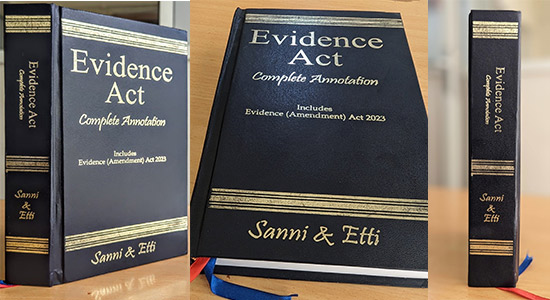
Available now for NGN 40,000 at ASC Publications, 10, Boyle Street, Onikan, Lagos. Beside High Court, TBS. Email publications@ayindesanni.com or WhatsApp +2347056667384. Purchase Link: https://paystack.com/buy/evidence-act-complete-annotation
______________________________________________________________________ “Enhance Legal Practice With Authoritative Reports” — Alexander Payne Offers Comprehensive Law Reports, Spanning Over A Century Of Nigerian Jurisprudence Interested buyers are encouraged to place their orders and enquiries via:
0704 444 4777, 0704 444 4999, 0818 199 9888
Website: www.alexandernigeria.com
“A Comprehensive Guide To Evidence Law” — Releases Second Edition In Three Volumes, Covering 4,051 Cases
For enquiries and orders, contact: 08035526491 Email: jerryamadisilk@gmail.com
 Prof. Jerry Amadi’s Evidence Law, Second Edition (2026), contains 3,314 pages in three volumes, covering the Evidence Act 2011, its 2023 amendment, and 4,051 Nigerian and English cases.