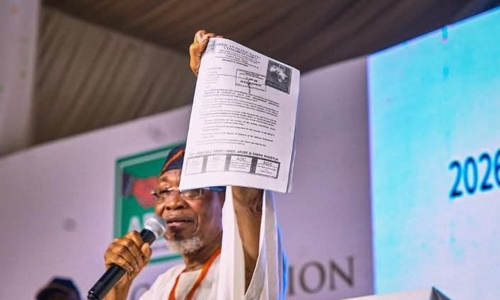
The National Secretary of the African Democratic Congress, Ogbeni Rauf Aregbesola, has presented a detailed legal argument that the Independent National Electoral Commission had no legitimate ground to refuse to attend and monitor the party’s national convention, citing specific provisions of the Electoral Act 2026 and producing documentary evidence that the party fulfilled all statutory notification requirements weeks before the event.

Speaking at the ADC national convention held at the Rainbow Event Centre in Abuja on Tuesday, Aregbesola a former Governor of Osun State and former Minister of Interior methodically dismantled INEC’s stated justification for boycotting the convention, arguing that the commission’s reliance on the Court of Appeal’s March 12 ruling was legally unsound because the ruling made no reference whatsoever to attending or monitoring the ADC’s convention.
Aregbesola anchored his argument on Section 82 of the Electoral Act 2026, which he said prescribes the only condition under which a political party’s convention can be rendered invalid.
“The only condition that would warrant a congress or convention of a party to be invalid is contained in Section 82, Subsection 6 of the Electoral Act 2026,” Aregbesola stated.
He then read the provision: “Failure of a party to notify the commission as stated in Sections 1 and 2 shall render the primaries, convention, congress, and congresses invalid.”
The implication of Aregbesola’s argument is clear: the Electoral Act establishes notification as the sole prerequisite for a valid convention. If a party notifies INEC in accordance with the prescribed procedure and timeline, the convention is valid regardless of whether INEC chooses to attend. Conversely, if a party fails to notify INEC, the convention is automatically invalid.
The question, therefore, is not whether INEC attended but whether the ADC notified the commission as required by law.
Aregbesola presented documentary evidence that the ADC fulfilled every statutory requirement ahead of the convention.
“We are equally required to supply INEC in advance with the list of committees to conduct the congresses and convention. And we are equally required by the law to give INEC soft and hard copies of the registers of our members 21 days before then,” Aregbesola explained.
He then made the critical disclosure: “So on the 17th of March, we met all the conditions. All the conditions.”
He produced what he said was the letter conveying the notification, signed by both the national chairman and himself.
“This is the second letter conveying that. The letter was written by me, signed by the chairman and myself on the 16th, delivered and acknowledged by INEC on the 17th of March. This is it. Media, capture it. So INEC has no hiding place,” Aregbesola stated, holding up the document for cameras.
The acknowledgment of receipt by INEC is significant. If INEC received and acknowledged the notification — as Aregbesola claims and as the document he produced purports to show — it would be difficult for the commission to argue that the notification requirement was not met.
Aregbesola directly challenged INEC’s stated basis for boycotting the convention the Court of Appeal’s March 12 ruling directing parties to maintain the “status quo ante bellum.”
He argued that the ruling made no reference to INEC attending or monitoring the ADC’s convention, and that by interpreting the ruling to mean it should boycott the convention, INEC was effectively acting as a court and making judicial determinations it has no authority to make.
“Hiding under the court of appeal, which did not make any reference to attending or monitoring the ADC convention, amounts to INEC assuming the role of a court, which it is not,” Aregbesola stated.
This argument has legal force. The Court of Appeal’s order directed the parties to the suit the ADC, Mark, Gombe, INEC, and Nwosu to maintain the status quo. It did not specifically direct INEC to refuse to monitor party activities. The question of whether a general “status quo” order extends to preventing INEC from performing its statutory duty of monitoring conventions is a matter of interpretation and Aregbesola argues that INEC has interpreted it in a way that exceeds the court’s actual directive.
Aregbesola pressed the legal point further, arguing that having satisfied the notification requirements under Section 82, there is no other lawful basis on which INEC can refuse to monitor the convention.
“Since ADC has already given the required notice as stated in Section 82, Subsections 1 and 2, there is no other legitimate ground that INEC can rely on to refuse monitoring our convention,” Aregbesola stated.
The argument presents INEC with a legal dilemma. If the Electoral Act prescribes notification as the sole condition for a valid convention, and if the ADC has complied with the notification requirement (as evidenced by the acknowledged letter), then INEC’s refusal to attend does not invalidate the convention it merely means the convention proceeded without INEC’s monitoring, which is INEC’s statutory duty rather than the party’s obligation.
In other words, Aregbesola’s position is that INEC’s absence is INEC’s failure, not the ADC’s.
Aregbesola did not mince words in characterising INEC’s conduct.
“The decision of INEC to refuse to attend and monitor our convention amounts to a dereliction of duty, bordering on a dangerously partisan outlook aimed at unlawfully delegitimising the otherwise legitimate actions of our party, the ADC,” Aregbesola stated.
The accusation of “dereliction of duty” carries specific legal weight. Under the Electoral Act, INEC has a statutory responsibility to monitor party conventions and related activities. If the commission refuses to perform this function without lawful justification, it could be argued that it has failed in its constitutional and statutory obligations a failure that should not be held against the party that complied with its own obligations.
Aregbesola reminded INEC of a fundamental legal reality: the ADC remains a registered political party that has not been deregistered or proscribed by any court or law.
“We wish to remind INEC that ADC remains a registered political party, with registered members and structures from the polling unit level up to the national level. ADC has not been proscribed by any law in Nigeria or court order,” Aregbesola stated.
“It therefore has the right to continue to undertake its legitimate functions under the law,” he added.
He accused INEC of treating the party as though it does not exist: “We are seriously concerned with the attitude of INEC treating the ADC as a party that has been proscribed and therefore does not exist. It is false, it is wrong, it is unconstitutional, it is bad.”
Beyond the legal arguments, Aregbesola accused INEC of deliberate partisanship.
“Except if INEC, as it has become apparent, is on a voyage to destroy ADC, to pave way for APC to coast to victory without any serious challenge,” Aregbesola stated.
This allegation that INEC’s actions are designed to clear the electoral field for the ruling APC connects to the broader opposition narrative about the INEC chairman’s alleged partisan social media activity, President Tinubu’s joke about “scattering” the opposition, and Senate President Akpabio’s defence of the INEC chairman.
Aregbesola’s arguments, if upheld, could have significant implications for the validity of the ADC’s convention and, by extension, for the party’s ability to conduct primaries and nominate candidates for 2027.
If the convention is deemed valid because the ADC met all statutory notification requirements regardless of INEC’s attendance then the decisions taken at the convention, including the ratification of the Mark-led National Working Committee, the expulsion of Gombe and Abejide, and any other resolutions, would carry legal weight.
However, INEC’s position is that it cannot recognise the outcomes of events it did not monitor. This creates a standoff where the party claims legal validity based on compliance with the Electoral Act, while the commission refuses recognition based on its interpretation of the Court of Appeal’s order.
The resolution of this standoff may ultimately depend on the Supreme Court’s ruling on April 22, which could clarify the legal status of the Mark leadership and, by extension, the legitimacy of the convention held under that leadership.
For Aregbesola, the legal case is clear: “INEC has no hiding place. We met all the conditions.”
Whether the courts agree will determine the ADC’s fate.
[A MUST HAVE] Evidence Act Demystified With Recent And Contemporary Cases And Materials

Available now for NGN 40,000 at ASC Publications, 10, Boyle Street, Onikan, Lagos. Beside High Court, TBS. Email publications@ayindesanni.com or WhatsApp +2347056667384. Purchase Link: https://paystack.com/buy/evidence-act-complete-annotation
______________________________________________________________________ “Enhance Legal Practice With Authoritative Reports” — Alexander Payne Offers Comprehensive Law Reports, Spanning Over A Century Of Nigerian Jurisprudence Interested buyers are encouraged to place their orders and enquiries via:
0704 444 4777, 0704 444 4999, 0818 199 9888
Website: www.alexandernigeria.com
Interested buyers are encouraged to place their orders and enquiries via:
0704 444 4777, 0704 444 4999, 0818 199 9888
Website: www.alexandernigeria.com