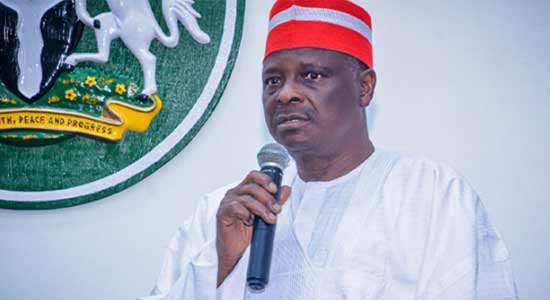
The vice-presidential candidate of the Nigeria Democratic Congress (NDC), Rabiu Musa Kwankwaso, has said a Peter Obi-led administration would introduce what he described as a different form of fuel subsidy, built around government investment in refining capacity and measures aimed at bringing petrol prices down to what Nigerians can reasonably afford.

Kwankwaso, a former Kano State governor, stated this during an interview with Arise Television on Tuesday while discussing the economic policies of President Bola Tinubu’s administration and the positions being advanced by presidential candidates ahead of the 2027 general elections.
Asked whether the NDC might face political difficulty in the North-West, where calls for a return of petrol subsidy have featured in public debate, Kwankwaso rejected the suggestion and said the party had its own approach.
“No, no, no, look. We are bringing subsidy in our own way,” he said.
Explaining what he meant, Kwankwaso said an NDC government could invest directly in refineries and increase domestic refining capacity rather than simply return to the previous subsidy arrangement.
He pointed to the fact that private investors had demonstrated that refineries could be built in Nigeria and argued that there was no reason the Federal Government could not, under appropriate circumstances, establish or invest in additional refining facilities.
According to him, the objective would be to ensure sufficient domestic supply and enable Nigerians to purchase petrol at filling stations at what he called a reasonable price.
“Now, if individuals in this country could build refineries, I see no reason why government, under certain circumstances, will not build a refinery or refineries to the extent that we achieve the minimum requirement,” Kwankwaso said.
He defined that “minimum requirement” as a situation where Nigerians across the country could obtain fuel without the current level of cost pressure.
“We, in the NDC, will do whatever it takes, really, to put the price of oil down,” he added.
Kwankwaso did not, in the remarks reported from the interview, provide a detailed funding structure for the proposed refinery investments or specify whether the intervention would involve direct payments to petroleum marketers, price controls, tax concessions, targeted support for refiners or another mechanism traditionally associated with fuel subsidies.
His description therefore appears to differ from a straightforward restoration of the previous petrol subsidy regime under which government absorbed part of the difference between the market cost of petrol and the price paid by consumers.
The comments are particularly significant because Obi, the NDC presidential candidate, had recently maintained that he supported removal of the previous subsidy regime.
At the Nigerian Bar Association Annual General Conference in August, Obi said mismanagement of the proceeds from subsidy removal was not, in itself, a reason to restore the old system. He argued instead that savings arising from subsidy removal should be transparently redirected into healthcare and other services that benefit citizens.
Obi subsequently said his approach would involve moderating fuel prices while directing government resources towards agriculture, education, healthcare, skills development and manufacturing rather than reviving the former subsidy structure.
Kwankwaso’s latest description of the NDC position as “subsidy in our own way” therefore adds detail to the debate by suggesting that government-backed investment in refining and measures to reduce the pump price could form part of the ticket’s approach.
The remarks also followed a recent Obi-Kwankwaso town hall in Kaduna, where the pair pledged to address the burden of high fuel costs alongside insecurity and poverty. Obi said the NDC would seek to tackle corruption and inefficiencies associated with the old subsidy regime while reducing the cost burden on Nigerians. (BreakingNews.com.ng)
Kwankwaso also criticised the manner in which the Tinubu administration ended the petrol subsidy in 2023.
He recalled that the three leading candidates in the 2023 presidential election had broadly supported subsidy removal, but argued that Tinubu’s implementation was too abrupt.
According to the NDC vice-presidential candidate, the administration removed the subsidy immediately after assuming office without first putting sufficient measures in place to deal with the economic consequences.
Tinubu announced at his May 29, 2023 inauguration that the previous subsidy arrangement could no longer be sustained and said funds previously committed to it would instead be channelled into infrastructure, education, healthcare and employment.
The President subsequently acknowledged that ending the subsidy increased the cost of fuel and contributed to higher food and other household expenses, while maintaining that the previous system had become financially unsustainable.
Kwankwaso disputed the way the policy was implemented, saying the consequences he and others anticipated followed the immediate removal.
He said the government should have considered the likely effects and measures needed to cushion Nigerians before carrying out such a major change.
The fuel subsidy question has consequently emerged as one of the economic policy differences being debated ahead of the 2027 presidential election, both between opposition parties and within discussions over how to reduce energy costs without recreating the fiscal and governance problems associated with the previous subsidy system.
The distinction is also relevant to the NDC ticket itself. While Obi has publicly said he would not simply restore the old fuel subsidy arrangement, Kwankwaso is now describing the ticket’s proposed intervention as a new form of subsidy centred, at least in part, on expanded domestic refining and lower consumer prices.
Neither candidate’s recent statements, however, set out a complete financing model, the projected cost to government or the precise mechanism by which a future NDC administration would determine and maintain what it considers a reasonable petrol price.
What is clear from Kwankwaso’s latest remarks is that the NDC vice-presidential candidate is not presenting the choice as one between the previous subsidy regime and complete government withdrawal from fuel pricing.
Instead, he said an Obi-led government would intervene through refining investment and other measures aimed at reducing the price Nigerians pay for petrol.
[A MUST HAVE] Evidence Act Demystified With Recent And Contemporary Cases And Materials

Available now for NGN 40,000 at ASC Publications, 10, Boyle Street, Onikan, Lagos. Beside High Court, TBS. Email publications@ayindesanni.com or WhatsApp +2347056667384. Purchase Link: https://paystack.com/buy/evidence-act-complete-annotation
______________________________________________________________________ “Enhance Legal Practice With Authoritative Reports” — Alexander Payne Offers Comprehensive Law Reports, Spanning Over A Century Of Nigerian Jurisprudence Interested buyers are encouraged to place their orders and enquiries via:
0704 444 4777, 0704 444 4999, 0818 199 9888
Website: www.alexandernigeria.com
Interested buyers are encouraged to place their orders and enquiries via:
0704 444 4777, 0704 444 4999, 0818 199 9888
Website: www.alexandernigeria.com