*Enugu AG: Virtual hearing legal, Law does not stand still, moves continually
*Hon. Justice Oji: Virtual hearing has advantages & disadvantages
*Chief (Mrs) A.J Offiah, SAN, FCIArb: Lawyers should give clients early alerts on cost implications
*Ikeazor Akaraiwe: Judges need to start recording electronically
*Ope Olugasa: E-registry, a way to go.

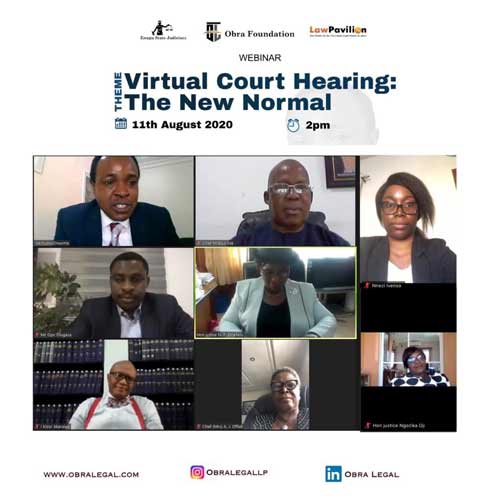
The webinar held on “Virtual Court Hearing: The New Normal” on 11th day of August, 2020 witnessed a robust and lucidly engaging discussion on the new normal foisted on our justice delivery system as a result of the ravaging Coronavirus pandemic in Nigeria.
The webinar which was hosted by Law Pavilion in partnership with Enugu State Judiciary and Obra Foundation had as special guests: Hon. Justice N.P Emehelu, FCIArb, F.DRI, FICMC, Chief Judge of Enugu State; Hon. Justice Ngozika Oji, Judge of Enugu State High Court and Chair, Enugu ICT Committee on Virtual Hearing; Chief (Mrs) A.J Offiah, SAN, FCIArb, Principal Partner of Obra Legal; Chief M. E Eze, the Attorney General of Enugu State; Mr. Ope Olugasa, Legal Tech Expert, MD/CEO, Law Pavilion and Mr. Ikeazor Akaraiwe, Principal Partner, Lex Rehoboth Partners.
Meanwhile, Ikechukwu Onuoma, Managing Partner of Obra Legal commenced the webinar by inviting the Hon. Chief Judge to make her opening remarks. However, the CJ noted thanked Obra foundation in ensuring that the judiciary keys into the new normal’’ and stated that “we were all woken up with with the pandemic’’.Also, the CJ also remarked that the Enugu State Judiciary had set up the ICT Committee knowing that it was not possible to conduct physical hearing and they are on top of it.
In another development, the Attorney General in his remarks noted that “it is a very interesting thing to join the webinar. The apposite time for us to key into the new normal” and he emphasized on the constitutionality of the virtual court hearings. He submits that no provision in the constitution provides for procedural actions like virtual hearing and as such, ‘’what is not prohibited is allowed’’. While quoting Lord Denning, he said “Law does not stand still, it moves continually”. Finally, he noted that “necessity is the mother of invention’’ and that there exists no better time to commence virtual court hearing than now, urging heads of court to key into the process and follow NJC guidelines.
Furthermore, Hon. Justice ngozika oji who spoke on the topic: “CAN VIRTUAL HEARING TAKE THE PLACE OF PHYSICAL HEARING?’’ stated that “Nigeria has been struggling with the digitization of court’’ and added that England has gone ahead to digitize their own process long ago.
Meanwhile, on constitutionality, she noted that the Supreme Court has settled the question on the “strange bird fellow’’ otherwise called technology, that is, virtual hearing. Also, she said that “the ideal thing is physical hearing”. However, that virtual hearing can seamlessly take the place of physical hearing most especially in affidavit evidences cases.
Therefore, she identified some advantages of virtual hearing, namely:
- It avoids delay.
- It saves time.
- It is convenient
- It enhances witness credibility.
- First hand assessment of evidence with ease like ‘locus in quo’’
However, she equally stated some of the disadvantages thus:
- The physical court has more control while virtual does not.
- Isolation of witnesses is not easy in virtual court as in physical court sessions
- Privacy protection
- Tendering documents, for example, how do you inspect in virtual hearing? She asked.
- Not all proceedings would be appropriate for virtual hearing
- Extra litigation cost
Finally, she gave the following recommendations:
- Need to look at the kind of cases that can be suitable for virtual hearing
- Agreement between the parties on virtual hearing
- Use of Pre-trial conference proceedings for virtual hearing due to suitability
- Need for advance preparations for virtual hearing
In another development, Chief (Mrs) A.J Offiah, SAN, FCIArb, who spoke on the topic “REMOTE HEARING AND CLIENT SATISFACTION” said “the webinar is intended to tickle our mind of thinking” and noted that the subject of virtual hearing is brought to fore by the necessity of the pandemic. Meanwhile, she noted that “it is very normal for people to view new things with a lot of doubt or suspicion”.
However, she categorized clients into the following three categories:
Illiterate/Uneducated Clients also referred to as “digital aliens”. She noted that these types of clients are complicated and would take time before they agree with virtual proceedings because of the orientation they have. Besides, she stated that the aura created by a physical court settings denote a serious business to this client.
Educated but not proficient clients also called “digital migrants”: she noted that these category of clients is a hybrid of the illiterate client. Also, “he may entertain doubt and suspicion”. Furthermore, it was stated that he would have a lot of questions to ask to be convinced about the efficacy of the virtual hearing”. In addition, she stated that these educated migrants clients will want to know the cost implication of the virtual hearing. This is because, it would determine his/her satisfaction and also, that he would wish to know the eventual output of the virtual hearing.
Educated & digitally proficient client: according to the learned silk, the concerns of these clients would be a little bit complicated. Majorly, this type of client would raise several issues relating to network. In addition, that the client will be worried about the Lawyer’s proficiency in the digital world and he may lose confidence. Furthermore, she noted that the client will be worried about possible manipulations of the justice delivery system in a virtual setting. Also, he would be concerned about the Judge’s perception and evaluation of evidence. She therefore noted that “all sophisticated clients will go on all these issues”.
Besides, she stated that every client will be concerned about the cost implication in a virtual setting which may lead to a renegotiation of fees payable. Also, she noted that there is a need for provision of facilities for clients in custodial centres.
Finally, she said that in the face of the current reality:
- Every Lawyer must improve themselves in using technology in a virtual hearing like procurement of the necessary gadgets amongst others
- Every Lawyer should try and engage a technical personnel for assistance
- Every Lawyer is expected to master and explain the processes of virtual hearing to clients in detailed
- Rehearse clients on his roles in a virtual hearing “psychologically , emotionally and practically”
She concluded that there is an imperative to give clients early alert on the cost implication of virtual hearing.
In addition, Mr. Ikeazor Akaraiwe who spoke on the topic “TECHNOLOGY AND ADVANCEMENT OF JUSTICE SECTOR” stated that technology has revolutionized our lives in every way and that serious societies advance their well being through it. However, he stated that the justice delivery sector in Nigeria is operating on a snail pace. Pre-pandemic, he said, we use long hand recording system in Nigerian judicial system and that only few like the Investment & Securities Tribunal and recently, the Federal High Court has started the process of electronic recording.
In this light, he noted that for an efficient justice sector driven by technology:
- We need to put in place an electronic recording system as opposed to Judges writing in long hand that is fraught with delay
- Every Judge/Magistrate needs to get an electronic library
- We must get rid or to the barest minimum, delay in our sysytem stating that “justice delayed is justice denied”
- Implementation of the e-filing of processes and service.
Similarly, Mr. Ope Olugasa who shared his thoughts on the topic “VIRTUAL COURT HEARING: FROM CONCEPT TO REALITY: HOW IT WORKS AND WHAT TO EXPECT” in his preliminary remark, stated as follows:
“The outbreak of the novel Corona Virus pandemic, Covid-19 has brought a new reality upon most of the countries on earth, necessitating various lockdown measures across board
Despite the lockdown, the Judiciary, being the backbone of every nation and the last hope of the common man should not have closed. But unfortunately, because Nigeria was not prepared for the possibility of such Force-Majeure, the court was shut down in Nigeria for almost a month due to the pandemic; and filing of court processes were also suspended because it had to be done physically. The entire judiciary was at the mercy of Covid-19!” He said.
Meanwhile, quoting Albert Einstein, “in the midst of every crisis, lies great opportunity”, he noted that the pandemic has presented several opportunities like a world driven by technology. In addition, he noted that the issues to be considered are the provision of the NJC guidelines as adopted by some judiciaries with focus on e-filing, e-service and remote hearing; concept to reality- perceived challenges to its implementation and how technology solution will resolve the identified challenges (solution).
Furthermore, on e-filing, he stated that there should be a provision to capture details of all partiesand counsel in a matter and phone numbers willn be made mandatory. Also, that there should be compliance with the requirements of the NDPR, 2019 by NITDA, and the EU GDPR.
Also, he stated that there is a need for an e-registry that consisits of an e-filing section where processes can be received either via email or direct upload and saved appropriately.
In addition, he stated that a provision of e-registry, e-filing, e-payment and e-service would mean that:
“Court processes duly signed and sealed are uploaded by the Counsel from the comfort of their offices or homes and sent for the Registrar’s review and assessment.
“After all assessments have been done, payments are made online with automatic generation of reciepts to (be) verified by the registrar .
“the filed court processes are sent to all the litigants and counsel”
Finally, on the management of the court through docket and schedule manager, he recommended thus:
- Introduction of Specific Time Based Schedule Management System whereby matters are timed and scheduled based on time allocations either for remote hearing or physical hearing
- Hearing notices will automatically be sent to all the parties
[A MUST HAVE] Evidence Act Demystified With Recent And Contemporary Cases And Materials

Available now for NGN 40,000 at ASC Publications, 10, Boyle Street, Onikan, Lagos. Beside High Court, TBS. Email publications@ayindesanni.com or WhatsApp +2347056667384. Purchase Link: https://paystack.com/buy/evidence-act-complete-annotation
______________________________________________________________________ “Enhance Legal Practice With Authoritative Reports” — Alexander Payne Offers Comprehensive Law Reports, Spanning Over A Century Of Nigerian Jurisprudence Interested buyers are encouraged to place their orders and enquiries via:
0704 444 4777, 0704 444 4999, 0818 199 9888
Website: www.alexandernigeria.com
Interested buyers are encouraged to place their orders and enquiries via:
0704 444 4777, 0704 444 4999, 0818 199 9888
Website: www.alexandernigeria.com