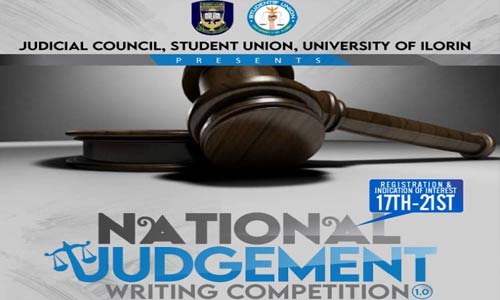
The Judicial Council, Student Union, University of Ilorin, has released Moot Facts for the FIRST-EVER National Online Judgment Writing Competition.

The Moot facts were made available to TheNigeriaLawyer (TNL) by the Council.
The facts are for knock out stage.
Find it below:
BETWEEN:
ASSOCIATION OF HUMAN RIGHTS ACTIVISTS – CLAIMANT
AND
FEDERAL MINISTRY OF EDUCATION & ANOR – DEFENDANT
By an Originating summons dated 29/07/2016 but filed on 03/12/ 2015 at the High Court of Galos State, the Claimant sought for reliefs and posed questions for determination as follows:
- A DECLARATION that the constitutional provisions on the right to free, compulsory and universal primary education up to junior secondary school for all Nigerian citizens under section 18 (3) (a) of the Constitution of the Federal Republic of Nigeria 1999 (as amended) is an enforceable constitutional right.
- A DECLARATION that the Federal and State Governments are under constitutional obligation to provide financial and institutional resources for free, compulsory and universal primary education and junior secondary education for all qualified Nigerians in fulfillment of their constitutional obligations under section 18 (3) (a) of the 1999 Constitution.
- A DECLARATION that failure to adopt and implement free, compulsory and universal primary education and free junior secondary education is a breach of the constitutional by the executive head of the government that failed to do so.
- AN ORDER compelling the Federal and State Governments to forthwith provide financial and institutional resources for citizens’ exercise of their right to free, compulsory and universal primary education and free junior secondary education.
- AN ORDER directing the 1st Defendant {Federal Minister of Education} to withdraw forthwith all tuition fee and any other payment by pupil at primary and junior secondary school in Nigeria in accordance with Chapter II.
ARGUMENTS OF PARTIES
The main issue for determination in this case is whether, having regard to the provision of Section 18 of the Constitution of the Federal Republic of Nigeria, the right to education in Nigeria is guaranteed, enforceable and justiciable.
CLAIMANT
- The provisions of Chapter 2 of the constitution are not enforceable by virtue of section 6 (6) (b) of the Constitution.However, once a legislation is enacted to give legal effect to any of the provisions of Chapter 2, the right contained in such provision become enforceable under section 6 (6) (b) of the Constitution. Section 18 (1) and (3) of the 1999 Constitution requires all governments in Nigeria to provide equal and adequate educational opportunities at all levels for all Nigerian citizens. It provides thus:
- (1) Government shall direct its policy towards Ensuring that there are equal and adequate educational opportunities at all levels.
(3) Government shall strive to eradicate illiteracy; and to this end Government shall as and when practicable provide
(a) free, compulsory and universal primary education;
(b) free secondary education;
(c) free university education; and
(d) free adult literacy programme.
The Claimant Counsel also argued further that although section 18 of the Constitution falls under the non- justiciable fundamental objectives and directive principles of state policy, the court can make it justiciable on its own self as it has done on countless numbers of occasions. Thus, Federal and state governments are therefore, under constitutional obligation to provide financial and institutional resources for free, compulsory and universal primary education and free junior secondary education.
Counsel also noted that Governments have the legal duty and responsibility under section 13 of the constitution to conform to, observe and apply the provisions of Chapter two of the constitution. Section 13 of the 1999 constitution provides that:
“13. It shall be the duty and responsibility of all organs of government, and of all authorities and persons, exercising legislative, executive or judicial powers, to conform to, observe and apply the provisions of this Chapter of this constitution.”
In support of the summons is a 16 paragraph affidavit deposed to by Swift Asuquo, a legal practitioner of the claimant. Annexed thereto are CTC of the Certificate of Registration and the Memorandum and Articles of Association of the Plaintiff, marked as Exhibit A. it is further supported by a Written Address dated 27/10/2015.
The core submissions relating to this question are contained in paragraphs 3.4 to 3.6 of the Plaintiff’s Written Address. Put briefly, the Plaintiff submitted that irrespective of the provisions of Section 6 (6) (c) of the 1999 Constitution, some provisions of Chapter 2 of the Constitution will become enforceable if the Constitution provides otherwise in another section. It is further submitted that where the National Assembly enacts a law on any Section or sections of Chapter II of the Constitution, such section (s) will become automatically enforceable. Referred to the Cases of Olafisoye v. FRN (2004) 4 NWLR (Pt. 864) 580 and A – G, Ondo State v. A – G., Federation (2002) 9 NWLR (Pt. 772) 222, per Uwaifo, J.S.C.
He concluded by saying that the National Assembly, in pursuit of her powers to make laws under Section 4 of the Constitution has enacted the Universal Basic Education Act, 2004 and through the provisions of that Act, Section 18 of the Constitution has been made justiciable. He submitted on the whole that the provisions of Section 18 therefore stands justiciable in the eyes of the law and there is a guaranteed right of Nigerian citizens to education at all levels.
RESPONDENT ARGUMENTS
The respondent argued that the provision of Section 6(6)C of the Constitution of the Federal Republic of Nigeria and where such situation manifests, the court can only resolve to literal rule of interpretation. He noted that the non-justiciability doctrine has been strategically placed in the Constitution in order to avoid elements that seek to distract the government from trying to do her duties. He pointed out many measures that the Federal and State Governments have been trying to put in place to ensure there are accessible education at all levels and that the Government is not relaxed in her efforts to secure the future of her citizens through education.
He brought the debt-profile of the Republic before the court [Exhibit RC2] and reminded the court of the need to take judicial notice of these public records so as not to make laws or write judgments that commands impossibility. Noting that it is a fundamental principle of statutory interpretation that the law does not command the impossible (lex non cogit ad impossibilia) vide the case of Lasun v. Awoyemi (2009) 16 NWLR (pt. 1168) 548. What would therefore have been the effect of judgment that does not resonate with the reality? Learned Counsel asked.
He referred the court to section 6(6)c again thus
The judicial powers vested in accordance with the foregoing provisions of this section shall not except as otherwise provided by this Constitution, extend to any issue or question as to whether any act of omission by any authority or person or as to whether any law or any judicial decision is in conformity with the Fundamental Objectives and Directive Principles of State Policy set out in Chapter II of this Constitution;
He noted that for any section in Chapter II of the Constitution to stand justiciable, it must be provided for in another chapter under the Constitution. He argued that judicial institutions should not be anti-government and that justice is a three way traffic, to the court, to parties and most definitely to Government. If, he argues, the Court thinks that the court will not want a situation where her judgments and orders will not be obeyed because of impracticability and the court is judicially aware of the situation of things in Nigeria. He persuaded the court that since cases are to be considered on their own peculiar circumstances, the circumstance with which The cases cited by the Claimant were decided differs totally from the case involving right to education. He urged the court not to mix things up by hastily generalizing any matter that comes under chapter II and Section 6(6)C as a chance to revolt against the government. Afterall, the judiciary is part of the government too.
The Court was urged to resolve the matter in the favour of the respondent.
All Laws of Galos state and the Federal Republic of Nagerii are the same as the Laws of the Federation of Nigeria.
NOTE:
- In this Stage, only one opinion is allowed and NOT THREE.
- This Stage shall be 100 % Content judged, NO VOTING.
- Tendencies to show judicial activism will attract marks.
- The last three teams with the lowest points will be knocked-out of the competition.
 The promotion, which commenced on January 8 and runs until February 8, 2026, offers five core maritime law books authored by Dr. Emeka Akabogu, SAN, ordinarily valued at N405,000, for just N150,000 — a 63% discount.
Interested buyers can place their orders through the following channels:
Phone: 0704 329 3271
Online Store: https://paystack.shop/aa-bookstore
Website: www.akabogulaw.com
_______________________________________________________________________
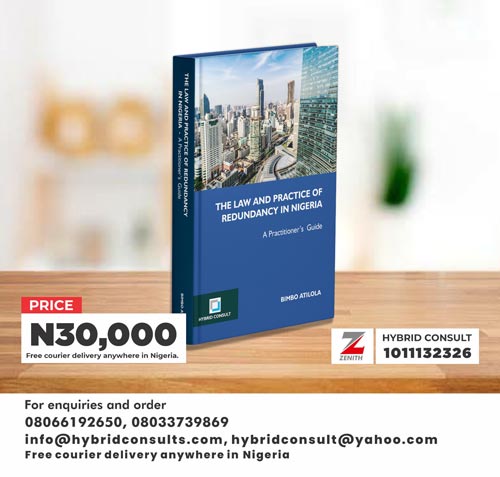
The Law And Practice Of Redundancy In Nigeria: A Practitioner’s Guide, Authored By A Labour & Employment Law Expert Bimbo Atilola
The promotion, which commenced on January 8 and runs until February 8, 2026, offers five core maritime law books authored by Dr. Emeka Akabogu, SAN, ordinarily valued at N405,000, for just N150,000 — a 63% discount.
Interested buyers can place their orders through the following channels:
Phone: 0704 329 3271
Online Store: https://paystack.shop/aa-bookstore
Website: www.akabogulaw.com
_______________________________________________________________________
The Law And Practice Of Redundancy In Nigeria: A Practitioner’s Guide, Authored By A Labour & Employment Law Expert Bimbo Atilola
 _______________________________________________________________________
[A MUST HAVE] Evidence Act Demystified With Recent And Contemporary Cases And Materials

Available now for NGN 40,000 at ASC Publications, 10, Boyle Street, Onikan, Lagos. Beside High Court, TBS. Email publications@ayindesanni.com or WhatsApp +2347056667384. Purchase Link: https://paystack.com/buy/evidence-act-complete-annotation
______________________________________________________________________ ARTIFICIAL INTELLIGENCE FOR LAWYERS: A COMPREHENSIVE GUIDE
Reimagine your practice with the power of AI “...this is the only Nigerian book I know of on the topic.” — Ohio Books Ltd
Authored by Ben Ijeoma Adigwe, Esq., ACIArb (UK), LL.M, Dip. in Artificial Intelligence, Director, Delta State Ministry of Justice, Asaba, Nigeria.
Bonus:
Get a FREE eBook titled “How to Use the AI in Legalpedia and Law Pavilion” with every purchase.
ARTIFICIAL INTELLIGENCE FOR LAWYERS: A COMPREHENSIVE GUIDE
Reimagine your practice with the power of AI “...this is the only Nigerian book I know of on the topic.” — Ohio Books Ltd
Authored by Ben Ijeoma Adigwe, Esq., ACIArb (UK), LL.M, Dip. in Artificial Intelligence, Director, Delta State Ministry of Justice, Asaba, Nigeria.
Bonus:
Get a FREE eBook titled “How to Use the AI in Legalpedia and Law Pavilion” with every purchase.
How to Order: 📞 Call, Text, or WhatsApp: 08034917063 | 07055285878 📧 Email: benadigwe1@gmail.com 🌐 Website: www.benadigwe.com
Ebook Version: Access directly online at: https://selar.com/prv626