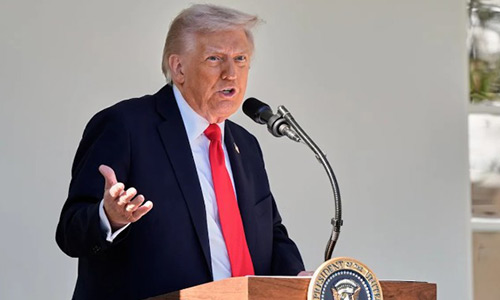
A United States federal judge has temporarily blocked President Donald Trump’s latest attempt to narrow birthright citizenship, ruling that the new executive order is likely unconstitutional as applied to children whose parents are in the country temporarily or without proper documentation.

U.S. District Judge Deborah Boardman of Maryland issued the preliminary injunction on Wednesday in CASA v. Trump, preventing the administration from enforcing the August 6 executive order against members of the certified class while the litigation continues.
Boardman said the order was “almost certainly unconstitutional” because the Supreme Court had already held that the children covered by the class are citizens at birth under the Citizenship Clause of the 14th Amendment.
“The 2026 Executive Order is almost certainly unconstitutional as applied to the certified class for the simple reason that the Supreme Court in Barbara already decided that the children in the class are citizens at birth,” the judge said.
“This Court must, once again, preliminarily enjoin enforcement of the President’s most recent attempt to strip the right to citizenship from them.”
The ruling is the latest development in the continuing legal battle over birthright citizenship since Trump returned to office and sought to restrict the longstanding constitutional rule granting citizenship to most people born on U.S. soil.
Shortly after beginning his second term, Trump issued an executive order seeking to prevent children born in the United States from automatically becoming citizens where their parents were undocumented immigrants or were only temporarily present in the country.
That measure eventually reached the Supreme Court in Trump v. Barbara, where, on June 30, 2026, the court rejected the administration’s position.
In the majority opinion delivered by Chief Justice John Roberts, the Supreme Court stressed the broad reach of the 14th Amendment’s Citizenship Clause, which provides citizenship to persons “born … in the United States and subject to the jurisdiction thereof.”
The court said historically recognised exceptions to birthright citizenship were narrow, including children of foreign diplomats and certain categories arising from 19th-century tribal relations.
Following that ruling, Trump issued a fresh executive order on August 6, seeking to carve out additional exceptions.
The new order went beyond children of ambassadors and purported to deny automatic citizenship to children of other foreign government employees, including some embassy personnel, as well as employees of international organisations such as the United Nations and World Bank.
It also sought to exclude children whose parents were designated as “alien enemies” under federal law.
Another provision targeted what the administration described as “birth tourism,” including cases where a parent allegedly engaged in a commercial transaction to travel to the United States or one of its territories for the purpose of giving birth.
The plaintiffs, comprising immigration advocacy organisations and individual members who have given birth in the United States, returned to court to challenge the new order.
They argued that the measure was vague, expansive and capable of denying citizenship to children whose parents might be wrongly classified by the government.
The plaintiffs raised concerns that a parent could be labelled an “alien enemy” and that the child could consequently be denied citizenship despite not falling within any historically recognised constitutional exception.
They also argued that the administration’s reference to a “commercial transaction” was so broad that it could potentially encompass something as ordinary as purchasing an airline ticket to travel to the United States before giving birth.
Boardman agreed that the plaintiffs had demonstrated a likelihood of succeeding on the merits, one of the principal requirements for granting preliminary relief.
She pointed to previous instances in which the government had allegedly attempted to remove individuals based on disputed affiliations with groups designated as alien enemies.
The judge said even a preliminary examination of the latest executive order showed that its new exceptions bore “little to no resemblance” to the narrow exceptions previously recognised by the Supreme Court.
Rather than extensively reconsidering the constitutional question, Boardman relied heavily on the Supreme Court’s June decision, describing it as controlling law.
The Trump administration had argued that the earlier Supreme Court ruling did not prevent the President from recognising additional exceptions to birthright citizenship.
Justice Department lawyers contended that while the Supreme Court had held that children of undocumented and temporary immigrants were not automatically excluded from birthright citizenship, it did not hold that every child born to such parents must necessarily receive citizenship regardless of other circumstances.
Government lawyers also relied on historically accepted exceptions involving children of diplomats and alien enemies.
The plaintiffs rejected that interpretation, arguing that the recognised exceptions are narrow and cannot be expanded unilaterally by executive action.
“The President has no power to unilaterally rewrite the Constitution,” their lawyers argued, asking the court to prevent the administration from denying citizenship under the new order.
The White House criticised Boardman’s ruling.
White House spokeswoman Lauren Bis described it as another decision by what she called an “activist judge appointed by Biden” seeking to frustrate Trump’s agenda.
She maintained that the administration’s executive order was consistent with the reasoning and holdings of the Supreme Court.
The administration has defended the measure partly as an effort to address “birth tourism” and situations involving individuals it classifies as alien enemies, including alleged members of designated criminal or terrorist organisations.
The plaintiffs, however, argued that such classifications could be wrongly applied and that children could consequently lose constitutional rights based on disputed allegations against their parents.
Boardman’s ruling does not finally determine the constitutionality of the August executive order. It temporarily prevents its enforcement against the affected class while the substantive case proceeds.
For now, however, the decision represents another judicial setback for Trump’s efforts to narrow birthright citizenship and reinforces the Supreme Court’s earlier position that the constitutional guarantee applies broadly, subject only to narrowly recognised exceptions.
[A MUST HAVE] Evidence Act Demystified With Recent And Contemporary Cases And Materials

Available now for NGN 40,000 at ASC Publications, 10, Boyle Street, Onikan, Lagos. Beside High Court, TBS. Email publications@ayindesanni.com or WhatsApp +2347056667384. Purchase Link: https://paystack.com/buy/evidence-act-complete-annotation
______________________________________________________________________ “Enhance Legal Practice With Authoritative Reports” — Alexander Payne Offers Comprehensive Law Reports, Spanning Over A Century Of Nigerian Jurisprudence Interested buyers are encouraged to place their orders and enquiries via:
0704 444 4777, 0704 444 4999, 0818 199 9888
Website: www.alexandernigeria.com
Interested buyers are encouraged to place their orders and enquiries via:
0704 444 4777, 0704 444 4999, 0818 199 9888
Website: www.alexandernigeria.com