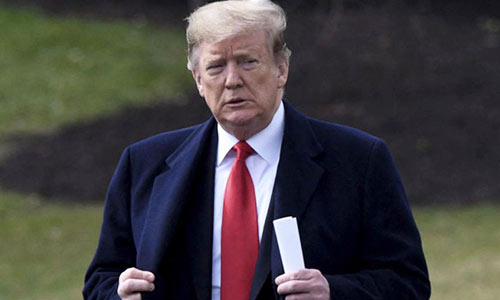
Trump lawyers: criminal and congressional investigations of a president amount to unconstitutional ‘harassment’.

In a major showdown over presidential powers in the United States Supreme Court on Tuesday, justices seemed divided over President Donald Trump’s efforts to quash subpoenas for his financial records from congressional committees but more sympathetic towards a New York prosecutor’s attempt to access many of the same records.
The court’s conservative majority repeatedly signalled concern about improper harassment of the Republican president in both instances, but – based on their questions – seemed more sceptical of the president’s attempts to keep those records from getting into the hands of state prosecutors.
Liberal Justice Elena Kagan told Trump lawyer Jay Sekulow, who also represented Trump in the impeachment hearings in January, that a “fundamental precept of our constitutional order is that the president is not above the law”.
The court’s decision in the cases, expected in June, could shape the outcome of November’s presidential election and redefine the limits of presidential power for decades to come. Rulings against the president could lead to the campaign season release of personal financial information that Trump has kept shielded from investigators and the public.
During the first session – dedicated to the congressional subpoenas – lawyers arguing on the president’s behalf alleged that the subpoenas amounted to unnecessary “harassment” of Trump and his family, noting that the requests for financial records extended beyond the president to his children and grandchildren.
A ruling against the president, they argued, would open the door for “endless subpoenas and harassment” anytime one party controlled the presidency and the other the White House.
It would “reshape and transform the balance of power … and harm and undermine the presidency of the United States – not just this president but the institution of the presidency going forward,” said Jeffrey Wall, a deputy solicitor general. “It doesn’t take much imagination to see where that road will lead and that we will regret having taken it.”
In the afternoon session, devoted to similar requests as part of a criminal investigation by a district attorney in New York City, Trump’s lawyers argued that the president is immune from prosecution by local authorities who may be motivated by political considerations.
Sekulow said a ruling that allowed the New York investigation to proceed would amount to “weaponising” 2,300 prosecutors across the US.
Conservative Justice Samuel Alito, however, challenged Sekulow’s assertion that a grand jury’s subpoena cannot be enforced against a sitting president in a case in which waiting for a president to leave office would undermine a criminal prosecution.
Chief Justice John Roberts’ questions of lawyers representing both Trump and the House signalled his view of the need to strike a balance between the powers of the president and Congress. He expressed scepticism that Congress had no authority to issue a subpoena or that a court could second-guess its motivations to do so, while also doubting that congressional power was limitless.
Roberts also seemed sceptical of arguments by a House lawyer, Doug Letter, that legislators have broad authority to investigate a president for the purpose of writing laws.
“Your test is not much of a test. It’s not a limitation,” Roberts told Letter, adding that the House needed to take into account that it was dealing with a co-equal branch of government.
Before the coronavirus pandemic erupted, the cases marked the most politically treacherous proceedings against Trump since the impeachment hearings in January. If, as some have testified, the financial records show that Trump has been artificially inflating his net worth for decades – to both the general public and to the banks lending him money – the sheen on his career in business, one of the president’s primary selling points, could quickly lose its lustre.
The court is holding its second week of arguments by telephone because of the coronavirus pandemic, with audio available live to audiences around the world for the first time in the court’s history.
The cases before the Supreme Court on Tuesday involving tax records from President Trump resemble earlier disputes over presidents’ assertions that they were too consumed with the job of running the country to worry about lawsuits and investigations.
In 1974, the justices acted unanimously in requiring President Richard Nixon to turn over White House tapes to the Watergate special prosecutor. In 1997, another unanimous court allowed a sexual-harassment lawsuit to go forward against President Bill Clinton.
Appellate courts in Washington and New York have ruled that the documents should be turned over, but those rulings have been put on hold pending a final court ruling. The appellate decisions brushed aside the president’s broad arguments, focusing on the fact that the subpoenas were addressed to third parties asking for records of Trump’s business and financial dealings as a private citizen, not as president.
House committees want records from Deutsche Bank and Capital One, as well as the Mazars USA accounting firm. Mazars also is the recipient of the subpoena from the Manhattan District Attorney Cyrus Vance Jr.
Two congressional committees subpoenaed the bank documents as part of their investigations into Trump and his businesses. Deutsche Bank has been one for the few banks willing to lend to Trump after a series of corporate bankruptcies and defaults starting in the early 1990s.
Vance and the House Oversight and Reform Committee sought records from Mazars concerning Trump and his businesses based on payments that Trump’s then-personal lawyer, Michael Cohen, arranged to keep two women from airing their claims of affairs with Trump during the 2016 presidential race.
SOURCE: AL JAZEERA AND NEWS AGENCIES
[A MUST HAVE] Evidence Act Demystified With Recent And Contemporary Cases And Materials

Available now for NGN 40,000 at ASC Publications, 10, Boyle Street, Onikan, Lagos. Beside High Court, TBS. Email publications@ayindesanni.com or WhatsApp +2347056667384. Purchase Link: https://paystack.com/buy/evidence-act-complete-annotation
______________________________________________________________________ “Enhance Legal Practice With Authoritative Reports” — Alexander Payne Offers Comprehensive Law Reports, Spanning Over A Century Of Nigerian Jurisprudence Interested buyers are encouraged to place their orders and enquiries via:
0704 444 4777, 0704 444 4999, 0818 199 9888
Website: www.alexandernigeria.com
Interested buyers are encouraged to place their orders and enquiries via:
0704 444 4777, 0704 444 4999, 0818 199 9888
Website: www.alexandernigeria.com