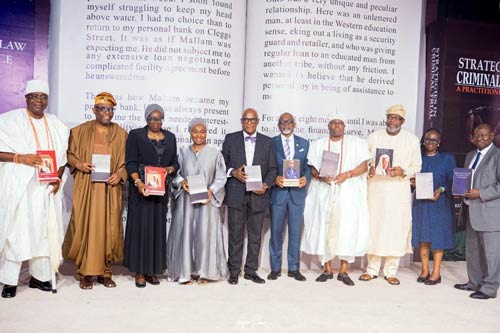
*Says “Experience That Is Documented Becomes Part Of The Profession’s Collective Inheritance”

The Chief Justice of Nigeria (CJN), Justice Kudirat Kekere-Ekun, has commended Senior Advocate of Nigeria (SAN), Kemi Pinheiro, for his contributions to legal scholarship, professional development and the advancement of legal practice, describing six publications presented in his honour as valuable resources that would enrich Nigerian jurisprudence and strengthen the intellectual foundation of the legal profession.
Kekere-Ekun, who chaired the public presentation of the books on Friday at the Civic Centre, Victoria Island, Lagos, said the publications reflected an impressive combination of legal scholarship, practical experience and engagement with contemporary developments in the administration of justice.
The CJN noted that the collection, comprising four books authored by Pinheiro and two compilations produced in his honour, addressed significant areas of legal practice, including litigation, arbitration, insolvency, criminal law, technology and contemporary jurisprudence.
According to her, the publications were not merely books assembled to commemorate an accomplished legal practitioner but works intended to make legal knowledge more accessible and useful to those responsible for applying, interpreting and developing the law.
She particularly commended their practical orientation and engagement with emerging legal issues, stressing that their significance extended beyond the occasion of their presentation.
“Taken together, the works reflect an engagement with important areas of legal practice and scholarship, as well as an attempt to preserve the experiences and contributions of a distinguished member of our profession,” Kekere-Ekun said.
The CJN described Defining Moments: Chronicles of a Silk as particularly significant, noting that it provided a personal account of the experiences, encounters, challenges and defining moments that shaped Pinheiro’s career spanning nearly four decades at the Bar.
She explained that professional memoirs were valuable because they preserved aspects of legal practice that might never appear in law reports or formal institutional records.
According to her, such accounts provided younger legal practitioners with opportunities to understand the human experiences behind professional achievements, including the uncertainties, disappointments and perseverance that often accompanied successful legal careers.
Turning to the publications on arbitration and insolvency, Kekere-Ekun stressed their importance in Nigeria’s increasingly sophisticated business environment, particularly the need for effective legal responses to commercial transactions, financial distress and dispute resolution.
She explained that Arbitration Law and Practice in Nigeria examined the legal framework established by the Arbitration and Mediation Act 2023 and the developing jurisprudence of Nigerian courts.
The CJN said the book’s practical examination of arbitration proceedings, from arbitration agreements to the recognition and enforcement of awards, made it a useful resource for lawyers involved in commercial dispute resolution.
Similarly, she described Insolvency Law in Nigeria: Practice and Procedure as an important contribution to an increasingly relevant area of legal practice under the Companies and Allied Matters Act 2020.
She noted that the publication examined corporate rescue, restructuring, administration and other mechanisms for addressing financial distress.
According to her, the book reflected the growing recognition that preserving viable businesses could, in appropriate circumstances, better serve the interests of creditors, employees, investors and the wider economy than immediate liquidation.
Speaking on Strategies in Criminal Trials: A Practitioner’s Guide, the CJN said the publication would benefit both experienced practitioners and younger lawyers seeking to strengthen their competence in criminal advocacy.
She observed that effective criminal litigation required not only a sound understanding of substantive law but also a firm grasp of procedure, evidence and the strategic decisions that arose at different stages of a trial.
Kekere-Ekun identified the book’s treatment of arraignment, bail, confessional statements, electronic evidence, no-case submissions and written addresses as particularly relevant to criminal law practice.
She also welcomed its examination of emerging issues, especially electronic evidence in the age of artificial intelligence.
The CJN further commended the two publications compiled in Pinheiro’s honour, The Compendium in Honour of Kemi Pinheiro and Trending Issues of Law and Faith: Essays in Honour of Kemi Pinheiro.
She explained that the compendium brought together contributions from scholars and practitioners on arbitration, taxation, maritime law, judicial precedent and the application of technology in dispute resolution.
Kekere-Ekun also praised the publication produced under the auspices of the Lagos Branch of the Muslim Lawyers Association of Nigeria (MULAN), noting that it extended beyond religious law to address broader questions relating to evidence, criminal law, technology, legal practice and contemporary jurisprudence.
She said the breadth of the publications demonstrated that professional and faith-based institutions could make meaningful contributions to the intellectual development of the legal profession.
Emphasising the importance of preserving professional knowledge, the CJN urged senior lawyers to document their experiences and make them available to younger practitioners.
She maintained that one of the most valuable legacies an experienced lawyer could leave behind was knowledge from which succeeding generations could learn and develop.
“Experience that is not shared may remain a personal achievement. Experience that is documented and transmitted becomes part of the profession’s collective inheritance,” she said.
Kekere-Ekun encouraged younger members of the Bar to regard the publications not merely as additions to their personal libraries but as an invitation to deepen their knowledge, think critically and take their professional development seriously.
Earlier, Pinheiro commended the Chief Justice for reforms within the judiciary, particularly the digitisation of the Supreme Court’s operations and the refurbishment of federal courts.
The SAN disclosed that a younger colleague recently informed him that the Supreme Court had contacted him, without any prompting or application, to notify him that an appeal filed 13 years earlier had been fixed for hearing.
Pinheiro described Kekere-Ekun as a “silent revolutionary”, expressing confidence that history and posterity would recognise her contributions to the development of the judiciary.
Explaining the motivation behind his publications, Pinheiro said the four books he authored were products of his practical experiences as an insolvency practitioner, criminal prosecutor and arbitrator, rather than purely theoretical exercises.
He described the publications as carefully curated accounts of the differences between legal principles taught in law schools and the realities encountered in legal practice.
Pinheiro, who disclosed that he would mark 40 years at the Bar in October 2027, said the books represented lessons accumulated over nearly four decades of professional experience and 20 years as a member of the Inner Bar.
He also reflected on the role of mentorship in his career, paying tribute to his professional mentors, particularly the late Chief Abiola Oshodi and his uncle, Chief Toyin Pinheiro, SAN, under whom he served seven years as a pupil.
Describing legal practice as a continuum, the SAN compared the profession to a relay race rather than a 100-metre sprint, stressing that each generation of lawyers had a responsibility to receive and pass the baton to its successors without dropping it.
He explained that the mentorship he received as a young lawyer had influenced his commitment to developing younger practitioners through his law firm, Pinheiro LP.
According to him, the firm recently celebrated the elevation of Bolu Akadri to the rank of Senior Advocate of Nigeria, following the earlier elevation of Chukwudi Enebeli in 2024.
Pinheiro also disclosed that the financial difficulties he encountered during his early years in legal practice inspired him to establish a free wig-and-gown initiative for indigent graduates of the Nigerian Law School.
He said more than 800 lawyers had benefited from the initiative.
The senior lawyer recalled an encounter involving a young lawyer who travelled from Lafia, Nasarawa State, to Lagos on a truck transporting tomatoes because he could not afford conventional transportation to collect a free wig and gown from his office in Ilupeju.
He also recounted how a distant uncle, Rasaq Shonibare, provided him with money to purchase his Joint Admissions and Matriculation Board (JAMB) application form, enabling him to secure admission to study Law at the University of Benin.
According to Pinheiro, more than five years later, he had the opportunity to repay that act of kindness when he represented the same uncle free of charge in a legal dispute involving the possible takeover of his assets by a bank.
He described the experience as part of the personal and professional journey that shaped his understanding of the responsibilities of legal practitioners.
The SAN further paid tribute to his wife, Justice Yetunde Pinheiro, for her encouragement and support throughout his professional career.
He particularly recalled her role during his unsuccessful first attempt at elevation to the rank of Senior Advocate of Nigeria.
Pinheiro said his wife stood by him during the disappointment and reassured him that he would eventually attain the prestigious rank.
He was subsequently elevated to the Inner Bar in 2006.
The public presentation brought together serving and retired judicial officers, senior lawyers, academics and other dignitaries to celebrate Pinheiro’s contributions to legal scholarship, professional mentorship and the development of Nigerian jurisprudence.
[A MUST HAVE] Evidence Act Demystified With Recent And Contemporary Cases And Materials

Available now for NGN 40,000 at ASC Publications, 10, Boyle Street, Onikan, Lagos. Beside High Court, TBS. Email publications@ayindesanni.com or WhatsApp +2347056667384. Purchase Link: https://paystack.com/buy/evidence-act-complete-annotation
______________________________________________________________________ “Enhance Legal Practice With Authoritative Reports” — Alexander Payne Offers Comprehensive Law Reports, Spanning Over A Century Of Nigerian Jurisprudence Interested buyers are encouraged to place their orders and enquiries via:
0704 444 4777, 0704 444 4999, 0818 199 9888
Website: www.alexandernigeria.com
“A Comprehensive Guide To Evidence Law” — Releases Second Edition In Three Volumes, Covering 4,051 Cases
For enquiries and orders, contact: 08035526491 Email: jerryamadisilk@gmail.com
 Prof. Jerry Amadi’s Evidence Law, Second Edition (2026), contains 3,314 pages in three volumes, covering the Evidence Act 2011, its 2023 amendment, and 4,051 Nigerian and English cases.