

The Federal Government has announced plans to accelerate the prosecution of drug-related offences, strengthen the confiscation of assets acquired through illicit drug trafficking and intensify international cooperation to dismantle criminal networks operating within and outside Nigeria.

The Attorney-General of the Federation and Minister of Justice, Lateef Fagbemi, SAN, disclosed this on Monday, November 23, 2026, in Abuja, during the inauguration of the National Drug Control Master Plan (NDCMP) 2026–2030.
Fagbemi said the Federal Ministry of Justice would collaborate with the judiciary to ensure the speedy disposal of drug-related cases in accordance with the Administration of Criminal Justice Act.
He explained that the government would also strengthen measures to ensure that convictions for drug offences were accompanied by the confiscation of assets acquired through illegal activities, thereby preventing traffickers from retaining the proceeds of their crimes.
According to him, effective prosecution, asset recovery and international legal cooperation are essential to dismantling organised drug trafficking networks and disrupting the financial systems that sustain their operations.
“The government will intensify mutual legal assistance, extradition processes and cross-border asset recovery to disrupt the financial networks sustaining organised drug trafficking.
“These measures are necessary to strengthen Nigeria’s criminal justice response and ensure that drug traffickers did not continue to benefit from the proceeds of their illegal activities,” Fagbemi said.
The Attorney-General maintained that the fight against drug trafficking must go beyond the arrest and prosecution of offenders to include the recovery of proceeds derived from illicit transactions.
He stressed that depriving drug traffickers of their financial resources would weaken criminal enterprises and discourage the continued financing of illegal drug markets.
Fagbemi also commended the National Drug Law Enforcement Agency (NDLEA) for promoting early collaboration between investigators and prosecutors, describing the approach as an important step towards improving the quality of criminal investigations and prosecutions.
He explained that closer cooperation between the two groups had strengthened evidence gathering, reduced procedural errors and improved the effectiveness of criminal proceedings.
The minister described the NDLEA as a central institution in Nigeria’s drug control system, acknowledging its contributions to intelligence gathering, interdiction, investigation, prosecution and public sensitisation.
“The agency remains the bedrock of our national drug control architecture, delivering vital results across intelligence operations, interdiction, investigation, prosecution and public sensitisation,” he stated.
Fagbemi particularly commended the Chairman of the NDLEA, Brigadier-General Buba Marwa (Rtd), for his leadership and commitment to strengthening Nigeria’s response to drug trafficking and substance abuse.
“I specifically commend Brig.-Gen Buba Marwa, who has been a silent achiever and has consistently made this administration and country proud,” he said.
Speaking on the newly inaugurated National Drug Control Master Plan, the Attorney-General explained that the 2026–2030 framework was designed to consolidate the achievements of the NDLEA and strengthen coordination among institutions responsible for addressing drug-related challenges.
He said the plan would promote collaboration among law enforcement agencies, public health institutions, educational authorities, social development agencies, financial investigators and community stakeholders.
According to Fagbemi, the complexity of drug trafficking and substance abuse requires a coordinated approach that addresses criminal conduct alongside the health, social and economic consequences of drug dependence.
He stressed that Nigeria’s legal and policy response must distinguish between major drug traffickers and individuals struggling with substance use disorders.
The minister maintained that while drug trafficking kingpins should face the full consequences of their criminal activities, persons suffering from drug dependence should have access to appropriate medical treatment, psychological support and rehabilitation services.
He explained that effective drug control must combine strong law enforcement with prevention, treatment, rehabilitation and social reintegration.
Fagbemi said such an approach would enable the criminal justice system to confront organised drug trafficking without neglecting the welfare and health needs of individuals affected by substance dependence.
The Attorney-General also praised the NDLEA’s alternative development initiatives aimed at replacing the cultivation of illicit drugs with legitimate agricultural activities.
He noted that encouraging communities to cultivate lawful cash crops and engage in other agricultural enterprises would help address some of the economic factors contributing to illicit drug production.
“As we saw in the documentary earlier, the NDLEA is delivering in that regard through successful efforts at replacing the planting and cultivation of illicit drugs with that of licit cash crops, in addition to other legitimate agricultural activities.
“This is a commendable move, in line with the agenda and philosophy of President Bola Tinubu to turn adversity into opportunities for progress,” he stated.
Fagbemi explained that providing sustainable economic opportunities to communities vulnerable to illicit drug cultivation was an important part of efforts to reduce drug production and strengthen legitimate livelihoods.
He described the NDCMP 2026–2030 as an instrument for improving institutional coordination and ensuring that drug control measures were implemented consistently across relevant sectors.
The minister urged government agencies and other stakeholders to translate the provisions of the master plan into practical programmes capable of producing measurable results.
He cautioned against treating the document merely as a policy statement, stressing that it should guide the daily operations and activities of institutions responsible for implementing Nigeria’s drug control strategy.
Fagbemi reiterated the commitment of the Federal Ministry of Justice to supporting legal reforms, strengthening cooperation with relevant institutions and improving the effectiveness of the country’s criminal justice response to drug-related offences.
In a goodwill message, the Economic Community of West African States (ECOWAS) Commission commended Nigeria for developing the NDCMP 2026–2030, describing it as an important contribution to regional efforts against illicit drug trafficking and substance abuse.
The ECOWAS Commissioner for Human Development and Social Affairs, Professor Nassirou Bako-Arifari, said the master plan aligned with regional commitments towards building a safer, healthier and more resilient West Africa.
He maintained that the successful implementation of the policy would require sustained political commitment, adequate funding and cooperation among governments, civil society organisations, communities, private sector institutions and international partners.
Bako-Arifari explained that drug trafficking and substance abuse were transnational challenges that could not be effectively addressed by individual countries acting alone.
He pledged the Commission’s continued support for Nigeria through the sharing of experiences, mobilisation of assistance and coordination with other ECOWAS member states.
“Nigeria’s progress in implementing the master plan will contribute significantly to strengthening regional cooperation against illicit drug trafficking and its associated consequences.
“The ECOWAS Commission will stand with Nigeria at every step, sharing experience, mobilising support and linking this national effort to the work of other member states.
“Nigeria’s progress will guide the region because no country can win this fight alone,” he stated.
[A MUST HAVE] Evidence Act Demystified With Recent And Contemporary Cases And Materials
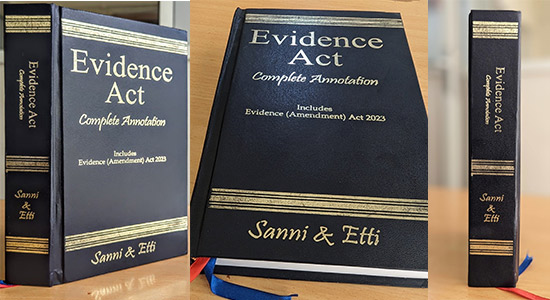
Available now for NGN 40,000 at ASC Publications, 10, Boyle Street, Onikan, Lagos. Beside High Court, TBS. Email publications@ayindesanni.com or WhatsApp +2347056667384. Purchase Link: https://paystack.com/buy/evidence-act-complete-annotation
______________________________________________________________________ “Enhance Legal Practice With Authoritative Reports” — Alexander Payne Offers Comprehensive Law Reports, Spanning Over A Century Of Nigerian Jurisprudence Interested buyers are encouraged to place their orders and enquiries via:
0704 444 4777, 0704 444 4999, 0818 199 9888
Website: www.alexandernigeria.com
“A Comprehensive Guide To Evidence Law” — Releases Second Edition In Three Volumes, Covering 4,051 Cases
For enquiries and orders, contact: 08035526491 Email: jerryamadisilk@gmail.com
 Prof. Jerry Amadi’s Evidence Law, Second Edition (2026), contains 3,314 pages in three volumes, covering the Evidence Act 2011, its 2023 amendment, and 4,051 Nigerian and English cases.