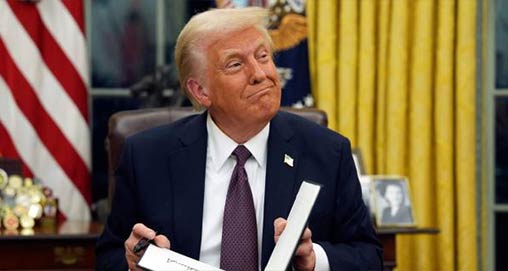
President Donald Trump on Saturday imposed tariffs on imports from Canada, Mexico and China, the nation’s three largest trading partners, in response to what he said was their role in permitting illegal immigration and drugs to enter the United States.

The president signed three executive orders establishing the measures, the first official actions of his second-term trade war, according to a White House official who briefed reporters.
American importers will pay a new 25-percent tax on goods from Canada and Mexico and a 10-percent levy on products from China, the president said. Most products from Canada and Mexico currently face no tariffs, under a trade deal Trump signed during his first term, while many Chinese goods incur taxes of up to 25 percent. The new tariffs are in addition to those fees.
Energy products, including crude oil from Canada, will suffer a 10 percent charge.
“We’ve suffered with millions of criminals coming into our country, criminals, people from jails, from all over the world. They come through Mexico and they come through Canada, too,” he said on Friday.
The president also has complained about Chinese fentanyl shipments making their way to the United States via Mexico and Canada and lashed out over the large U.S. trade deficits with each country. Steep U.S. tariffs are aimed at incentivizing manufacturers to make their products in the United States with American workers rather than ship them here from aboard.
Many economists are skeptical about prospects for success. In Trump’s first term, factory employment rose by 462,000 before flatlining in the year before the pandemic.
For the typical American household, the tariffs will mean a loss of about $1,200 in purchasing power, according to the Budget Lab at Yale University, a nonpartisan research center.
American companies and consumers purchased about $1.3 trillion worth of merchandise from those three countries, including food, electronics, cars and car parts, and clothing, according to the Census Bureau.
Trump’s abrupt imposition of steep tariffs on goods moving across U.S. borders threatens significant disruption for regional supply chains that have become deeply intertwined over the past three decades. The auto industry in particular could soon be plunged into enormous upheaval.

Get your copy today and take the first step toward financial growth:👉 https://selar.co/4f16676016
_______________________________________________________________________ The Law And Practice Of Redundancy In Nigeria: A Practitioner’s Guide, Authored By A Labour & Employment Law Expert Bimbo Atilola _______________________________________________________________________
[A MUST HAVE] Evidence Act Demystified With Recent And Contemporary Cases And Materials

Available now for NGN 40,000 at ASC Publications, 10, Boyle Street, Onikan, Lagos. Beside High Court, TBS. Email publications@ayindesanni.com or WhatsApp +2347056667384. Purchase Link: https://paystack.com/buy/evidence-act-complete-annotation
______________________________________________________________________ ARTIFICIAL INTELLIGENCE FOR LAWYERS: A COMPREHENSIVE GUIDE
Reimagine your practice with the power of AI “...this is the only Nigerian book I know of on the topic.” — Ohio Books Ltd
Authored by Ben Ijeoma Adigwe, Esq., ACIArb (UK), LL.M, Dip. in Artificial Intelligence, Director, Delta State Ministry of Justice, Asaba, Nigeria.
Bonus:
Get a FREE eBook titled “How to Use the AI in Legalpedia and Law Pavilion” with every purchase.
ARTIFICIAL INTELLIGENCE FOR LAWYERS: A COMPREHENSIVE GUIDE
Reimagine your practice with the power of AI “...this is the only Nigerian book I know of on the topic.” — Ohio Books Ltd
Authored by Ben Ijeoma Adigwe, Esq., ACIArb (UK), LL.M, Dip. in Artificial Intelligence, Director, Delta State Ministry of Justice, Asaba, Nigeria.
Bonus:
Get a FREE eBook titled “How to Use the AI in Legalpedia and Law Pavilion” with every purchase.
How to Order: 📞 Call, Text, or WhatsApp: 08034917063 | 07055285878 📧 Email: benadigwe1@gmail.com 🌐 Website: www.benadigwe.com
Ebook Version: Access directly online at: https://selar.com/prv626