*Reveals ADC Collapsed Because Atiku Stood Against Zoning, Says Centre Could Not Hold When Some Insisted There Was No Need For Rotation

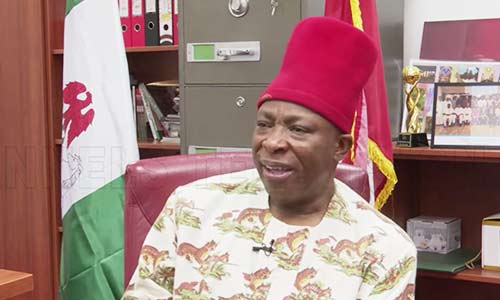
Senator Victor Umeh, representing Anambra Central Senatorial District and one of the lawmakers who followed Peter Obi from the ADC to the NDC, has fired back at those describing Obi as a “political nomad” for changing parties, revealing that President Tinubu himself moved through five political parties before arriving at the APC, disclosing that the ADC coalition collapsed because former Vice President Atiku Abubakar and his supporters stood against zoning the presidential ticket to the South, and questioning what Atiku would come to look for in the NDC given that the new party has already agreed its presidential candidate will come from the South.
Speaking on Channels Television’s Political Paradigm, Umeh provided the most detailed insider account yet of why the ADC coalition fractured, moving beyond the public narrative of government-sponsored litigation and court-ordered paralysis to reveal that a fundamental disagreement over the rotation of the presidential ticket between North and South was the fault line that made the coalition’s collapse inevitable.
Umeh responded directly to the Presidency’s characterisation of Obi as a “political nomad” and the APC’s criticism that he changes parties instead of building structures, by listing President Tinubu’s own political trajectory.
“There’s nobody in Nigerian polity that has consistently stayed in one political party. All of them saying these things, both those in the presidency — let one person, you give me a piece of paper, I write for you all the parties they’ve gone through,” Umeh stated.
He then listed Tinubu’s movements: “Even Mr. President was in SDP. From SDP he went to Alliance for Democracy. From Alliance for Democracy, he went to Action Congress. From Action Congress, he went to Action Congress of Nigeria. From Action Congress of Nigeria, he went to APC.”
“So if you take other people, they’ve all been moving in accordance with the dictates of the time. When dynamics of events change, people will find a place to settle to continue to pursue their interests politically,” Umeh stated.
The five-party trajectory — SDP to AD to AC to ACN to APC — demolishes the argument that party loyalty is a virtue in Nigerian politics or that Obi’s movement from APGA to PDP to Labour Party to ADC to NDC is exceptional. If the sitting President navigated five platforms before reaching his current party, the standard cannot be different for opposition politicians facing the additional challenge of government-sponsored destabilisation of their platforms.
“I can tell you that if APC implodes today, many of them will leave to another party. By the time they are done with nomination of their candidates through consensus, you will notice that many people would have gone. They will leave if there is space,” Umeh predicted.
He noted that the ruling party anticipated this and used the Electoral Act to create a tight timetable: “They anticipated that this will happen. So in the Electoral Act, they tried to pigeonhole everybody to a certain timetable where it will be very difficult for you to move to another political party in case you are disappointed by a party during nomination time.”
Umeh’s most consequential revelation concerned the internal dynamics that destroyed the ADC coalition from within, independent of the external pressures from government-sponsored litigation.
“For those of them who are wanting to be president from the other side, like Atiku — Atiku is somebody who stands against zoning,” Umeh stated.
“NDC has confirmed as a presidential candidate that will come from the South. So these are the things they didn’t give the ADC the opportunity to harness, to be able to be stable as a platform,” Umeh added.
He elaborated on how the zoning dispute played out within the ADC: “President stayed in ADC and pretended that it wasn’t an issue. Those who are supporting him are saying that there’s no need for zoning, that everybody should just go there. I don’t support that it should be like that.”
Umeh stated his own position clearly: “I believe in equity. Buhari having served 8 years from the North, the next 8 years should come from a southern Nigerian candidate.”
He drew a parallel with the APC’s own experience: “APC used this they fought for it in 2022/23 nomination in APC. There were elements who stood against zoning in the APC. There were elements that were wise enough, people who fought for APC to go South to get a candidate. And that’s how the current president got the ticket of the APC to be able to contest.”
Umeh then made the statement that explains, from the perspective of the Obi/Kwankwaso camp, why the ADC was always destined to fracture.
“Coming back to this year, a president from southern Nigeria is just about doing four years and the election is coming up again. He wants to come and contest to run for the remaining four years again,” Umeh stated, referring to Tinubu.
“That’s the reason why ADC could not hold. The centre could not hold there,” Umeh declared.
The statement reveals that the ADC’s collapse was not merely about government-sponsored litigation, INEC derecognition, or court-ordered paralysis. Those external pressures accelerated the breakdown, but the internal fault line was the irreconcilable disagreement over whether the opposition’s presidential ticket should be zoned to the South or left open for any aspirant from any region.
With Atiku wanting the ticket and opposing zoning, and Obi and his supporters insisting on Southern rotation after Buhari’s eight years from the North and Tinubu’s potential eight years also from the South-West, the coalition lacked the internal consensus needed to survive even without external pressure.
Umeh was blunt about the implications for Atiku and others who might consider following Obi and Kwankwaso to the NDC.
“So if he’s coming to NDC, is he coming to NDC to look for that presidential ticket again? In this case, what is he coming to? So I don’t understand,” Umeh stated.
He clarified that in the NDC, “from all the discussions had already, these issues have been agreed to,” meaning the zoning question has been settled in favour of a southern presidential candidate.
“If they want to come there and now become members of the party without wanting to become presidential candidate again, so be it. I don’t know. But the mission has to be defined,” Umeh stated.
The message to Atiku is unmistakable: the NDC’s presidential ticket is going South. If Atiku accepts that and wants to support a southern candidate, he is welcome. If he is coming to contest for the presidential ticket from the North, he will find the same resistance that he encountered in the ADC, only this time the zoning arrangement has already been agreed upon rather than being left ambiguous.
Umeh provided a vivid description of the pattern of government interference that has followed Obi from party to party.
“The people who are in government now believe that the only thing that can be done first of all will be to ensure that Peter Obi does not find peace in any political platform to prepare for the next election,” Umeh stated.
“So wherever they see him, they put fire there. He runs out, they follow him to wherever he goes, they put fire there,” Umeh stated.
He traced the pattern through each party: “He has made that move from Labour Party to the ADC. The ADC is now a place of confusion because the courts have also gone in. They have used somebody to take the party to court, and once that is achieved, they destabilise the place.”
The description of the government strategy as following Obi from platform to platform and setting each one on fire is the most graphic articulation yet of what the opposition alleges is a systematic campaign to deny Obi a viable political vehicle for 2027.
Umeh used an evocative metaphor to explain the opposition’s serial defections.
“It’s just like a rabbit. A rabbit lives in a hole, and when you go and put smoke inside the hole, the rabbit will look for somewhere to jump out of the hole and escape. So to avoid asphyxiation, that is exactly what’s happening in Nigerian political parties,” Umeh stated.
“Conscious efforts are being made to choke people in various parties, destabilise the platform, make it non-conducive for any reasonable activity to take place there. And naturally, people will want to escape and look for alternative places,” Umeh stated.
“When you leave party A because of this situation, you go to party B, they cause the same problem in party B, you move again to party C, all in the search to find a stable platform where you can at least pursue your political activities,” Umeh stated.
Umeh explained why the Supreme Court’s ruling, while celebrated publicly, was the final signal for those who understood its implications.
“The Supreme Court on the 30th of April delivered a judgment that gave reprieve partially to the leadership of the ADC, directing them back to the Federal High Court where they came from. And the primaries in the party will start this month, end on 30th of May,” Umeh stated.
“If you are involved in such a disputation and you are sent back to the Federal High Court, from where you start, you go for full trial, go to Court of Appeal, come back to the Supreme Court before a final verdict is given — it is as good as keeping you in a rainbow,” Umeh stated.
“So anybody who is serious about continuing with the election of 2027 should find his way out of ADC. And that is what we did,” Umeh concluded.
The “rainbow” metaphor captures the ADC’s predicament: an appealing vision that is always visible but never reachable, a legal process that could take months or years to complete while the electoral calendar runs out in weeks.
Umeh’s account, from an insider who participated in the ADC coalition from its inception and who moved with Obi to the NDC, reveals that the opposition’s fragmentation was caused by two simultaneous forces: external destabilisation through government-sponsored litigation and INEC actions, and internal disagreement over the fundamental question of which region produces the presidential candidate.
The external forces accelerated the timeline, but the internal disagreement over zoning would have fractured the coalition eventually. A coalition that includes Atiku who opposes zoning and Obi who insists on southern rotation cannot survive the moment when the presidential ticket must actually be allocated.
As Umeh stated: “The centre could not hold.”
The question now is whether the NDC, where the zoning question has reportedly been settled in favour of a southern candidate, can hold its own centre, or whether the forces that destroyed the Labour Party and the ADC will follow Obi to his third political home and set fire to it too.
As Umeh described: “Wherever they see him, they put fire there.”
Whether the NDC proves fireproof remains to be seen.
[A MUST HAVE] Evidence Act Demystified With Recent And Contemporary Cases And Materials

Available now for NGN 40,000 at ASC Publications, 10, Boyle Street, Onikan, Lagos. Beside High Court, TBS. Email publications@ayindesanni.com or WhatsApp +2347056667384. Purchase Link: https://paystack.com/buy/evidence-act-complete-annotation
______________________________________________________________________ “Enhance Legal Practice With Authoritative Reports” — Alexander Payne Offers Comprehensive Law Reports, Spanning Over A Century Of Nigerian Jurisprudence Interested buyers are encouraged to place their orders and enquiries via:
0704 444 4777, 0704 444 4999, 0818 199 9888
Website: www.alexandernigeria.com
Interested buyers are encouraged to place their orders and enquiries via:
0704 444 4777, 0704 444 4999, 0818 199 9888
Website: www.alexandernigeria.com