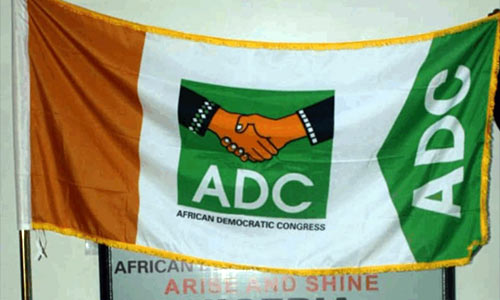
The leadership crisis rocking the African Democratic Congress has escalated into the most complex political party dispute in Nigeria’s democratic history with three rival factions advancing competing constitutional claims, the Independent National Electoral Commission refusing to recognise any of them, multiple courts handling interrelated cases at every level of the judiciary, and the party’s capacity to function as a viable opposition platform ahead of the 2027 general elections now in serious doubt.

The dispute, which began as an internal transition disagreement in mid-2025, has now evolved into a multi-dimensional legal, political, and institutional standoff that has drawn in the Supreme Court, the Court of Appeal, multiple Federal High Court judges, state high courts, INEC, international diplomats, and every major opposition political figure in Nigeria — while raising fundamental questions about the independence of the electoral commission, the integrity of the judiciary, and whether Nigeria’s democratic space is being deliberately contracted by the ruling party.
What distinguishes the ADC crisis from other party disputes is the emergence of not two but three distinct factions, each claiming constitutional legitimacy and each dismissing the others as usurpers.
The Mark-led faction the most prominent of the three insists it emerged through due process, citing a series of National Executive Committee decisions in 2025 including the July 29 ratification of a caretaker leadership. Relying on Article 13 of the ADC Constitution, the group argues that the NEC is empowered to administer the party, implement convention decisions, and establish interim structures where necessary. It contends that the two-year membership requirement under Article 9(4) was lawfully waived through NEC resolutions to accommodate coalition-building efforts, and that INEC’s initial recognition of its leadership in September 2025 affirms its legitimacy.
The Mark faction held a national convention on April 14, 2026, at the Rainbow Event Centre in Abuja without INEC monitoring ratified its National Working Committee, expelled Gombe and lawmaker Leke Abejide, and declared itself an unstoppable political force.
The Gombe faction maintains that the entire process that produced the Mark leadership is unconstitutional. It argues that the appointments violated Article 9(4) on eligibility and Article 8(2) on proper ward-level membership registration, insisting that key figures in the Mark camp did not meet basic requirements for holding national office. Gombe contends that as Deputy National Chairman, he automatically assumed the position of Acting National Chairman following the leadership vacuum created by Ralph Nwosu’s departure. He has anchored his claim on the Court of Appeal’s March 12 order directing parties to maintain the “status quo ante bellum.”
The Kachikwu faction a “third force” backed by approximately 25 state chairmen has rejected both the Mark and Gombe claims as legally defective and procedurally flawed. This group argues that neither faction complied with constitutional requirements, particularly on eligibility and membership. It contends that key decisions, including the formation of caretaker structures, were not ratified by a properly constituted NEC as defined under Article 12, which includes state chairmen as critical members. The Kachikwu bloc has constituted its own interim leadership, endorsed INEC’s derecognition of the rival factions, and warned that the April 14 convention is null and void.
INEC’s April 1 decision to withdraw recognition from both the Mark and Gombe factions citing the Court of Appeal’s status quo order has effectively frozen the party’s operations.
The commission removed Mark and Aregbesola’s names from its portal, announced it would not engage with any faction pending a final judicial determination, and refused to monitor the April 14 convention.
INEC Chairman Professor Joash Amupitan warned that holding the convention could attract “grave legal consequences” and insisted the commission’s decision was anchored on a subsisting court order, not arbitrary discretion.
“If they are going ahead with their convention, it’s left for them to look at whether it is in contravention of the court. INEC didn’t just take a decision. We didn’t just wake up one day and took this decision. There was something that led to it. There was an order of court,” Amupitan stated.
However, the ADC and opposition analysts have accused INEC of partisanship, arguing the commission is “allowing itself to be used by the ruling APC to destabilise opposition parties ahead of 2027.”
The ADC’s national secretary, Aregbesola, presented a detailed legal argument at the convention that INEC had no lawful basis to boycott the event, citing Section 82 of the Electoral Act which provides that the only condition that invalidates a convention is failure to notify INEC a requirement the party says it fulfilled on March 17 with acknowledged receipt.
The ADC’s decision to hold its convention without INEC has drawn immediate comparisons to the PDP’s Ibadan convention of November 15-16, 2025, which was subsequently nullified by the Court of Appeal a parallel that raises the question of whether the ADC convention faces the same fate.
However, there is a critical distinction that ADC defenders emphasise.
In the PDP’s case, two Federal High Court judges Justice James Omotosho and Justice Peter Lifu handed down express orders stopping the Ibadan convention before it took place. The PDP proceeded despite these specific restraining orders, and the Court of Appeal subsequently nullified the convention on that basis.
In the ADC’s case, no court gave an express order stopping the April 14 convention. The only relevant judicial directive was the Court of Appeal’s general order for parties to “maintain the status quo ante bellum” an order whose meaning and scope has been disputed by all parties.
A court order reportedly seeking to stop the ADC convention was reported by media only after the convention had already taken place meaning the ADC leadership could argue it had no knowledge of the order before proceeding.
This distinction may prove decisive when the convention’s validity is inevitably challenged in court. Legal analysts note that disobedience of a specific court order restraining a convention is a clearer ground for nullification than proceeding under a general status quo order whose interpretation is itself in dispute.
The ADC crisis has become a focal point for broader concerns about the independence of Nigeria’s electoral and judicial institutions.
Opposition figures and civil society organisations have accused INEC of being “increasingly populated by former political office holders and allies of prominent politicians” who exhibit biases against opposition parties rather than acting as neutral arbiters.
The judiciary has fared no better in public perception. Analysts quoted in the report allege that “some agents of the ruling party can never lose political cases in courts because of the huge patronage they dole out to judges and judicial officers.”
These perceptions whether accurate or not have created a crisis of confidence that extends beyond the ADC. Multiple opposition parties and civic organisations now openly question whether free and fair elections are possible under the current institutional framework a sentiment that has been reinforced by the INEC chairman’s resurfaced partisan social media posts, Senate President Akpabio’s public defence of the chairman, and President Tinubu’s joke about “sending Akpabio to scatter” the opposition.
The ADC crisis is currently before multiple courts simultaneously.
At the Supreme Court, the five-member panel led by Justice Mohammed Garba has fixed April 22 for hearing of Mark’s appeal (SC/CV/180/2026), with an accelerated timeline requiring all briefs to be completed by April 20.
At the Federal High Court, Justice Nwite has adjourned Gombe’s suit indefinitely, declaring it would be “judicial rascality” to proceed while the Supreme Court is seized of the matter.
Justice Joyce Abdulmalik has issued a separate status quo order in the state chairmen’s suit, with hearing fixed for April 23.
Justice Musa Liman’s judgment in the Abejide suit remains pending.
The Katsina State High Court has struck out the Wamba suit, applying Section 83 of the Electoral Act the first court to decline jurisdiction on that basis.
The Adamawa State High Court had earlier restrained ADC congresses in that state.
The Supreme Court hearing on April 22 one day before the party primaries window opens on April 23 now carries the entire weight of the ADC’s future.
The apex court’s ruling will determine whether the Court of Appeal’s March 12 decision stands, whether the trial court has jurisdiction, and by extension whether the Mark leadership is legitimate, the April 14 convention is valid, and the party can proceed with primaries.
Legal observers note that the Supreme Court faces a delicate balancing act — ensuring justice while avoiding a situation where its decision inadvertently sidelines a political party due to timing constraints. The accelerated hearing timeline suggests the court is cognisant of this pressure.
With INEC’s timetable requiring parties to conclude primaries between April 23 and May 30, submit candidate lists between June 27 and July 11, and begin presidential campaigns on August 19, the ADC’s window for compliance is narrowing by the day.
Without resolved leadership, without INEC recognition, and with three factions each claiming legitimacy, the party cannot validly conduct primaries, submit candidates, or meet electoral timelines.
A governorship aspirant in Imo State, David Mbamara, expressed what many in the opposition feel: “No serious coalition would anchor itself on a party facing existential legal uncertainty so close to a major electoral deadline.”
Some aspirants are already quietly exploring fallback options with larger parties. The ADC’s senior figures have held contingency discussions with the PRP and NDC though both parties have their own internal challenges.
The ADC attracted former Vice President Atiku Abubakar, former Labour Party presidential candidate Peter Obi, former Kano Governor Rabiu Kwankwaso, former Transport Minister Rotimi Amaechi, and nine sitting senators as the primary vehicle for opposition realignment in 2027.
Its crisis therefore affects not just one party but the entire architecture of opposition politics in Nigeria. If the ADC fragments beyond repair, the opposition’s capacity to mount a credible challenge to the APC in 2027 would be severely diminished potentially handing the ruling party a walkover in what many Nigerians hoped would be the most competitive election in the country’s history.
As one analyst noted: “The ADC remains divided among three power centres, each asserting legitimacy but none formally recognised its immediate future tied to the outcome of a legal battle that could ultimately determine whether it emerges as a unified political force or fragments beyond repair.”
The answer begins on April 22, at the Supreme Court.
[A MUST HAVE] Evidence Act Demystified With Recent And Contemporary Cases And Materials

Available now for NGN 40,000 at ASC Publications, 10, Boyle Street, Onikan, Lagos. Beside High Court, TBS. Email publications@ayindesanni.com or WhatsApp +2347056667384. Purchase Link: https://paystack.com/buy/evidence-act-complete-annotation
______________________________________________________________________ “Enhance Legal Practice With Authoritative Reports” — Alexander Payne Offers Comprehensive Law Reports, Spanning Over A Century Of Nigerian Jurisprudence Interested buyers are encouraged to place their orders and enquiries via:
0704 444 4777, 0704 444 4999, 0818 199 9888
Website: www.alexandernigeria.com
Interested buyers are encouraged to place their orders and enquiries via:
0704 444 4777, 0704 444 4999, 0818 199 9888
Website: www.alexandernigeria.com