Introduction

Citizens are the legal members of a country. They have many rights and these rights may be differently gifted to them by the constitution of their country. The aliens may not enjoy such rights, we mean.
A country is usually blessed with her citizens and persons who are not her citizens, aliens. This is internationally evident though we take Nigeria for an instance. Legally speaking, a citizen of Nigeria together with his properties is protected inside and outside Nigeria. A citizen of South Africa together with his property is also protected only when he’s in Nigeria; the protection ceases as soon as his legs are out of Nigeria.
Pursuant to The Declaration on the Human Rights of Individuals who are not nationals of the country in which they live, adopted by General Assembly resolution 40/144 of 13 December 1985, the United Nations’ Declarations are aimed at respecting the observance of the human rights and fundamental freedoms of all human beings, without distinction as to race, sex, language or religion, Considering that the Universal Declaration of Human Rights proclaims that all human beings are born free and equal in dignity and rights and that everyone is entitled to all the rights and freedoms set forth in that Declaration, without distinction of any kind, such as race, colour, sex, language, religion, political or other opinion, national or social origin, property, birth or other status.
Considering that the Universal Declaration of Human Rights proclaims further that everyone has the right to recognition everywhere as a person before the law, that all are equal before the law and entitled without any discrimination to equal protection of the law, and that all are entitled to equal protection against any discrimination in violation of that Declaration and against any incitement to such discrimination, Being aware that the States Parties to the International Covenants on Human Rights undertake to guarantee that the rights enunciated in these Covenants will be exercised without discrimination of any kind as to race, colour, sex, language, religion, political or other opinion, national or social origin, property, birth or other status, Conscious that, with improving communications and the development of peaceful and friendly relations among countries, individuals increasingly live in countries of which they are not nationals.
Reaffirming the purposes and principles of the Charter of the United Nations, Recognizing that the protection of human rights and fundamental freedoms provided for in international instruments should also be ensured for individuals who are not nationals of the country in which they live.
Article 2 provides that the Declaration shall not prejudice the enjoyment of the rights accorded by domestic law and of the rights which under international law a State is obliged to accord to aliens, even where this Declaration does not recognize such rights or recognizes them to a lesser extent.
So, article 3 provides that every State shall make public its national legislation or regulations affecting aliens.
Most importantly, Article 6 provides that no alien shall be subjected to torture or to cruel, inhuman or degrading treatment or punishment and, in particular, no alien shall be subjected without his or her free consent to medical or scientific experimentation.
Article 7 also provides that an alien lawfully in the territory of a State may be expelled therefrom only in pursuance of a decision reached in accordance with law and shall, except where compelling reasons of national security otherwise require, be allowed to submit the reasons why he or she should not be expelled and to have the case reviewed by, and be represented for the purpose before, the competent authority or a person or persons specially designated by the competent authority. Individual or collective expulsion of such aliens on grounds of race, colour, religion, culture, descent or national or ethnic origin is prohibited.
The aliens in a country enjoy, pursuant to Article 5 subarticle 1 paragraph a to g, in accordance with domestic law and subject to the relevant international obligations of the State in which they are present, in particular the right to life and security of person; no alien shall be subjected to arbitrary arrest or detention; no alien shall be deprived of his or her liberty except on such grounds and in accordance with such procedures as are established by law; The right to protection against arbitrary or unlawful interference with privacy, family, or correspondence; The right to be equal before the courts, tribunals and all other organs and authorities administering justice and, when necessary, to free assistance of an interpreter in criminal proceedings and, when prescribed by law, other proceedings; The right to choose a spouse, to marry, to found a family; The right to freedom of thought, opinion, conscience and religion; the right to manifest their religion or beliefs, subject only to such limitations as are prescribed by law and are necessary to protect public safety, order, health or morals or the fundamental rights and freedoms of others; The right to retain their own language, culture and tradition; The right to transfer abroad earnings, savings or other personal monetary assets, subject to domestic currency regulations.
In this view, no alien can be treated unlawfully in Nigeria. This is so, because as ill-mannered as the Nigerian government is suspected to be, it cannot allow such. Two souls were recently interred on the day a property belonging to South Africa was aimed at to be unlawfully destroyed. Also, 83 Nigerians(her own citizens) would be arraigned for allegedly looting a property belonging to South Africa. This is insinuating that Nigeria is following the due process of law.
The government of South Africa has failed to protect the aliens in her country. The country failed to learn that those aliens have the country to which they belong and so they are protected by their country. The country failed to avert the danger of the actual violence sponsored by her citizens.
The community reading of S. 5 (4) and (5) CFRN, reveals that the president of the federation cannot deploy no member of the Armed Forces of the Federation of combat duty outside Nigeria. However, the President can, in consultation with the National Defence Council, deploy members of the Armed Forces of the Federation of a limited combat duty outside Nigeria, if he’s satisfied that the national security is under imminent threat or danger. This is, however, Subject to a condition subsequent; the requirement of the consent of the Senate within seven days of the actual combat which shall be given or refused within fourteen days, thereafter.
The victims witnessed the bitterness of double jeopardy. South Africa denied them their rights and the Government of Nigeria did same. The President of the government of the Federation of Nigeria should’ve deployed the members of Armed Forces of Nigeria a little more pronto on a limited combat duty. It would mean a reasonable measure has been taken to protect her citizens that are out of the country.
In conclusion,there is no excuse for the attacks on the homes and businesses of foreign nationals,just as there can be no excuse for xenophobia or any form of intolerance. The Nigerian government as a matter of urgency should do whatever it takes to protect the lives and property of her citizens. Tangible measures should be demanded from south Africa to deter its citizens from attacking Nigerians at will. The South African government should ensure that those responsible for such acts of violence and violations of human rights are brought to account.If unchecked, such xenophobic attacks could lead to further damage and destruction. All possible efforts should be made to avert future attacks including incitements or attempt to block peaceful solutions.
Issa Abdulazeez Atere, FACULTY OF LAW, UNIVERSITY OF ILORIN.

Get your copy today and take the first step toward financial growth:👉 https://selar.co/4f16676016
_______________________________________________________________________ ARTIFICIAL INTELLIGENCE FOR LAWYERS: A COMPREHENSIVE GUIDE
Reimagine your practice with the power of AI “...this is the only Nigerian book I know of on the topic.” — Ohio Books Ltd
Authored by Ben Ijeoma Adigwe, Esq., ACIArb (UK), LL.M, Dip. in Artificial Intelligence, Director, Delta State Ministry of Justice, Asaba, Nigeria.
Bonus:
Get a FREE eBook titled “How to Use the AI in Legalpedia and Law Pavilion” with every purchase.
ARTIFICIAL INTELLIGENCE FOR LAWYERS: A COMPREHENSIVE GUIDE
Reimagine your practice with the power of AI “...this is the only Nigerian book I know of on the topic.” — Ohio Books Ltd
Authored by Ben Ijeoma Adigwe, Esq., ACIArb (UK), LL.M, Dip. in Artificial Intelligence, Director, Delta State Ministry of Justice, Asaba, Nigeria.
Bonus:
Get a FREE eBook titled “How to Use the AI in Legalpedia and Law Pavilion” with every purchase.
How to Order: 📞 Call, Text, or WhatsApp: 08034917063 | 07055285878 📧 Email: benadigwe1@gmail.com 🌐 Website: www.benadigwe.com
Ebook Version: Access directly online at: https://selar.com/prv626
________________________________________________________________________ The Law And Practice Of Redundancy In Nigeria: A Practitioner’s Guide, Authored By A Labour & Employment Law Expert Bimbo Atilola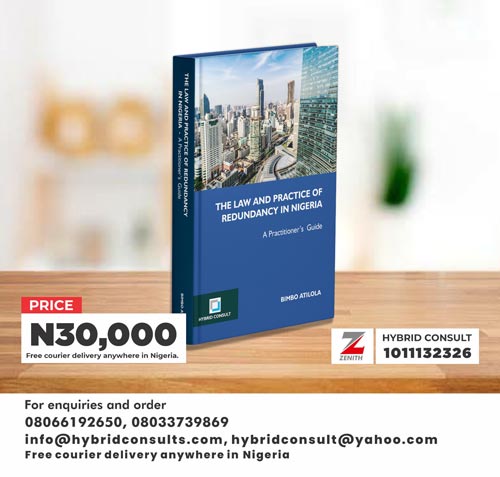 _______________________________________________________________________
[A MUST HAVE] Evidence Act Demystified With Recent And Contemporary Cases And Materials
_______________________________________________________________________
[A MUST HAVE] Evidence Act Demystified With Recent And Contemporary Cases And Materials